Choosing the right brochure size is one of the most important decisions you’ll make before designing your marketing material, and it’s a decision that needs to happen before you pick fonts, colors, or layouts. Get it wrong, and your beautifully crafted content ends up cramped, awkward to hand out, or expensive to print in bulk.
Whether you’re a designer preparing files for a commercial printer, a small business owner creating your first company brochure, or a marketer planning a direct mail campaign, this 2026 brochure size guide covers everything you need to know. From standard dimensions in inches, cm, mm, and pixels, to bi-fold, tri-fold, and z-fold brochure sizes – we’ve laid it all out in one place.
Standard Brochure Sizes
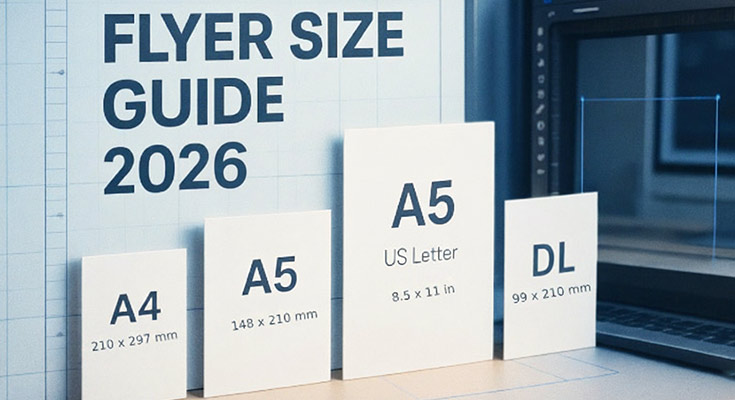
Internationally, the ISO 216 paper system is the standard, which is deeply embedded in the region’s business and printing culture, while the rest of the world follows A-series sizes like A4 (210mm × 297mm).
Letter size
Most popular×
11″
Bi-fold or tri-fold. The most versatile size for any purpose in North America.
Legal size
×
14″
More space for two or three panels. Best when letter size feels too crowded.
Half letter / memo
×
8.5″
Smallest standard size. Budget-friendly with a focused, compact message.
Tabloid size
Four-panel folds. Ideal for image-heavy layouts, travel, and product catalogs.
Largest standard
×
25.5″
Biggest size for wide product ranges or step-by-step brochure sequences.
A4 — Global standard
Global standard×
297mm
A touch taller and narrower than US Letter. Professional look for global marketing materials.
A5
×
210mm
Half of A4. Use as-is or fold in half to create a compact bi-fold brochure.
DL — Dimension Lengthwise
×
210mm
A4 folded lengthwise twice into three panels — the classic trifold brochure size.
Brochure Sizes in Inches, CM, MM, and Pixels
One of the most common sources of confusion for designers and marketers is unit conversion, particularly when setting up files for print vs. digital use. Here is a complete reference table covering the most common brochure sizes across all four unit systems.
Standard Brochure Size Comparison Table
| Size Name | Inches | CM | MM | Pixels (at 72 PPI) |
|---|---|---|---|---|
| Letter | 8.5 × 11 | 21.59 × 27.94 | 215.9 × 279.4 | 612 × 792 |
| Legal | 8.5 × 14 | 21.59 × 35.56 | 215.9 × 355.6 | 612 × 1008 |
| Half Letter | 5.5 × 8.5 | 13.97 × 21.59 | 139.7 × 215.9 | 396 × 612 |
| Tabloid | 11 × 17 | 27.94 × 43.18 | 279.4 × 431.8 | 792 × 1224 |
| Large Tabloid | 11 × 25.5 | 27.94 × 64.77 | 279.4 × 647.7 | 792 × 1836 |
| A3 | 11.69 × 16.54 | 29.7 × 42.0 | 297 × 420 | 842 × 1191 |
| A4 | 8.27 × 11.69 | 21.0 × 29.7 | 210 × 297 | 595 × 842 |
| A5 | 5.83 × 8.27 | 14.8 × 21.0 | 148 × 210 | 420 × 595 |
| DL | 3.90 × 8.27 | 9.9 × 21.0 | 99 × 210 | 283 × 595 |
For print, always design at 300 DPI (dots per inch) to ensure crisp, high-resolution output. For high-quality printing, design your brochure at 300 DPI and export it as a PDF, JPG, or PNG, making sure the canvas size matches the brochure size you plan to print and includes bleed if required. For digital brochures (web, email, presentations), 72–96 PPI is standard, which is what the pixel values in the table above reflect.
Learn more: Explore different types of brochures and formats for better design decisions
Common Brochure Sizes: Bi-Fold, Tri-Fold, and Z-Fold
The flat paper size is only half of the story. How a brochure is folded dramatically changes its final dimensions, how readers interact with it, and how much content you can fit. Below are the three most popular fold types with their specific dimensions.
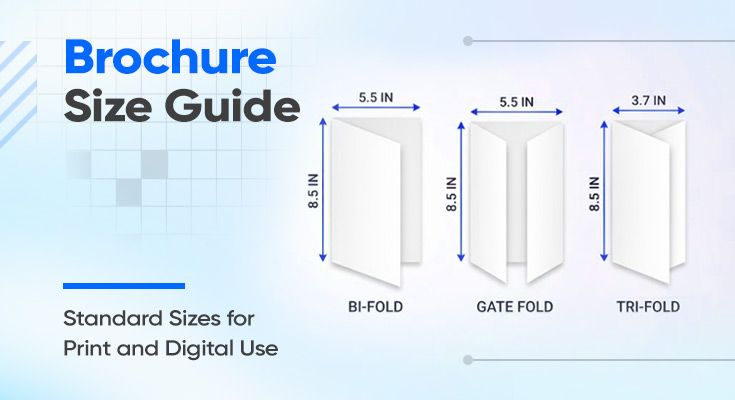
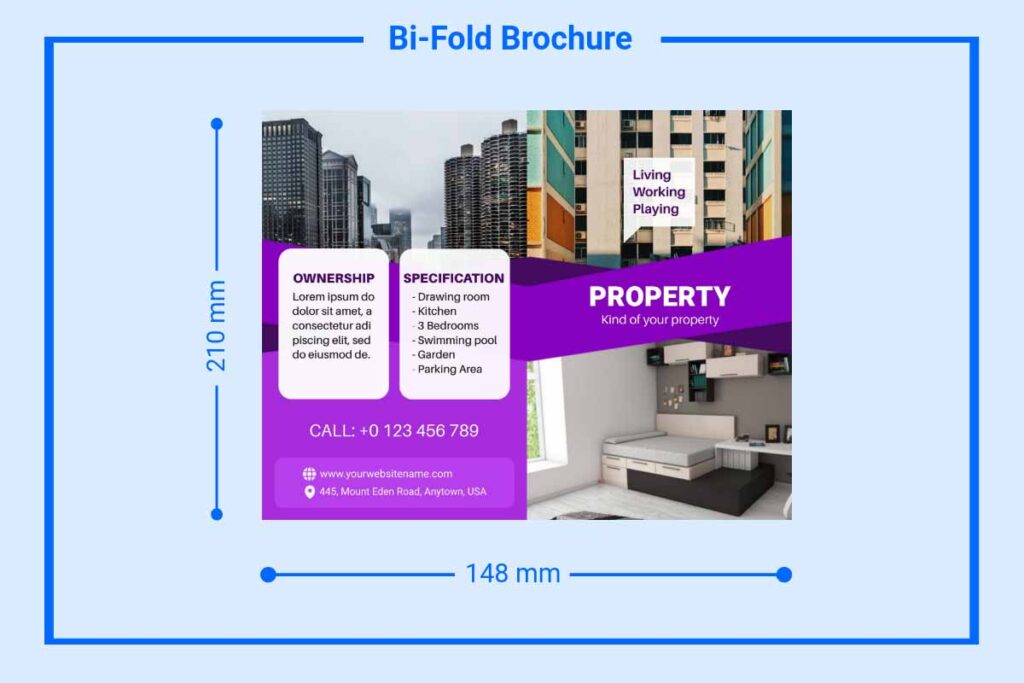
Bi-Fold (Half-Fold) Brochure Size
A bi-fold brochure is created by folding a sheet once down the middle, resulting in four panels, two on the front and two on the back.
If you print a half-fold brochure on standard letter-size 8.5″ × 11″ paper, each side will measure 8.5″ × 5.5″ after folding.
| Flat Paper Size | Folded Panel Size | Best Use |
|---|---|---|
| 8.5″ × 11″ | 5.5″ × 8.5″ | Company profiles, product catalogs |
| 8.5″ × 14″ | 7″ × 8.5″ | Service menus, real estate flyers |
| 11″ × 17″ | 8.5″ × 11″ | Magazines, event programs |
| A4 | A5 (148 × 210mm) | International marketing, presentations |
The bi-fold is clean and simple, making it the preferred format for corporate brochures, product lookbooks, and restaurant menus. Its wider panels also give you more room to let images breathe.
Tri-Fold Brochure Size
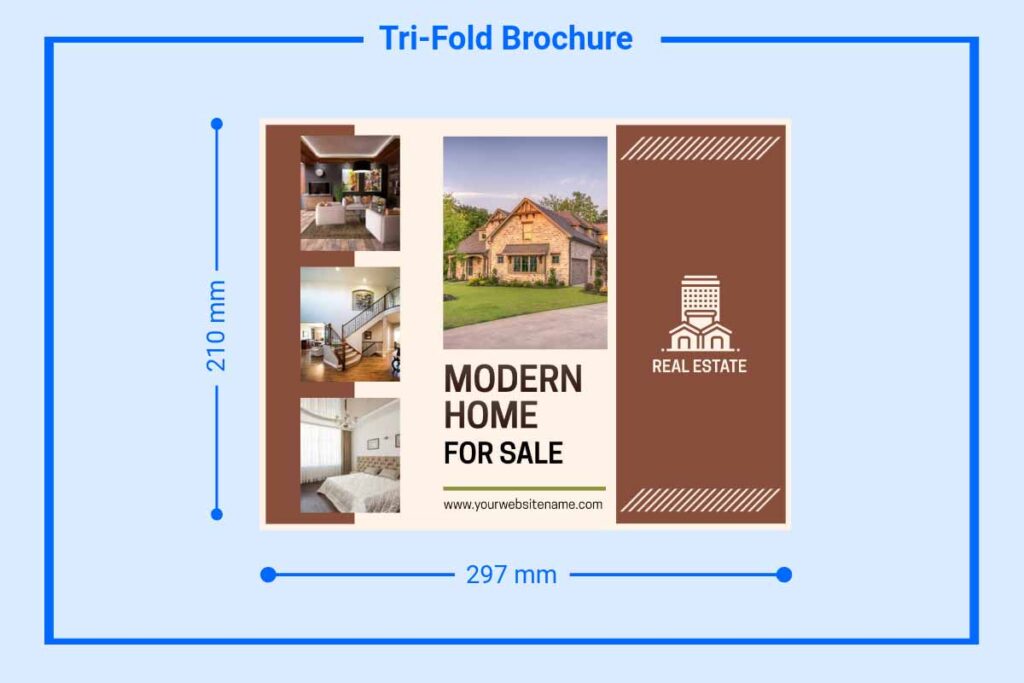
The tri-fold is the most recognizable brochure format. Each side of a tri-fold brochure is printed on standard letter-size 8.5″ × 11″ paper, and after folding the paper three times, the brochure measures 8.5″ × 3.69″. In Europe and most other regions, the standard equivalent is A4 paper at 210 × 297 mm, which folds down to approximately 99 × 210 mm per panel.
Novice designers often assume that a tri-fold brochure folds into three equal parts, but this is not the case. For the standard 8.5″ × 11″ tri-fold, panels 1/2 and 3/6 would both be 3.688″ wide, and panel 4/5 would be 3.624″ wide – one panel must be slightly narrower to allow the other two to fold inside neatly.
| Flat Paper Size | Folded Panel Size | Panels |
|---|---|---|
| 8.5″ × 11″ | ~3.69″ × 8.5″ | 6 panels (3 front, 3 back) |
| 8.5″ × 14″ | ~4.67″ × 8.5″ | 6 panels |
| 11″ × 25.5″ | ~8.5″ × 11″ per panel | 6 large panels |
| A4 (DL fold) | 99mm × 210mm | 6 panels |
Tri-folds are the gold standard for travel brochures, healthcare information guides, product overviews, and direct mail campaigns. The multiple panels help to fit and categorize a lot of information, making them commonly used for direct mail campaigns and other marketing collateral.
Z-Fold Brochure Size
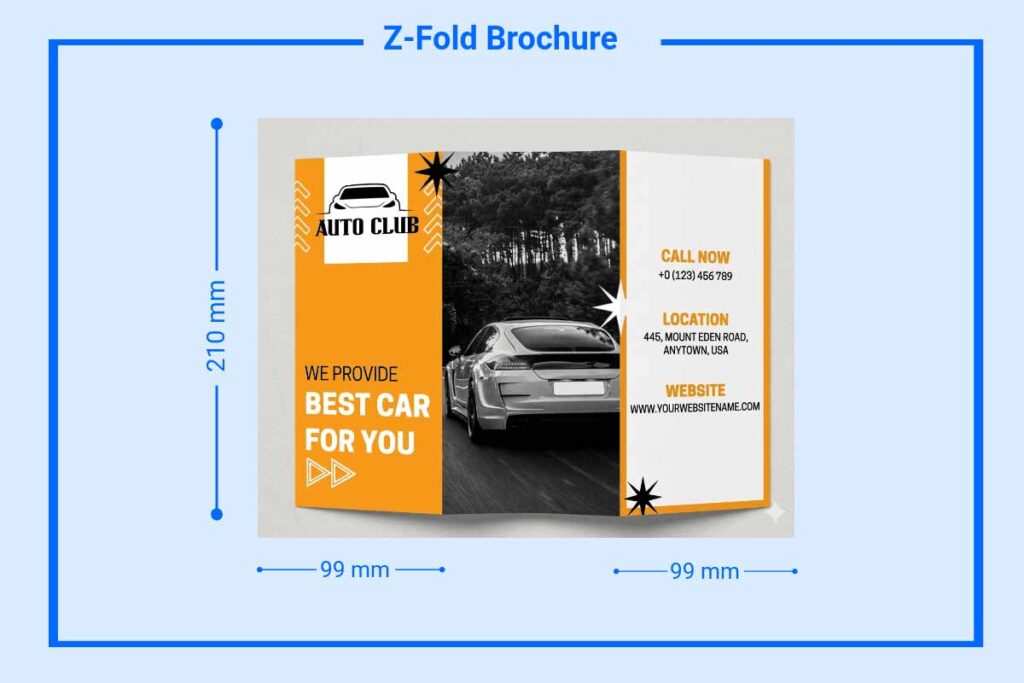
Z-fold brochures are constructed by folding three equal panels in a way that allows them to open like an accordion, forming a distinct zigzag “Z” shape. They are commonly used in image-heavy applications and allow images to spill over from one panel onto the next.
The z-fold uses the same flat paper sizes as a tri-fold, but the folding direction alternates, so rather than panels tucking inside each other, they fan outward in a Z pattern.
| Flat Paper Size | Folded Panel Size | Best Use |
|---|---|---|
| 8.5″ × 11″ | ~3.69″ × 8.5″ | Step-by-step guides, timelines |
| 8.5″ × 14″ | ~4.67″ × 8.5″ | Event schedules, maps |
| A4 | 99mm × 210mm | Menus, informational handouts |
The key difference between a tri-fold and a z-fold isn’t the size — it’s the reading experience. Z-folds are commonly used when the design spreads across all three panels on one side, since the format reveals content in a way that feels natural and dramatic when unfolded.
Other Popular Fold Types
Gate Fold — Two outer panels fold inward to meet in the center, creating a “reveal” effect. Works best on tabloid (11″ × 17″) or A3 paper. Popular for high-end product launches and event invitations.
Accordion Fold — The accordion fold has four panels that are each folded in alternating directions to the previous, creating a zigzag-like fold shape. It is commonly used for travel brochures, instructional booklets, and event schedules, and lends itself well to a timeline or chronological reading experience.
French Fold — The French fold involves one vertical fold followed by a horizontal fold, yielding four equal panels. Its unique layout is ideal for spotlighting specific products and showcasing larger graphics, especially for promotional purposes.
How to Choose the Right Brochure Size
With so many options available, the right brochure size comes down to four key factors:
1. Volume of Content
The amount of information you need to include is the single biggest determining factor. If your brochure features extensive product listings, multiple service categories, or detailed technical specs, a larger size such as legal (8.5″ × 14″), tabloid (11″ × 17″), or A3, gives you the real estate you need. If your goal is to deliver a punchy, focused message, a half-letter (5.5″ × 8.5″) or A5 keeps things tight and digestible.
2. Type of Fold
Your fold choice should match your content structure. Bi-folds work well for brochures with two clear sections, an introduction and a call-to-action, for example. Tri-folds are best when you have three to six distinct categories of information. Z-folds shine when you design your imagery or messaging to span the full width of the sheet.
3. Distribution Method
How you distribute your brochure plays a significant role in size selection. Brochures that will sit in display racks should be tri-fold letter size or DL format. Brochures going out in direct mail campaigns need to comply with postal dimension requirements. Sizes like 8.5″ × 11″ tri-fold brochures meet USPS letter-mail requirements, which can help you save on postage costs, while oversized formats may require flat-rate or large-envelope pricing. Brochures distributed at trade shows or handed out at events can afford to be larger and more visually striking.
4. Budget and Printing Costs
Standard sizes are always more affordable to print than custom sizes. Sticking to common sizes can cut your printing costs by 15–25% compared to a custom job, since print shops already have their machines configured for standard dimensions. If budget is a concern, the letter size (8.5″ × 11″) and A4 are your safest and most cost-effective bets.
Quick Decision Guide
| Situation | Recommended Size & Fold |
|---|---|
| Product overview, limited content | 5.5″ × 8.5″ bi-fold or A5 |
| General company/service brochure | 8.5″ × 11″ tri-fold |
| Detailed catalog or real estate listing | 8.5″ × 14″ or 9″ × 12″ |
| Large-format event or trade show | 11″ × 17″ bi-fold or gate fold |
| International audience | A4 tri-fold or DL |
| Email or digital distribution | 600 × 650px or A4 at 72 PPI |
Learn more: Avoid common brochure design mistakes when setting up dimensions and layouts
Frequently Asked Questions
The standard Letter size (8.5 × 11) is the most common brochure size in North America, while A4 (210mm × 297mm) is the global standard used across Europe, Asia, and most of the rest of the world.
A tri-fold brochure printed on standard 8.5 × 11 letter paper measures approximately 8.5 × 3.69 when folded.
For digital use, a standard letter-size brochure (8.5 × 11) at 72 PPI converts to approximately 612 × 792 pixels. At 96 PPI (screen resolution), it is approximately 816 × 1056 pixels. For email brochures, the recommended size is 600px × 650px.
The industry standard bleed is 0.125 inches (about 3mm) on all four sides of your document, meaning your final design file should be 0.25 inches wider and 0.25 inches taller than the finished brochure size. For a standard 8.5 × 11 brochure, set up your document at 8.75 × 11.25.
The 5.5 × 8.5 half-letter size, also called memo size, is the smallest standard brochure size. It is budget-friendly and effective for focusing on a single product or key selling point.
Final Thoughts
Choosing the right brochure size isn’t just a logistical decision; it’s a design decision, a budget decision, and a communication decision all rolled into one. The size you choose shapes how your audience perceives your brand.
For most businesses, the 8.5″ × 11″ letter size tri-fold or the A4 tri-fold covers virtually every scenario. When you need more space, step up to legal or tabloid. When you want something compact and cost-effective, go with half-letter or A5. And when designing for digital use, always confirm your pixel dimensions against the platform you’re designing for.