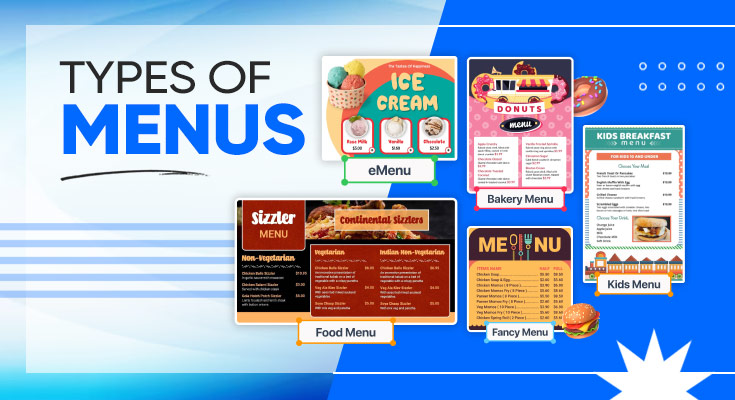
If you’ve ever walked into a restaurant and found yourself overwhelmed, or underwhelmed, by how the menu was presented, you already understand why menu types matter. The format of a menu isn’t just a formality. It shapes how customers make decisions, how they feel about your brand, and ultimately, how much they spend.
Whether you’re a restaurant owner figuring out your first menu, a café manager looking to refresh your format, or someone curious about how menus work, this guide is for you.
From traditional paper menus to modern digital formats and specialized types used in fine dining, this article breaks down major types of menus, explains how each one works, and helps you pick the right one for your business.
Before choosing a menu format, it’s worth understanding how a professionally structured menu is actually created. If you’re starting from scratch, our step-by-step guide on how to make a restaurant menu walks you through planning, organizing, and designing your menu from start to finish.
Main Types of Menus
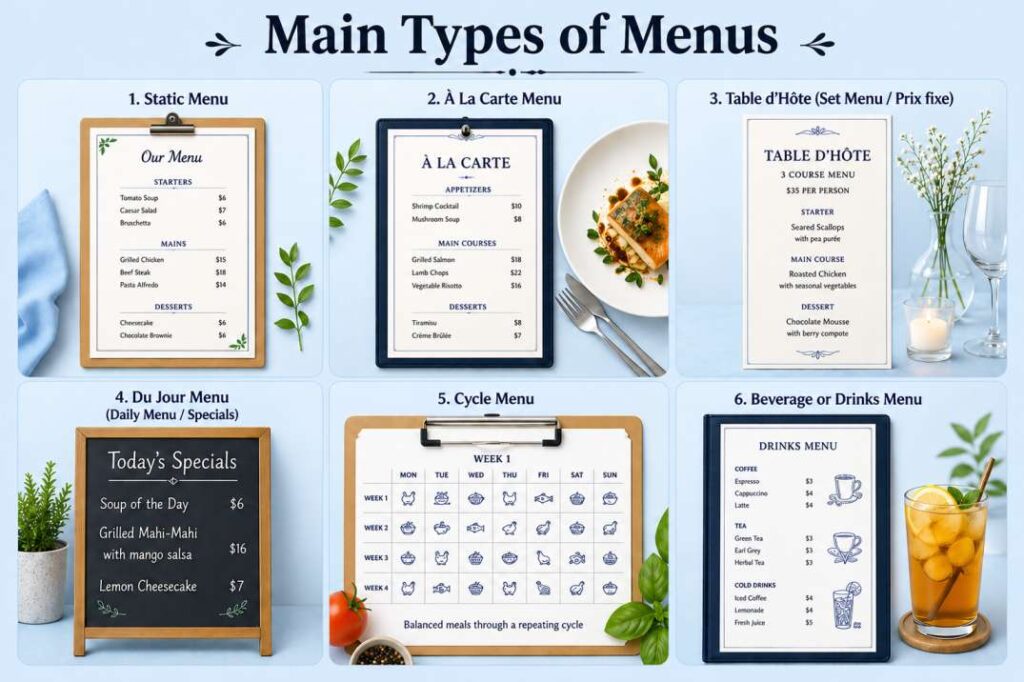
Before diving into digital menu format ideas and niche menu categories, let’s cover the foundational types of menus that have shaped the food service industry for decades. These core menu examples are the building blocks that almost every restaurant, café, or food business will encounter.
Static Menu
A static menu is the most common type used in restaurants worldwide. It features a fixed list of dishes that remains consistent across service periods, meaning customers see the same offerings every visit.
À La Carte Menu
With an à la carte menu, every item is listed and priced individually. Customers build their own meal by choosing from separate starters, mains, sides, and desserts, paying only for what they select.
This format gives guests full control and makes upselling natural. However, it requires a careful pricing strategy and a clear menu layout to avoid confusion.
Table d’Hôte / Prix Fixe
A table d’hôte menu offers a complete multi-course meal at a fixed price. Customers choose one option per course, typically starter, main, and dessert, from a limited set of choices. The value proposition is built in.
Du Jour Menu / Specials
“Du jour” means “of the day” in French. This type of menu changes daily based on ingredient availability, seasonal produce, or the chef’s inspiration. It’s printed or written fresh each day and usually features a small selection of items outside the regular menu.
Cycle Menu
A cycle menu rotates through a set of dishes over a defined period, typically a week, two weeks, or a month, before repeating. Once the cycle ends, the same menu rotates again.
Beverage or Drinks Menu
Often presented separately from the food menu, a beverage menu focuses exclusively on drinks, including cocktails, wine, beer, non-alcoholic options, and specialty coffees.
Standalone drink menus are a strategic tool that encourages additional orders and highlights high-margin items.
Now that you understand the different menu formats, the next step is turning the right format into a polished design. Browse these professionally designed restaurant menu templates to see how each menu type looks in practice.
Modern Digital Menu Types
The food service industry has evolved rapidly, and so have menu formats. Digital menus are no longer a novelty; they’re a practical tool that reduces costs, enables real-time updates, and enhances the ordering experience.
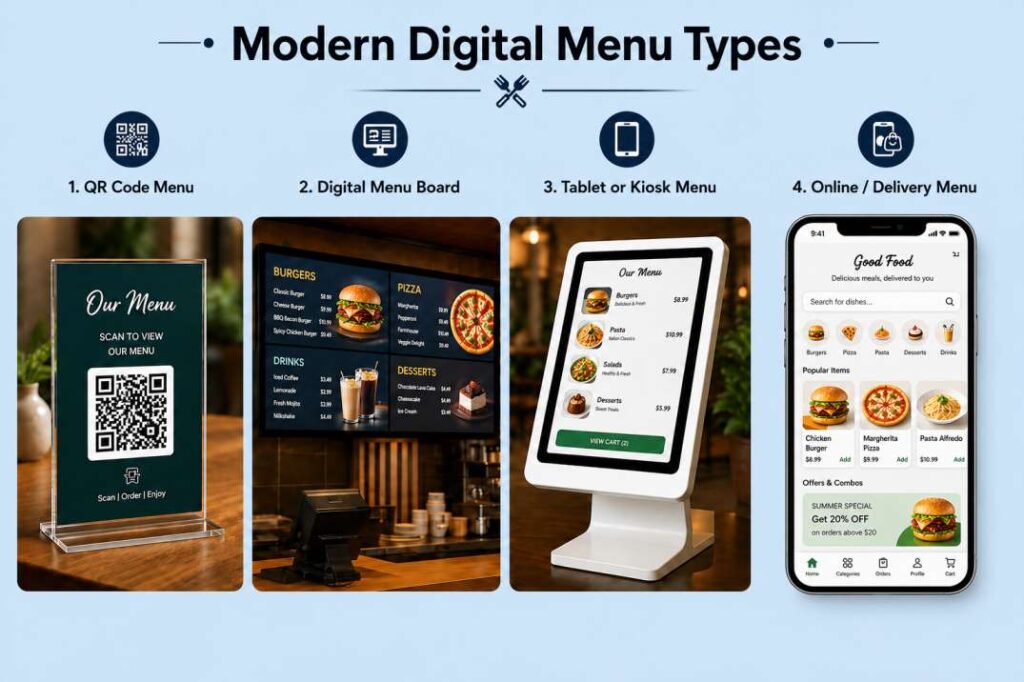
QR Code Menu
A QR code menu replaces the physical menu entirely. Customers scan a code at the table using their smartphone, which opens the menu in a browser, no app download required. The menu is hosted online and can be updated instantly. If you want to build a QR menu without hiring a designer, you can create one using our free online menu maker, customize it, and publish updates whenever your menu changes.
Advantages: lower printing costs, real-time updates, contactless experience, and easy integration with online ordering.
Digital Menu Board
These are screen-based displays mounted in visible areas, typically above the counter or at the entrance. They can show rotating images, highlight daily specials, display pricing, and include promotional content.
Tablet or Kiosk Menu
Tablet menus sit on tables or counters, allowing customers to browse, customize, and place orders directly. Kiosk menus function similarly but are freestanding, customers walk up to them before being seated or served.
This format improves order accuracy, reduces wait staff pressure, and has been shown to increase average order values because customers tend to explore more when browsing on their own.
Online / Delivery Menu
An online menu is formatted specifically for delivery platforms or a restaurant’s own website. These menus are optimized for mobile browsing, include item photography, and are designed to make the ordering process as frictionless as possible.
Unlike dine-in menus, delivery menus often need to account for travel time, dishes that don’t hold up well during delivery are typically excluded.
Specialized Menu Types in Food Businesses
Beyond the standard formats, many food businesses use specialized menus that serve specific customer groups, dining occasions, or business goals. These aren’t universal, but when they fit the concept, they can significantly elevate the dining experience.
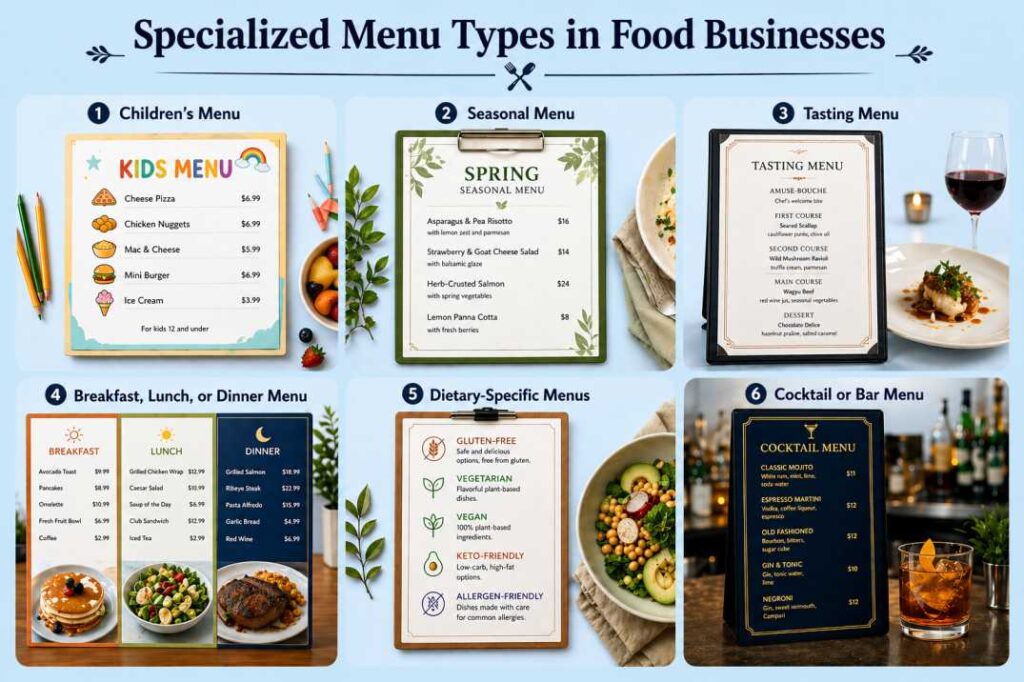
Children’s Menu
A dedicated children’s menu features smaller portions, simpler flavors, and kid-friendly presentation. It’s designed to make families feel welcome and reduce decision fatigue for parents.
Seasonal Menu
A seasonal menu changes based on the time of year, featuring ingredients that are currently at their freshest and most flavorful. Restaurants often release spring, summer, autumn, and winter editions.
This approach reinforces brand quality, gives regular customers a reason to return, and can support local sourcing partnerships.
Tasting Menu
A tasting menu (also called a chef’s tasting or degustation menu) presents a curated sequence of small dishes, often 5 to 12 courses, designed to tell a culinary story or showcase seasonal ingredients. It’s typically prix fixe and requires advance planning or reservation.
Breakfast, Lunch & Dinner Menu
Many restaurants use separate menus for different meal periods. A breakfast menu focuses on morning-appropriate items, eggs, pastries, and lighter plates. A dinner menu may feature more elaborate dishes and a longer drinks section.
Using separate menus for each service period allows the kitchen to manage prep efficiently and gives the customer a more contextually appropriate selection.
Dietary-Specific Menus
Vegan, vegetarian, gluten-free, halal, and allergy-friendly menus address the growing demand for transparent dietary options. Some restaurants offer these as standalone menus; others integrate them with icons or flags within the main menu.
Cocktail or Bar Menu
A bar or cocktail menu goes beyond a standard drinks list, it becomes a curated experience in itself, featuring signatures, seasonal specials, tasting notes, and pairing suggestions. Visually, it often takes on a more editorial design style.
How to Choose the Right Menu Type for Your Business
With so many menu formats available, the challenge isn’t finding options; it’s choosing the one that best aligns with your business model, customer expectations, and operational reality.
Here’s a practical framework to help you decide:
Define Your Concept and Service Style
Quick service, casual dining, fine dining, and ghost kitchens all operate differently. Your menu format should support your service style, not work against it. A tasting menu doesn’t belong in a fast-casual burger bar; a static menu may not suit a farm-to-table kitchen.
Understand Your Customers
Who are your customers? Families with children? Business lunchers? Late-night diners? Tourists? Each group has different expectations around complexity, speed, and price. A family-friendly concept may benefit from a children’s menu and clear visual hierarchy; a business lunch crowd may respond better to a clean, time-efficient set menu.
Assess Your Kitchen Capacity
A large à la carte menu is only sustainable if your kitchen team can execute it consistently. If you’re running a small team, a focused static menu or cycle menu will serve you better than a sprawling list of dishes that strain your prep capacity.
Consider Your Pricing Strategy
Some menu formats naturally support premium pricing (tasting menus, à la carte), while others are built around value (set menus, du jour specials). Align your menu format with the pricing model that fits your cost structure and target customer.
Match Format to Your Digital Presence
If your business relies on delivery or has significant takeaway volume, your delivery menu needs to be a distinct, optimized format, not just a copy of your dine-in menu. Consider what travels well, what photographs well, and what customers typically order remotely.
Advantages and Disadvantages of Each Menu Type
No single menu type is universally superior. Here’s a clear breakdown of the trade-offs for the most common formats:
| Menu Type | Advantages | Disadvantages |
|---|---|---|
| Static Menu |
Operationally simple and cost-effective to maintain
Easy for staff to learn and execute consistently
Familiar and reassuring for customers
|
No variety, can feel repetitive for frequent visitors
Doesn’t respond to seasonal ingredient availability
Harder to test new dishes without a full menu reprint
|
| À La Carte Menu |
Flexible, customers build exactly what they want
Supports premium pricing for each item
Natural upselling opportunity through add-ons and sides
|
Can be overwhelming for indecisive guests
Requires careful cost management per dish
Higher menu design complexity needed for clarity
|
| Table d’Hôte / Set Menu |
Predictable kitchen workflow and ingredient management
Faster service, fewer decisions to make at the table
Easier to price for events, groups, and bookings
|
Limited choice may frustrate guests with dietary needs
Less opportunity for upselling individual items
Fixed format can feel inflexible in a changing market
|
| Digital Menu (QR / Tablet / Kiosk) |
Real-time updates without printing costs
Can include photos, descriptions, and allergen info easily
Supports contactless ordering and payment integration
|
Requires reliable internet or device infrastructure
Some customer demographics prefer physical menus
Initial setup investment can be significant
|
| Tasting Menu |
Positions the restaurant as a premium, curated experience
Supports high per-head revenue
Creates memorable dining occasions that drive word-of-mouth
|
Requires preparation and specialized kitchen skills
Not accessible for budget-conscious diners
Long format can deter guests with time constraints
|
Frequently Asked Questions
Start by identifying your service style and customer base. Consider your kitchen’s capacity to execute the menu consistently, your pricing strategy, and whether you have a delivery channel that requires a separate format. The best menu type is the one that matches your operations and makes ordering effortless for your customers.
Digital menus replace printed formats with screen-based alternatives, including QR code menus, tablet menus, kiosk screens, and wall-mounted digital menu boards. They can be updated in real time, include photography and allergen information, and often integrate directly with ordering and payment systems.
A static menu is usually the most practical choice for small restaurants. It reduces kitchen complexity, lowers food waste through predictable prep, and is easier for a small team to execute consistently. Adding a du jour special board lets you introduce variety without rebuilding the full menu.
With an à la carte menu, each dish is priced and ordered separately, giving customers full flexibility. A table d’hôte menu offers a fixed multi-course meal at a set price, with limited choices per course. À la carte typically generates higher revenue per item; table d’hôte is faster and operationally simpler.
The main types include static menus, à la carte menus, table d’hôte (set menus), du jour (daily) menus, cycle menus, and beverage menus. In addition, modern restaurants increasingly use digital formats like QR code menus, tablet menus, and digital menu boards.
Final Thoughts
Menus are more than just a list of food and prices; they’re a communication tool, a branding decision, and a direct driver of customer behavior. Choosing the right menu type for your context helps improve clarity, reduce friction, and increase order values. Whether you’re running a high-end tasting experience or a neighborhood café, your menu format should feel intentional and aligned with both your customers and your kitchen.
Start with the basics: define your concept, understand your customers, and match your format to your operational capacity. From there, you can layer in digital tools, seasonal formats, or specialized menus as a natural evolution. The right types of menus don’t just organize your offerings, it tells your story, build trust, and support every order that follows.