Many food service providers often miss peak seasonal opportunities due to poor timing and ineffective promotion during high-demand periods. Editable Food flyer templates solve this by creating urgency around limited-time offers that align with customer expectations and natural demand cycles.
Effective Food promotion flyers use seasonal triggers, holiday themes, and time-limited messaging to boost response rates and revenue. This guide reveals proven strategies for timing, design, and distribution that help restaurants capture attention, increase conversions, and maximize profitability during key dining seasons. Using a free online flyer maker helps restaurants quickly create professional marketing materials without design experience.
How Do Seasonal Food Flyers Help Restaurants Maximize Peak Dining Periods?
Seasonal food flyers help restaurants capitalize on peak dining periods by creating targeted urgency and anticipation around limited-time offerings. These restaurant marketing flyers leverage holiday themes and seasonal transitions to drive immediate customer action during high-traffic windows. By highlighting special menus, seasonal ingredients, and time-sensitive promotions, food promotion flyers cut through the noise of increased competition during busy seasons.
They enable restaurants to communicate value propositions that resonate with customers’ seasonal expectations, from summer barbecue specials to holiday catering packages, ensuring businesses capture maximum revenue when demand naturally peaks using free printable flyer templates that simplify design adjustments and maintain consistent branding.
Strategic Timing Windows That Drive Maximum Customer Response
Successful seasonal food flyers capitalize on predictable consumer behavior patterns during peak dining seasons. Restaurants experience 25-40% increased foot traffic during holidays, summer months, and special occasions when customers actively seek dining experiences that match seasonal moods. Research on consumer psychology demonstrates that strategically created scarcity environments can increase purchase urgency and influence buying behaviors, particularly when consumers perceive products or experiences as limited in availability.1
Food business flyers distributed 2-3 weeks before major holidays capture early planners while avoiding oversaturation from competitor marketing materials. Strategic placement during pre-season periods allows restaurants to establish mindshare before competitors flood the market. Valentine’s Day restaurant promotions launched in late January, summer patio dining campaigns started in early May, and holiday catering materials distributed in October consistently outperform last-minute efforts.
These catering service flyers benefit from reduced competition fatigue since customers haven’t yet experienced promotional overload. Weather-driven opportunities create additional timing advantages. Restaurants promoting outdoor dining, seasonal cocktails, or comfort food specials align their marketing materials with natural customer inclinations, resulting in higher response rates and stronger emotional connections to promotional offers, showcasing the impact of effective restaurant marketing using flyers.
Creating Urgency Through Limited-Time Seasonal Menu Promotions
Limited-time seasonal offerings generate psychological urgency that drives immediate customer action during peak periods. Food promotion flyers featuring “available while supplies last” messaging or specific end dates create scarcity that motivates customers to choose your restaurant over competitors offering standard year-round menus. Seasonal ingredients naturally support urgency messaging since availability is genuinely limited.
Restaurants highlighting fresh summer produce, holiday spice blends, or local harvest specials communicate authentic time-sensitivity that resonates with customers seeking seasonal experiences, making it important to understand how to make a flyer that clearly conveys these promotions and engages the target audience. Menu rotation strategies maintain customer interest throughout extended peak seasons by introducing weekly seasonal specials or progressive menu changes, instead of promoting identical offerings for months.
This approach encourages repeat visits and maximizes customer lifetime value while keeping promotions fresh. Additionally, price anchoring through seasonal menu tiers allows restaurants to appeal to different customer segments, offering premium seasonal dishes alongside more accessible options to ensure broad appeal and maximize revenue per customer during peak traffic periods.
Leveraging Holiday Peak Traffic With Targeted Food Business Flyers
Holiday seasons offer prime revenue opportunities for restaurants. Targeted food business flyers help capture peak demand by promoting catering, family dining, and festive specials while standing out from increased competition.
- Capitalize on peak holiday demand: Holiday periods from November through January generate 30–50% of annual profits, requiring focused flyer campaigns to stand out amid heightened competition.
- Develop targeted catering promotions: Create catering service flyers for office parties, client events, and year-end celebrations, emphasizing convenience, presentation, and early booking benefits.
- Launch campaigns strategically early: Begin holiday catering promotions 6–8 weeks before peak periods to align with corporate and group planning cycles.
- Design family-oriented dining flyers: Highlight family-friendly atmospheres, kid-focused specials, and festive menus to attract family gatherings during school breaks and holiday vacations.
- Integrate social media engagement: Include QR codes linking to Instagram-worthy dishes and shareable dining moments to amplify digital visibility and flyer reach.
- Leverage hybrid promotional strategies: Combine printed flyers with online engagement for maximum exposure, driving both immediate orders and long-term brand recognition.
- Build strategic holiday partnerships: Collaborate with gift shops, entertainment venues, and local attractions to co-distribute flyers and share marketing costs during high-advertising seasons.
Explore food business flyer templates designed for seasonal promotions, holiday campaigns, and strategically timed marketing that drives maximum customer response.
- Summer Sizzler Offer Food Flyer Template
- Stuffed Turkey Leg Restaurant Promotion Flyer Template
- Tropical Flavors Caribbean Food Event Flyer Template
What Makes Seasonal Food Flyers More Effective Than Year-round Marketing Materials?
Seasonal food flyers outperform year-round marketing materials because they tap into customers’ heightened emotional states and spending patterns during specific times. Unlike generic food business flyers, seasonal designs create psychological relevance by aligning with customers’ current mindset and cultural moments.
These catering service flyers benefit from reduced competition fatigue since they appear fresh and timely rather than perpetual background noise. Seasonal flyers also leverage natural conversation starters and social sharing opportunities, as people actively seek and discuss seasonal dining experiences. This temporal relevance creates stronger recall and immediate action compared to evergreen promotional materials.
Psychological Triggers That Make Seasonal Messaging More Compelling
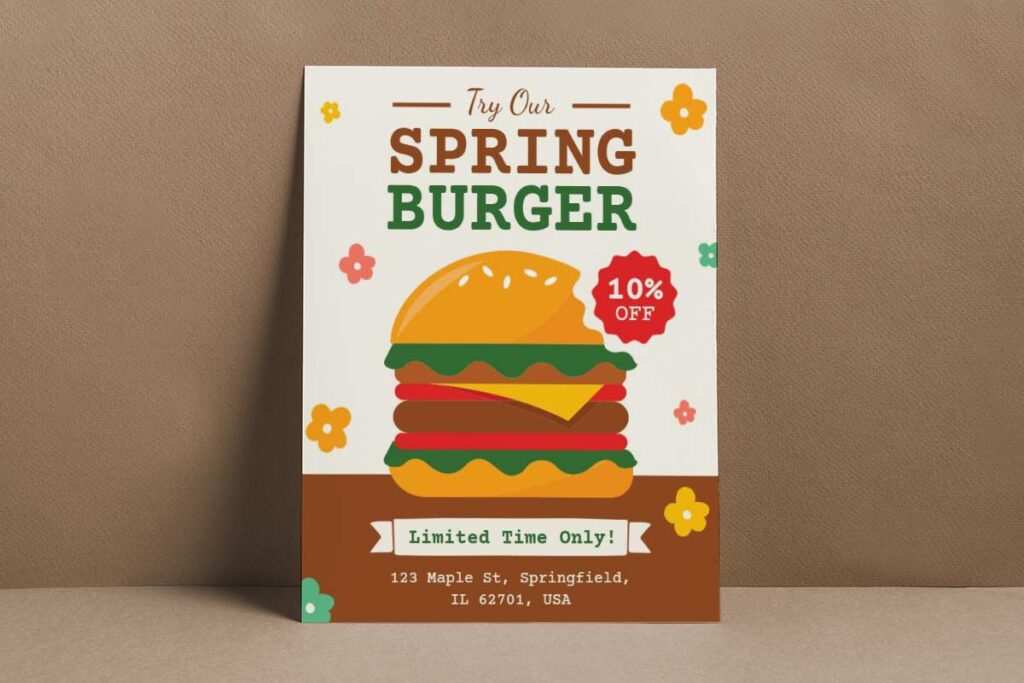
Seasonal food promotion flyers activate powerful psychological drivers that year-round materials cannot match. The principle of temporal scarcity creates urgency when customers know offerings are limited-time only. Restaurant marketing flyers featuring “Spring Menu Available March-May Only” generate immediate action because the opportunity feels fleeting.
Holiday-themed messaging triggers nostalgic emotions and social expectations, making customers more receptive to purchasing decisions they associate with celebration and tradition. Seasonal colors and imagery also influence consumer psychology through environmental congruity. When food delivery flyers feature autumn harvest colors during fall, they align with customers’ seasonal mindset, creating subconscious comfort and relevance, illustrating an effective food flyer messaging strategy that resonates with target audiences.
This psychological harmony increases message processing and recall compared to generic designs that ignore seasonal context. Restaurants using seasonal psychological triggers see 35% higher engagement rates than those using standardized messaging year-round. Incorporating the key elements of a flyer ensures your seasonal messaging balances psychological triggers with clear information.
Reduced Market Saturation During Specific Seasonal Windows
Year-round marketing materials compete in constantly saturated markets where customers develop banner blindness and promotional fatigue. Seasonal food flyers benefit from concentrated attention during specific windows when customer receptivity peaks. During holiday seasons, people actively seek themed dining options, creating natural demand spikes that seasonal materials can capitalize on while generic promotions remain invisible.
Competition also shifts during seasonal periods, with many food businesses failing to adjust their marketing approach. Food business flyers that embrace seasonal themes face less competition from businesses using standard promotional materials. This reduced saturation allows seasonal messages to stand out in ways impossible during regular periods. Local catering services using Christmas-themed flyers in December compete against fewer holiday-specific competitors, increasing visibility and response rates significantly compared to year-round promotional saturation.
Enhanced Social Sharing Potential of Time-Sensitive Food Delivery Flyers
Time-sensitive food delivery flyers drive stronger social engagement by aligning with seasonal trends and limited offers. Their timely relevance encourages organic sharing, expanding reach and boosting marketing impact effortlessly.
- Leverage seasonal engagement patterns: Seasonal food flyers align with customers’ natural desire to share time-specific experiences, boosting organic visibility across social networks.
- Promote unique, timely opportunities: Holiday specials, seasonal menu launches, and limited-time offers inspire sharing because they represent exclusive moments worth recommending.
- Encourage visual social interaction: Customers photograph and post seasonal flyers as part of documenting festive dining or delivery experiences, generating authentic user-driven promotion.
- Create conversational social currency: Time-sensitive promotions like “Summer BBQ Specials” act as value-sharing tools among networks, sparking meaningful engagement and recommendations.
- Integrate trend-based hashtags: Seasonal flyers gain additional exposure by aligning with trending hashtags and social discussions during high-engagement holiday or event periods.
- Achieve measurable sharing advantages: Seasonal marketing materials can generate up to 60% higher social sharing rates compared to generic, year-round food flyers.
- Amplify word-of-mouth marketing power: Temporal relevance makes sharing feel helpful rather than promotional, driving extended organic reach without added advertising costs.
Explore seasonal food flyer templates designed to capture timely attention, drive engagement, and maximize social sharing impact.
- Summer Bbq Cookout Food Event Flyer Template
- Thanksgiving Desserts Promotion Flyer Template
- Cloud Kitchen Opening Special Deal Flyer Template
How Can Seasonal Food Providers Time Their Flyer Campaigns for Maximum Impact?
Strategic timing for seasonal food promotion flyers requires launching campaigns 2-3 weeks before peak demand periods to build anticipation. Restaurant marketing flyers should align with local event calendars, weather patterns, and competitor schedules. Food business flyers perform best when distributed during specific windows: breakfast menus during morning commutes, holiday catering services 4-6 weeks prior to events, and summer specials before vacation season begins. Catering service flyers need earlier distribution for corporate holiday parties, while food delivery flyers should coincide with seasonal lifestyle changes like back-to-school or winter comfort food cravings.
Pre-Season Campaign Launch Windows for Different Food Categories
Holiday catering requires the longest lead times, with campaigns launching 6-8 weeks before major holidays when corporate clients begin planning events. Summer food services should begin promotion in early April, capturing customers planning outdoor events and vacation dining. Back-to-school campaigns for lunch catering and family restaurants achieve maximum impact when launched in mid-July.
Spring menu transitions work best with campaigns starting in late February, while fall comfort food promotions should begin in early September. Restaurant marketing flyers for breakfast specials perform optimally when distributed 2-3 weeks before daylight saving time changes, as eating patterns shift. Seasonal ingredient promotions require precise timing based on local harvest schedules, typically 3-4 weeks before peak availability to educate customers and build demand for limited-time offerings.
Weather-Driven Distribution Strategies for Outdoor Food Services
Weather patterns significantly impact food service demand, requiring flexible distribution strategies. Food truck seasonal flyers achieve best results when distributed during the first warm week of spring, capturing pent-up demand for outdoor dining after winter months. Summer festival vendors should distribute promotional materials during mild weather weeks leading up to events, as extreme heat reduces foot traffic and flyer effectiveness.
Outdoor catering services need weather-contingent backup plans, with indoor venue options clearly displayed on marketing materials. BBQ restaurants and outdoor dining establishments should increase flyer distribution before predicted mild weather weekends, capitalizing on increased customer willingness to dine outdoors.
Seasonal food providers must monitor local weather forecasts and adjust distribution timing accordingly, implementing a targeted food flyer distribution strategy that aligns with seasonal demand patterns and maximizes customer engagement.
Holiday Booking Cycles and Corporate Catering Timeline Planning
Holiday catering success depends on understanding booking cycles. Timely flyer campaigns, launched 6–12 weeks in advance, capture early planners and last-minute bookers alike, maximizing corporate and small business catering opportunities.
- Capitalize on early corporate booking patterns: Company holiday parties typically book 8–12 weeks in advance, making early September flyer campaigns ideal for capturing initial planner interest.
- Target peak booking windows: September and October represent the highest corporate catering activity for December events, ensuring your flyers reach decision-makers before competitors dominate.
- Plan Thanksgiving campaigns strategically: Thanksgiving orders peak in early October, requiring mid-September flyer launches to secure priority bookings and avoid market saturation.
- Address Christmas and New Year dual opportunities: Early August to October campaigns capture progressive companies reserving premium dates and venues for year-end celebrations.
- Account for religious and cultural calendars: Holidays like Hanukkah have distinct booking patterns, typically 4–6 weeks in advance, requiring flyer messaging tailored to specific community timing.
- Optimize small business catering promotions: Optimize small business catering promotions: Small business clients usually plan 4–6 weeks before events, necessitating focused flyer campaigns emphasizing convenience and stress reduction, demonstrating how flyer marketing for small business can effectively reach decision-makers and boost bookings.
- Position services as practical solutions: Highlight time-saving and hassle-free benefits on flyers, presenting holiday catering as an essential service for busy corporate planners rather than a luxury option.
What Design Elements Should Seasonal Food Flyers Include to Stand Out During Holidays?
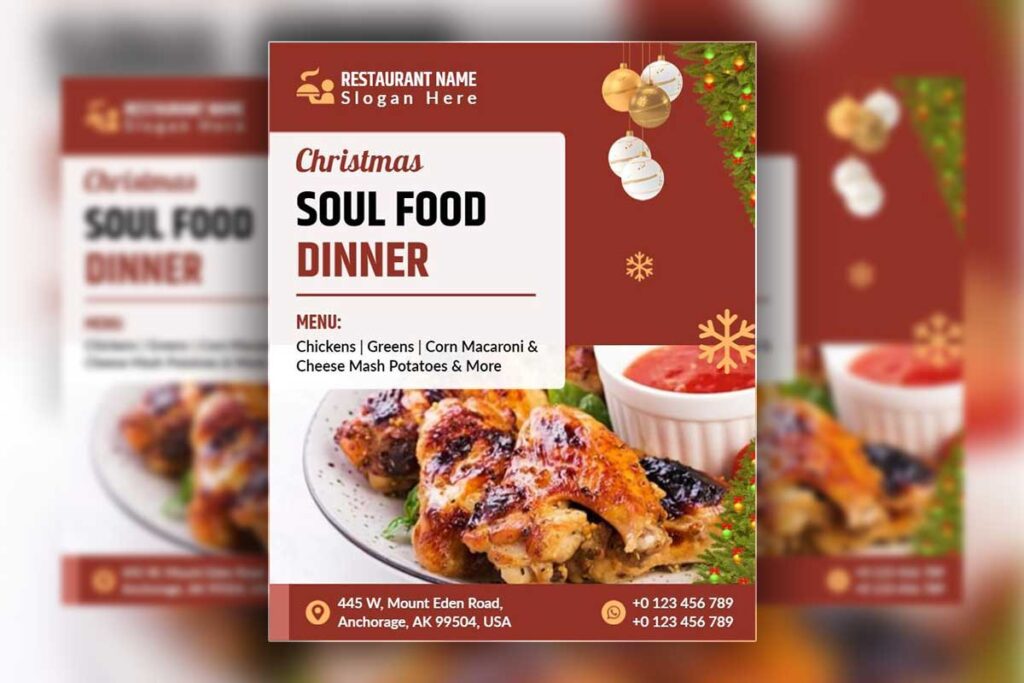
Holiday food business flyers must incorporate season-specific color palettes, festive typography, and appetite-stimulating food photography to capture attention in crowded markets. Successful seasonal food flyers feature bold seasonal borders, holiday-themed icons, and limited-time offer callouts that create urgency.
Restaurant marketing flyers should include traditional holiday symbols while maintaining brand consistency through logo placement and signature colors. Food promotion flyers perform better with contrasting backgrounds that make text readable, seasonal ingredient highlights, and clear contact information. Catering service flyers need elegant design elements that convey professionalism for corporate holiday events while incorporating festive touches that signal seasonal specialization.
Color Psychology and Seasonal Palette Selection for Food Marketing
Christmas food catering flyers maximize impact through traditional red and green palettes that trigger immediate holiday recognition, while gold accents add premium positioning for upscale catering services. Spring seasonal food flyers leverage fresh greens and sunny yellows to evoke renewal and growth, perfect for farm-to-table restaurants highlighting seasonal ingredients.
Summer food promotion flyers utilize vibrant oranges and ocean blues to create energy and appetite appeal for outdoor dining specials. Autumn campaigns benefit from warm oranges, deep burgundy, and golden browns that psychologically connect with harvest themes and comfort food cravings. Color contrast remains critical for readability, with dark backgrounds requiring bright text and light backgrounds needing bold, dark fonts.
Restaurant marketing flyers should maintain 70% brand colors and 30% seasonal accents to preserve brand recognition while capturing holiday spirit. Exploring creative flyer design ideas provides inspiration for balancing seasonal themes with effective visual communication.
Typography Choices That Enhance Holiday Menu Readability
Holiday-themed fonts balance festive appeal with practical readability, using decorative scripts for headers while maintaining clean sans-serif fonts for menu details and pricing. Government design standards emphasize that typography controls readability through careful attention to size, style, and spacing, with most body text requiring at least 16px font size for comfortable reading across devices.2
Food business flyers perform best when headline fonts capture seasonal mood without sacrificing legibility at small sizes common in digital distribution. Serif fonts like Times New Roman work effectively for upscale catering service flyers, conveying elegance and tradition appropriate for corporate holiday events. Typography hierarchy guides customer attention through seasonal food flyers, using larger font sizes for limited-time offers and special holiday pricing.
Font weight variations create visual interest while maintaining professional appearance, with bold text highlighting key seasonal dishes and special promotions. Avoid overly decorative fonts that become illegible when flyers are reduced for social media sharing or mobile viewing. Script fonts work best for accent elements like “Season’s Greetings” rather than entire menu sections.
Photography and Visual Hierarchy Techniques for Appetite Appeal
Compelling food photography and smart visual hierarchy make seasonal flyers irresistible. Highlight high-margin dishes with large, appetizing images, seasonal props, and clean layouts that guide attention and drive orders.
- Use high-quality food photography: Warm lighting and steam effects enhance appetite appeal, making seasonal comfort foods look freshly prepared and irresistible.
- Incorporate holiday-themed props subtly: Pine branches, autumn leaves, or festive tableware provide seasonal context without overpowering the main dish presentation.
- Apply strategic visual hierarchy: Highlight high-margin seasonal items with larger images and prominent placement to direct customer attention toward profitable offerings.
- Include lifestyle photography: Show families or friends enjoying seasonal meals to create emotional connections beyond product features, increasing perceived value.
- Invest in professional food styling: Seasonal garnishes and polished plating elevate the visual appeal, justifying premium pricing during competitive holiday periods.
- Maintain negative space for clarity: Prevent clutter around featured dishes while allowing seasonal design elements to complement rather than compete with food photography.
- Use borders, frames, and textures strategically: Wood grain, holiday fabrics, and subtle frames draw attention to specials while keeping the flyer clean, appetizing, and conversion-focused.
Discover seasonal food flyer templates featuring festive colors, appetizing visuals, and clear typography to stand out during holidays.
- Delicious Meals Humpday Food Flyer Template
- Ice Cream Sandwich Promotion Flyer Template
- Vibrant Culinary Adventure Food Tour Event Flyer Template
How Do Seasonal Food Flyers Communicate Unique Value During High-competition Periods?
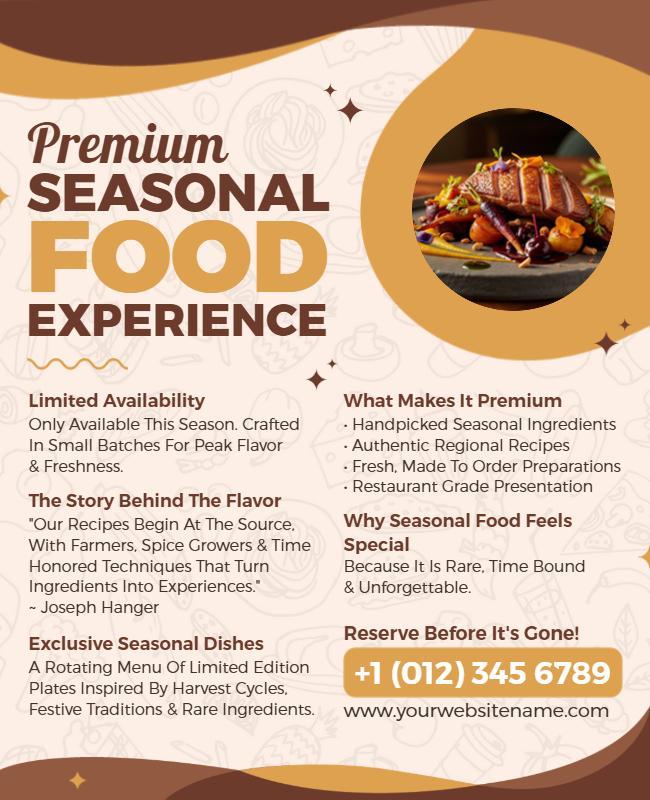
Seasonal food flyers communicate unique value during high-competition periods by emphasizing time-sensitive exclusivity, authentic seasonal ingredients, and distinctive experiences that competitors cannot easily replicate. Effective restaurant marketing flyers highlight limited-time seasonal menus, local harvest specials, and holiday-themed offerings that create immediate differentiation.
Food promotion flyers succeed by showcasing unique preparation methods, cultural authenticity, or exclusive partnerships with local suppliers. Strategic positioning focuses on emotional connections to seasonal traditions, convenience benefits like catering service offerings, and clear differentiation from mainstream competitors through specialized expertise, premium ingredients, or authentic cultural experiences that justify premium pricing during peak demand periods.
Leveraging Scarcity and Exclusivity Messaging for Seasonal Menu Items
Seasonal food flyers create urgency through limited-availability messaging that drives immediate customer decisions. Food business flyers perform best when highlighting “limited-time only” offers, exclusive seasonal ingredients available “while supplies last,” or chef-curated menus with specific end dates. Effective catering service flyers emphasize booking deadlines for holiday events, creating pressure that motivates quick action.
Smart positioning uses phrases like “exclusive winter menu” or “only 50 holiday platters available” to differentiate from unlimited chain restaurant offerings. This scarcity approach works because customers understand seasonal ingredients truly have limited windows, making the urgency authentic rather than manufactured.
Highlighting Authentic Cultural Traditions and Local Sourcing Stories
Authenticity messaging separates independent food providers from generic chains during competitive periods. Restaurant marketing flyers that tell specific stories about family recipes, local farm partnerships, or traditional preparation methods create emotional connections competitors cannot duplicate.
Food delivery flyers highlighting “grandmother’s recipe” or “locally-sourced from [specific farm name]” build trust and justify premium pricing. Academic research on food authenticity demonstrates that producers create value through storytelling about their craft, skill, and heritage, with consumers responding positively to narratives that establish direct connections between producer and consumer.3
Cultural authenticity particularly resonates during holidays when customers seek meaningful traditions. Effective food promotion flyers include chef backgrounds, ingredient origin stories, or preparation techniques passed down through generations. This storytelling approach transforms commodity food items into unique experiences worth seeking out despite numerous alternatives.
Positioning Premium Ingredients and Chef Expertise Against Generic Competitors
Showcase premium ingredients and chef expertise to stand out from generic competitors. Detailed menu descriptions, professional photography, and elegant design signal quality, justifying higher seasonal pricing and attracting discerning customers.
- Highlight premium ingredients clearly: Specify items like grass-fed beef, organic seasonal vegetables, or imported specialty ingredients to communicate quality worth premium pricing.
- Showcase chef expertise: Emphasize culinary credentials, training, and signature techniques to establish authority over generic chain restaurant alternatives.
- Use ingredient specificity in seasonal menus: Detail offerings such as “chef-selected winter root vegetables roasted with house-made herb oil” or “dry-aged beef prepared using traditional French techniques” to justify premium value.
- Combine quality with preparation expertise: Explain both ingredient origin and cooking method to help customers understand why your menu surpasses mass-market competitors.
- Apply visual hierarchy to premium elements: Use elegant typography, professional photography, and clean layouts to draw attention to high-value menu items.
- Ensure flyer design reflects premium positioning: Sophisticated layouts and polished visuals reinforce the perception of quality and professionalism.
- Target customers willing to pay for quality: Position offerings as superior to convenience-focused alternatives, appealing to those prioritizing taste, ingredient quality, and culinary expertise during busy seasonal periods.
What Distribution Strategies Work Best for Seasonal Food Flyers in Competitive Markets?
Successful seasonal food flyers in competitive markets require strategic distribution that combines precise location targeting with timing optimization. Food delivery flyers perform best when distributed during peak decision-making moments, reaching customers when they’re most receptive to seasonal dining options.
Restaurant marketing flyers succeed through geographic clustering around competitor locations and partnership placements with complementary businesses that amplify reach while minimizing costs. Businesses using targeted distribution strategies see 40% higher response rates than broad-spectrum approaches. Digital-physical hybrid methods, including QR codes linking to online ordering systems, maximize conversion rates by bridging immediate interest with convenient action steps.
Strategic Location Targeting Based on Customer Decision-Making Patterns
Effective food promotion flyers target customers during active decision-making phases rather than passive exposure moments. High-traffic grocery stores during weekend shopping periods capture families planning seasonal meals, while office complexes during lunch hours reach corporate catering decision-makers.
Shopping mall food courts during peak dining times position seasonal offerings directly against competitors. Strategic placement near complementary businesses increases engagement by 60%. Fitness centers work well for healthy seasonal menu promotions, while community centers excel for family-style catering services.
The key involves matching flyer placement with customer mindset – distribute holiday catering flyers where event planners gather, summer menu promotions where outdoor activity enthusiasts frequent, and comfort food specials where busy professionals seek convenient dining solutions. Avoiding common flyer distribution mistakes ensures your seasonal campaigns reach target customers at optimal decision-making moments.
Event-Driven Distribution Timing for Maximum Seasonal Impact
Seasonal food business flyers achieve maximum impact through event-driven timing rather than arbitrary calendar dates. Corporate holiday party bookings begin 6-8 weeks before events, requiring early catering service flyers distribution to office complexes and business centers. Summer outdoor event promotions work best distributed 2-3 weeks before local festivals, farmers markets, and community gatherings when customers start planning attendance.
Back-to-school season demands different timing for family restaurants versus lunch-focused businesses. Weather-dependent distribution proves crucial for outdoor dining promotions – monitor forecasts and deploy umbrella-ready teams for unexpected opportunities. Local event calendars provide distribution timing guides, while competitor monitoring reveals market saturation points. The most successful seasonal campaigns distribute flyers when customers mentally shift into seasonal planning mode, not when the season officially begins.
Hybrid Digital-Physical Approaches for Enhanced Tracking and Conversion
Combine physical flyers with digital tools to boost conversions. QR codes, geotargeted ads, and mobile links connect offline distribution to online engagement. Using QR code flyers that increases response rates by ensuring instant access to menus and promotions.
- Combine physical and digital distribution: Leverage printed seasonal food flyers with QR codes linking to online ordering systems for immediate conversions.
- Integrate geotargeted social media campaigns: Retarget customers near flyer locations with seasonal promotions to amplify physical distribution efforts.
- Use location-based mobile advertising: Reach customers in proximity to flyer placement points, increasing visibility and engagement during peak meal planning periods.
- Capture emails through QR codes: Build customer databases for future campaigns while tracking current flyer effectiveness.
- Implement SMS response capabilities: Enable immediate action for time-sensitive seasonal offers, improving conversion speed.
- Analyze performance and optimize placement: Compare physical distribution ROI against digital advertising to focus budgets on highest-performing locations.
- Track customer origin and ordering behavior: Use GPS-enabled promotional codes and delivery app integration to monitor flyer-to-order conversion from discovery to meal delivery.
Explore seasonal food flyer templates designed for strategic distribution, event-driven timing, and seamless digital-physical integration to boost engagement and conversions.
- Community Jambalaya Cook-Off Fundraiser Flyer Template
- Charity Turkey Leg Sale Event Flyer Template
- Tapas Tuesday Culinary Event Flyer Template
How Can Small Seasonal Food Businesses Create Cost-effective Flyer Campaigns?
Small seasonal food businesses can create cost-effective flyer campaigns by focusing on digital design tools, strategic local distribution, and precise timing. Seasonal food flyers generated 40% higher response rates than year-round materials when properly targeted. Budget-conscious restaurants save 60-80% on campaign costs by using template-based designs, batch printing during off-peak periods, and partnering with local businesses for cross-promotional distribution. Strategic timing 2-3 weeks before peak demand captures early customer attention while avoiding expensive last-minute printing costs.
Budget-Friendly Design Tools and Print Strategies for Food Promotion Flyers
Professional food promotion flyers don’t require expensive design agencies. Canva, Adobe Express, and similar platforms offer restaurant-specific templates starting at $10-15 monthly. These tools provide seasonal design elements, food photography, and customizable layouts that maintain professional appearance.
Bulk printing reduces per-unit costs significantly. Ordering 500-1000 flyers costs $0.10-0.25 each, compared to $0.50+ for small batches. Standard 8.5×11 inch glossy cardstock creates premium feel without premium pricing. Local print shops often discount seasonal orders placed during slower periods.
Digital printing allows small batch customization for different locations or seasonal offers. Variable data printing personalizes flyers with location-specific information, increasing relevance without additional design costs.
Strategic Distribution Networks That Maximize Local Food Business Exposure
Effective distribution leverages high-traffic community locations rather than expensive advertising spaces. Coffee shops, community centers, libraries, and local gyms welcome professionally designed flyers from complementary businesses. This community-focused approach mirrors effective food drive awareness through flyers, demonstrating how strategic local placement builds meaningful connections with target audiences.
Cross-promotional partnerships with florists during Valentine’s Day or party supply stores during summer create mutual marketing benefits. Door-to-door distribution in targeted neighborhoods costs only time and transportation. Focus on residential areas matching your customer demographics rather than broad distribution. Businesses using strategic local placement achieved 25% higher conversion rates than random distribution.
Food business flyers placed at farmers markets, school pickup areas, and office complexes during lunch hours connect directly with decision-makers during peak consideration moments. Digital hybrid approaches maximize reach. QR codes linking to online menus or social media pages extend flyer impact beyond physical interaction. Email newsletter integration amplifies printed campaigns through existing customer lists.
Timing Your Campaign Launch to Capture Pre-Season Demand
Launch campaigns 4–6 weeks before peak seasons to capture early bookings and avoid competitor saturation. Strategic timing around local events and weather patterns maximizes visibility and boosts seasonal food service conversions.
- Launch campaigns 4-6 weeks before peak holidays: Target corporate event planners and early bookers to secure bookings ahead of competitors.
- Distribute summer restaurant specials in May: Capture early vacation and seasonal dining planning for maximum engagement.
- Avoid market saturation through early timing: Pre-season launches reduce competition and create anticipation before multiple businesses flood the market.
- Align campaigns with local event calendars: Use school, sports, and graduation schedules to position promotions strategically for optimal visibility.
- Test smaller distribution batches: Validate timing effectiveness by tracking response rates before full-scale campaign deployment.
- Monitor competitor activity: Identify gaps in competitor pushes via local advertising and social media to maximize attention.
- Combine resource allocation with precise market timing: Ensure small seasonal food businesses compete effectively against larger competitors through focused, strategic campaigns.
What Seasonal Food Flyer Mistakes Cause Providers to Miss Peak Opportunities?
The most critical seasonal food flyer mistakes include launching campaigns too late when competitors already dominate customer mindshare, using generic restaurant marketing flyers that fail to communicate seasonal urgency, and neglecting mobile-optimized contact methods when customers want immediate ordering access. Poor visual hierarchy that buries key information like limited-time offers or booking deadlines kills conversion rates. Additionally, failing to refresh creative elements throughout the season makes businesses appear stagnant, while inadequate call-to-action clarity leaves potential customers confused about next steps, resulting in lost revenue during peak demand windows when timing is everything.
Critical Timing Errors That Cost Food Businesses Peak Season Revenue
Late campaign launches represent the costliest mistake in seasonal food promotion flyers. Food business flyers distributed after competitors establish market presence face significantly reduced effectiveness, requiring 40% higher promotional investment for equivalent results. Many catering service flyers miss corporate holiday booking windows by launching only 2-3 weeks before events, when decision-makers already committed budgets elsewhere.
Weather-dependent timing errors compound losses. Summer food festival flyers templates distributed during unseasonably cold periods generate minimal response, while winter comfort food promotions launched during warm spells fail to trigger psychological appetite triggers. Holiday peaks create narrow opportunity windows where even one-week delays dramatically impact bookings.
Distribution timing within daily cycles also matters. Lunch promotion flyers distributed after 2 PM miss decision-making windows, while breakfast special announcements sent during evening hours lack psychological relevance for morning dining choices.
Design Flaws That Weaken Seasonal Food Business Flyer Impact
Visual hierarchy failures destroy seasonal food flyer effectiveness by burying critical information below generic imagery. Food promotion flyers featuring seasonal colors without clear focal points confuse customers about primary messages, reducing response rates by 25-35%. Typography choices that sacrifice readability for decorative appeal prevent quick information processing during peak decision periods.
Recognizing common flyer design mistakes helps seasonal food providers create materials that convert rather than confuse potential customers. Overcomplicated layouts overwhelm customers with excessive information when simple, focused messages drive action. Restaurant marketing flyers attempting to showcase entire menus dilute impact compared to highlighting 3-4 signature seasonal items.
Poor color contrast makes text illegible in various lighting conditions, particularly problematic for outdoor distribution locations. Photography mistakes include using stock images instead of actual food items, creating credibility gaps, or selecting images that don’t align with seasonal emotional triggers. Low-resolution images appear unprofessional when customers compare multiple dining options during competitive holiday periods.
Communication Gaps That Prevent Customer Action on Catering Service Flyers
Conversion suffers when catering flyers lack clear instructions, urgency, complete contact info, or a compelling value proposition. Clear calls-to-action and precise booking details drive customer response during seasonal campaigns.
- Unclear call-to-action instructions reduce conversions: Flyers stating “call for information” without specifying booking requirements, lead times, or pricing frustrate potential customers. Effective call-to-action for flyers transforms interest into confirmed bookings through clear instructions.
- Lack of direct ordering mechanisms causes lost sales: Food delivery flyers without QR codes, clickable links, or immediate contact options drive prospects to competitors with streamlined ordering.
- Missing urgency indicators fail to motivate action: Generic phrases like “available now” lack the impact of time-specific messaging such as “Holiday catering bookings close December 15th.”
- Seasonal transitions require tailored urgency messaging: Messaging should adapt to peak holiday, summer, or other seasonal windows to reflect limited availability and encourage prompt response.
- Incomplete contact information creates barriers: Flyers missing mobile-optimized phone numbers, direct ordering links, or business hours force customers to search elsewhere, reducing conversions.
- Confusing value propositions reduce perceived benefits: Highlighting features alone, such as “fresh seasonal ingredients,” is less effective than benefit-focused language like “Exclusive fall harvest flavors available only through October.”
- Hidden or unclear pricing diminishes trust: Flyers must clearly communicate package costs, compare value options, and justify premium pricing to prevent hesitation or abandonment.
Discover seasonal food flyer templates designed to avoid common mistakes, highlight key offers, and capture peak customer opportunities effectively.
- White Barbique Food Flyer Template
- Authentic Jamaican Food Advertisement Flyer Template
- Simple Green and Orange Fast Food Sale Flyer Template
How Do Holiday Catering Flyers Differ From Regular Restaurant Promotional Materials?
Holiday catering flyers focus on large-group orders, advance booking requirements, and seasonal menu offerings with festive design elements, while regular restaurant promotional materials emphasize individual dining experiences and immediate service availability. Holiday catering service flyers target corporate event planners and party hosts who need advance coordination, whereas standard food promotion flyers appeal to customers seeking quick dining solutions. These seasonal food flyers incorporate holiday themes, seasonal colors, and time-sensitive booking messages that create urgency around limited availability during peak celebration periods.
Seasonal Menu Focus vs. Standard Daily Offerings
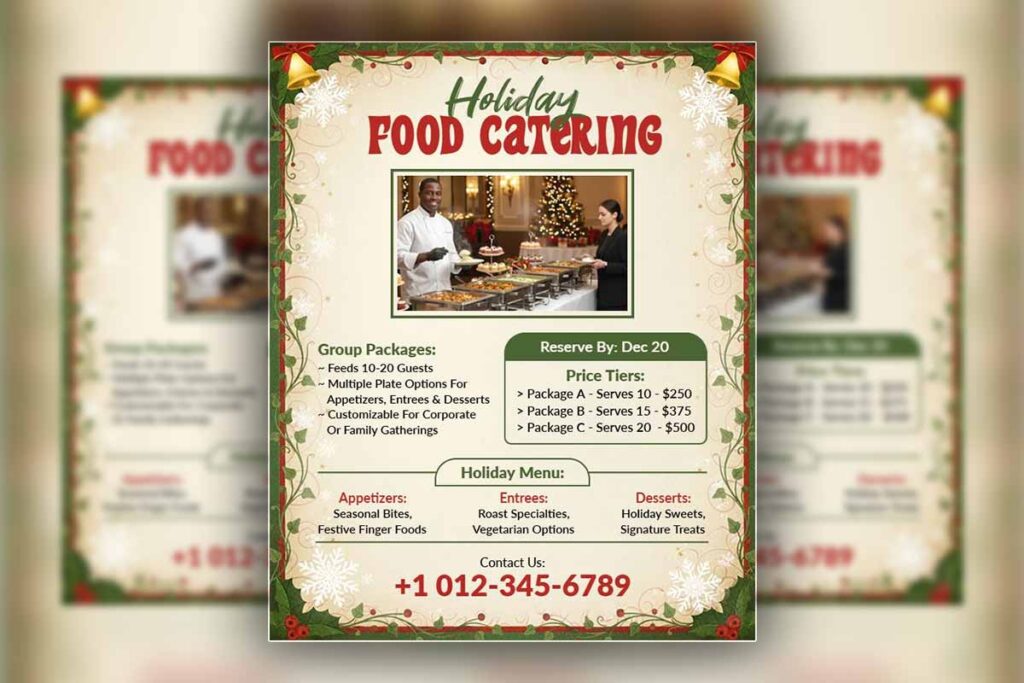
Holiday food business flyers prominently feature seasonal specialties like holiday-themed appetizers, traditional feast menus, and celebratory desserts that aren’t available year-round. These restaurant marketing flyers emphasize limited-time seasonal ingredients and culturally significant dishes that resonate with holiday traditions. Standard promotional materials showcase consistent menu items and daily specials without seasonal constraints.
Holiday catering materials highlight package deals for groups, family-style serving options, and complete meal solutions including appetizers, entrees, and desserts. Regular restaurant flyers focus on individual portions, daily specials, and à la carte ordering flexibility. The seasonal approach creates exclusivity and emotional connection through traditional holiday foods, while standard materials emphasize consistency and availability. Food delivery flyers during holidays often feature “feeds 10-12 people” messaging versus typical “individual meal” positioning.
Group Ordering Requirements vs. Individual Customer Appeals
Catering service flyers emphasize minimum order quantities, group pricing tiers, and bulk serving logistics that accommodate large gatherings. These materials include headcount planning guides, serving size calculations, and coordination requirements for corporate events or family celebrations. Research on restaurant customer choice demonstrates that dining occasions and situational factors significantly influence menu selection, with group dining contexts requiring different service approaches and menu presentations than individual customer experiences.4
Regular food promotion flyers target individual customers or small groups with personal meal preferences and immediate satisfaction. Holiday catering materials feature “serves 25-100 people” messaging with tiered pricing structures and advance ordering requirements. They include delivery coordination details, setup services, and disposable serving options.
Standard restaurant materials focus on “feeds 1-4 people” with pickup times and individual customization options. The group focus requires different value propositions – convenience for hosts versus personal dining experience for individuals. Seasonal food flyers often include party planning assistance and event coordination services not found in regular promotional materials.
Advanced Booking Timelines vs. Immediate Service Messaging
Holiday catering flyers focus on advanced booking with deadlines and planning details, while regular restaurant promotions emphasize immediate availability and convenience. Tailoring messaging to the service type maximizes conversions and revenue.
- Holiday catering flyers emphasize advanced booking deadlines: Materials communicate 2–4 weeks lead time for peak events like Christmas, Thanksgiving, and New Year’s to ensure planning and availability.
- Limited availability messaging drives planning urgency: Flyers include phrases like “book by November 15th” and “limited holiday slots available,” creating scarcity for high-demand dates.
- Regular restaurant promotions focus on immediate service: Messaging such as “order now,” “available today,” and “walk-ins welcome” encourages spontaneous dining decisions.
- Holiday materials include detailed planning elements: Consultation scheduling, menu customization, deposit requirements, and cancellation policies are highlighted for premium service management.
- Immediate service materials emphasize convenience: Flyers stress quick fulfillment, minimal planning, and accessibility to attract last-minute or casual customers.
- Advanced booking enables premium pricing and guaranteed revenue: Catering flyers for peak seasons justify higher rates and secure larger orders through structured planning timelines.
- Seasonal marketing requires different sales strategies: Longer sales cycles, higher-value transactions, and customer relationship management contrast with standard restaurant promotions focused on speed and volume.
Explore holiday catering flyer templates designed to highlight seasonal menus, group ordering options, and advance booking urgency for peak event success.
- Pupusa Sale Event Promotional Flyer Template
- Plantilla De Volante De Promoción Diaria De Alitas De Pollo Picantes
- Healthy Food Offer for Senior Citizens Flyer Template
What ROI Metrics Should Seasonal Food Providers Track for Their Flyer Campaigns?
Seasonal food providers should track conversion rates from flyer distribution to actual bookings, average order value increases during promotional periods, and cost per acquisition compared to other marketing channels. Key metrics include response time from distribution to inquiries, seasonal revenue attribution to specific flyer campaigns, and customer retention rates post-holiday season. Geographic performance data helps optimize distribution zones, while tracking repeat seasonal customers measures long-term campaign effectiveness. Cost-per-impression and revenue-per-flyer distributed provide direct ROI calculations for budget allocation decisions.
Seasonal Booking Conversion Tracking Methods
Track unique promotional codes on seasonal food flyers to measure direct response rates from distribution to bookings. Monitor phone call volume increases during campaign periods using dedicated tracking numbers for different distribution zones. Analyze website traffic spikes following flyer campaigns through UTM parameters on QR codes linking to catering service flyers and menu pages. Calculate booking lag time between flyer distribution and actual orders to optimize campaign timing for future seasons.
Digital tracking integration captures both immediate responses and delayed conversions. Restaurant marketing flyers should include multiple touchpoints – phone, website, and social media handles – to measure cross-channel attribution. Track booking completion rates from initial inquiry to confirmed orders, identifying friction points in the conversion process. Compare seasonal conversion rates against baseline periods to isolate flyer campaign impact from natural holiday demand increases.
Revenue Attribution Models for Holiday Campaigns
Implement first-touch attribution tracking to identify which food business flyers generate initial customer awareness versus last-touch models measuring final conversion drivers. Track average order values during campaign periods compared to non-promotional baselines, accounting for seasonal menu premium pricing. Monitor customer lifetime value for flyer-acquired customers, measuring repeat bookings throughout holiday seasons and following years.
Multi-touch attribution models provide comprehensive understanding of food promotion flyers effectiveness across customer journey touchpoints. Analyze revenue per distribution zone to identify high-performing geographical areas worth increased investment. Track upselling success rates when customers order seasonal packages versus standard menu items, measuring incremental revenue beyond base flyer offers.
Distribution Zone Performance Analytics
Distribution zone analytics identify high-ROI locations for food delivery flyers, track conversions by neighborhood and venue type, and optimize placement based on demographics, foot traffic, and seasonal trends.
- Geographic performance analytics identify high-ROI zones: Track which neighborhoods and specific locations generate the most conversions for food delivery flyer campaigns.
- Cost per acquisition varies by distribution area: Compare high-traffic office complexes, residential neighborhoods, grocery stores, and community centers to optimize placement strategies.
- Competitive density affects flyer performance: Adjust distribution intensity based on market saturation and nearby competitor activity to maximize impact.
- Demographic correlation analysis guides targeting: Match distribution zones with ideal customer profiles, seasonal migration trends, and foot traffic patterns for optimized timing.
- Heat mapping visualizes zone effectiveness: Highlight successful zones in green, underperforming areas in red, and calculate break-even points considering printing, labor, and conversion rates.
- Zone fatigue monitoring prevents over-distribution: Track declining response rates in overexposed areas and rotate placements to maintain engagement.
- Seasonal and weather considerations impact performance: Track separate metrics for holidays, summer festivals, and climatic variations that influence flyer effectiveness across geographic zones.
People Also Ask: Flyer Marketing for Niche and Seasonal Opportunities Implementation Questions
- What size should seasonal food flyers be?
Standard 8.5×11 inch flyers work best for detailed menus and catering information, while 5×7 inch postcards are ideal for simple seasonal promotions and door-to-door distribution in residential areas. - How much do seasonal food flyer campaigns cost?
Budget $200-$800 for small seasonal campaigns including design and printing 500-2000 flyers. Professional design costs $50-$200, printing ranges $0.10-$0.30 per flyer depending on quality and quantity ordered. - What fonts work best for seasonal food flyers?
Use readable serif fonts like Times New Roman for body text and bold sans-serif fonts like Arial or Helvetica for headlines. Decorative fonts work for seasonal accents but avoid overuse that reduces readability. - Should seasonal food flyers include QR codes?
Yes, QR codes linking to online menus, ordering systems, or social media increase engagement by 20-30%. Place them prominently but don’t rely solely on them since not all customers use smartphones regularly. - How many seasonal menu items should flyers feature?
Feature 3-5 signature seasonal items to avoid overwhelming customers while providing enough variety. Highlight your most profitable or unique offerings that differentiate you from competitors during peak periods. - What call-to-action phrases work best on seasonal food flyers?
Use urgent phrases like Order by [Date], Limited Time Only, Book Your Holiday Event Today, or While Seasonal Ingredients Last to create urgency and encourage immediate action from potential customers.
Frequently Asked Questions
- What should be included in effective seasonal food flyers?
Feature limited-time offers, seasonal dishes, strong visuals, pricing, and clear CTAs. Add contact info, hours, and booking details with colors matching the season or holiday. - How far in advance should seasonal food providers distribute flyers?
Distribute 2–3 weeks before peak periods for restaurants and 4–6 weeks for catering. Send holiday flyers 6–8 weeks early to secure bookings. - What is the best paper quality for seasonal food flyers?
Use 80–100lb glossy cardstock for a premium feel. Matte suits elegant catering, while glossy highlights food images. - How can food trucks use seasonal flyers effectively?
Show daily specials and seasonal items with QR codes for live updates. Distribute at offices, events, and busy lunch areas using bold, easy-to-read designs. - What headlines work best for holiday food catering flyers?
Use urgency and exclusivity, e.g., Book by [Date] or Limited Holiday Slots Available. Stress convenience with phrases like Stress-Free Holiday Catering. - How do seasonal food flyers compare to digital advertising ROI?
Flyers often generate 15–25% higher local response rates. At $0.10–$0.30 each, they are cheaper than digital ads and deliver stronger neighborhood engagement. - What distribution locations maximize seasonal food flyer effectiveness?
Target offices, residential areas, and event venues. Partner with florists, gift shops, or party supply stores for seasonal promotions. - How can seasonal food providers track flyer campaign success?
Use QR codes, promo codes, or unique contacts to measure responses. Track bookings, traffic, and revenue to refine future campaigns. - What colors work best for different seasonal food flyer campaigns?
Spring: greens/pastels; Summer: bright oranges/blues; Fall: warm reds/oranges; Winter: reds, greens, golds. Align colors with seasonal moods. - How often should seasonal food providers update their flyer designs?
Refresh designs for each season or holiday, 4–6 times yearly. During peak seasons, update monthly while keeping branding consistent.
Conclusion: Flyer Marketing for Niche and Seasonal Opportunities Success Framework
Successfully implementing flyer marketing for seasonal food promotions depends on precise timing, targeted messaging, and audience insight. Businesses that plan campaigns around seasonal demand cycles achieve significantly higher conversion rates by leveraging colors, imagery, and holiday themes that emotionally connect with customers. Professionally designed flyers using appetizing visuals, consistent branding, and clear value propositions enhance visibility and credibility during peak dining seasons.
By adopting a structured approach to seasonal flyer campaigns, starting promotions 4–6 weeks before peak periods and tailoring designs for holidays or festivals, food providers can capture more market share and maintain long-term customer engagement. Systematic use of themed flyers for events such as summer festivals or Christmas catering helps restaurants and caterers stand out, drive bookings, and build a strong brand presence across recurring seasonal opportunities.
Reference
- The Psychological Effects of Perceived Scarcity on Consumers’ Buying Behavior” – University of Nebraska-Lincoln.
- Typography Guidelines – U.S. Web Design System (USWDS).
- Theorizing Authenticity – University of California Press Gastronomica Journal.
- Customer Restaurant Choice: An Empirical Analysis of Restaurant Types and Eating-Out Occasions – National Institutes of Health (PMC).