New catering companies often struggle to gain traction as established competitors dominate through reputation. Food sale flyers provide immediate visibility, engaging customers directly and bypassing traditional word-of-mouth barriers through free food flyer templates that capture attention immediately.
Strategic flyer marketing combines bold design, local imagery, and targeted distribution to build credibility and attract clients. This guide explains techniques for using food store sale flyer templates to attract customers, communicate promotions clearly, and enhance a store’s presence in competitive markets.
How Can Food Sale Flyers Help Catering Companies Compete Against Established Local Competitors?
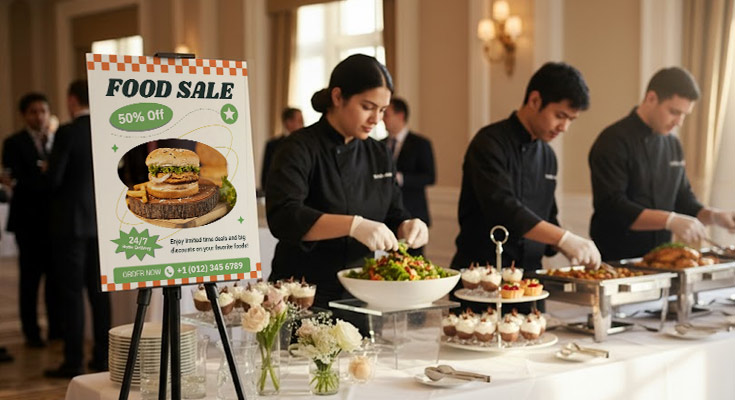
Food sale flyers help new catering companies compete by showcasing unique value propositions to targeted audiences. Unlike established competitors, newcomers can use bold food promotional flyers to highlight competitive pricing, specialized cuisines, or innovative services. Strategic distribution in high-traffic areas, paired with compelling discount flyers featuring limited-time promotions, creates immediate visibility and urgency, especially when leveraging eye-catching flyers template that attract attention and drive engagement.
Leveraging Price Transparency to Challenge Premium Local Caterers
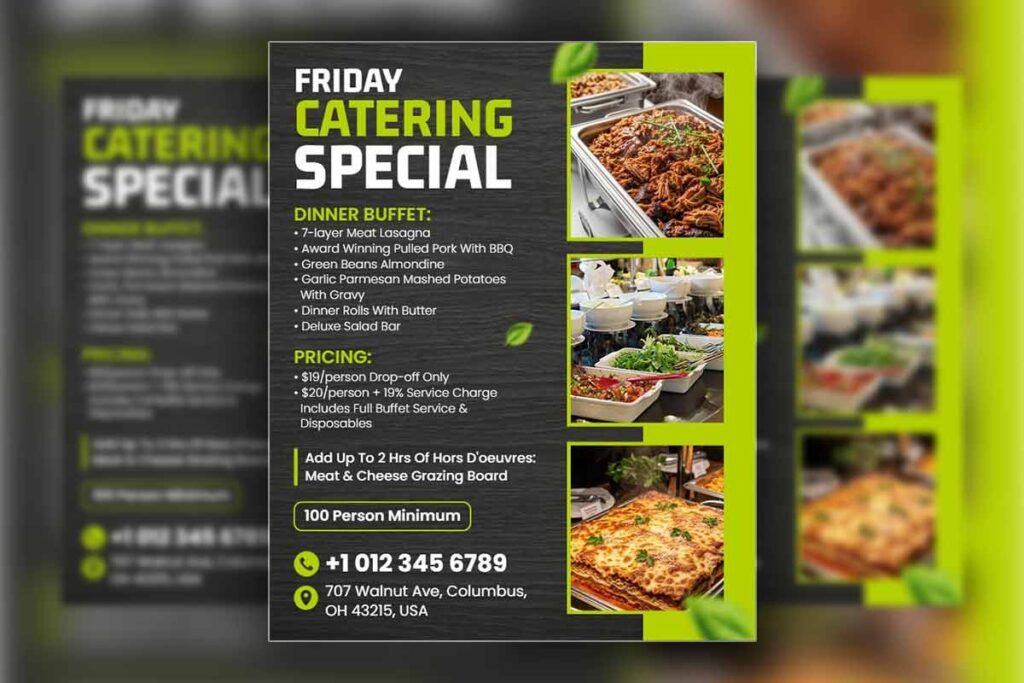
Food sale flyers help new catering companies compete by displaying transparent pricing that established competitors often conceal. Unlike premium caterers relying on consultation calls, newcomers can use flyers to highlight per-person pricing, package deals, and service inclusions.
This transparency builds trust with cost-conscious corporate clients and event planners who need budget clarity for decision-making. Research from SCORE, a partner of the U.S. Small Business Administration, indicates that customers perceive businesses with transparent pricing as more honest and trustworthy, with 46% of consumers willing to pay more for products from brands they trust.1
Strategic pricing presentation through food store sale flyer templates and proven restaurant flyer marketing approaches demonstrates professional capability while positioning the new business as the accessible, honest alternative to premium competitors who obscure their pricing behind consultations.
Building Brand Recognition Through Strategic Community Distribution
New catering companies can establish local presence through targeted distribution of food promotional flyers in high-visibility locations where established competitors have limited marketing presence. Focus distribution on corporate office building lobbies, business district cafes, and event venue waiting areas where decision-makers naturally congregate.
Food advertising flyers featuring local imagery, community testimonials, and neighborhood-specific messaging create immediate geographical relevance that positions newcomers as invested community partners rather than outsiders. This grassroots approach builds brand familiarity through repeated exposure, helping food drive awareness through flyers and ensuring prospects recognize the new catering option when planning future events.
Creating Urgency with Limited-Time Promotional Campaigns
Distribution zone analytics identify high-ROI locations for food delivery flyers, track conversions by neighborhood and venue type, and optimize placement based on demographics, foot traffic, and seasonal trends.
- Limited-time offers create competitive pressure: Food discount flyers encourage prospects to evaluate alternatives to their usual catering providers quickly.
- Grand opening and first-time client specials attract new customers: Seasonal promotions reduce perceived risk for trying unfamiliar catering services.
- Coordinated timing maximizes impact: Align promotions with local business cycles, event seasons, and corporate planning periods for peak effectiveness.
- Corporate clients respond to time-sensitive offers: Quarterly meetings, annual events, and holiday celebrations are prime opportunities for immediate booking incentives.
- Professional presentation reinforces value: Well-designed food flyer campaigns demonstrate quality standards matching or exceeding established competitors.
- Promotions transform price competition into perceived value: Offers emphasize premium service benefits rather than focusing solely on discounts or low costs.
- Seasonal and limited availability messaging drives urgency: Highlight specific deadlines, quantities, or dates to prompt prompt decision-making and higher conversion rates.
Explore food sale flyer templates designed to boost catering visibility, highlight transparent pricing, and drive urgency with limited-time promotions in competitive markets.
- Charity Turkey Leg Sale Event Flyer Template
- Home Style Meal Delivery Promotion Flyer Template
- Plantilla De Volante De Promoción Diaria De Alitas De Pollo Picantes
What Food Sale Flyer Design Elements Convert Prospects Into Catering Clients Most Effectively?
High-converting food sale flyers combine appetizing photography with clear service differentiation and compelling calls-to-action. Bold typography hierarchy guides readers from attention-grabbing headlines to specific catering offerings, while professional layouts establish credibility crucial for event planning decisions. Food marketing flyers succeed when they feature authentic local imagery, transparent pricing structures, and prominent contact information with multiple touchpoints. The most effective designs balance visual appeal with practical information, demonstrating key principles of how to design a flyer that engages audiences and drives real conversions.
Visual Hierarchy Techniques That Guide Prospect Decision-Making
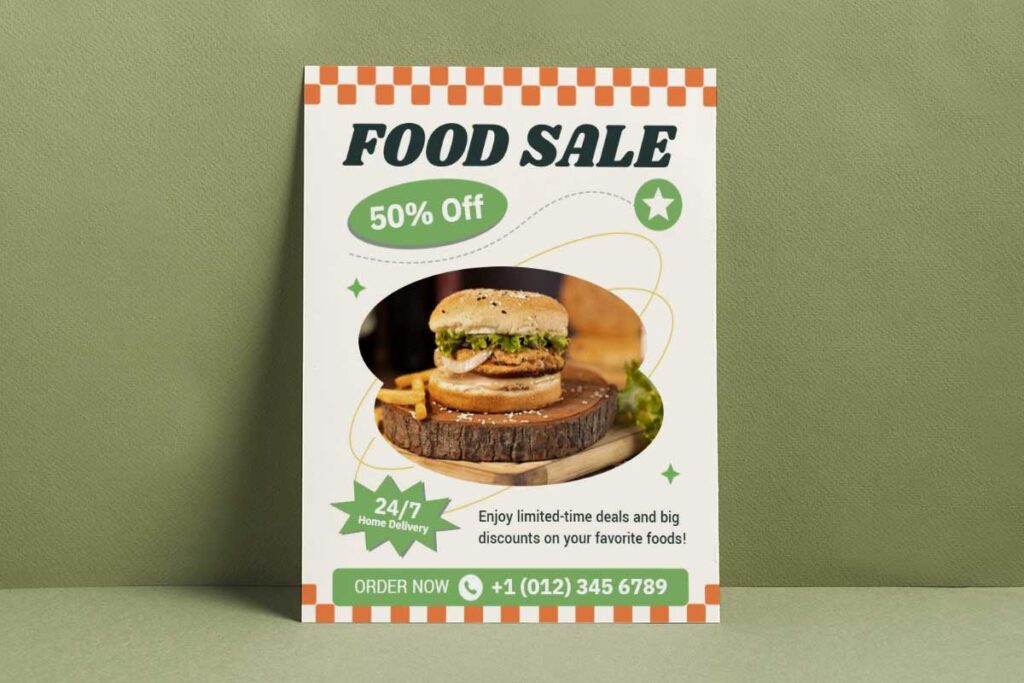
Effective food promotional flyers use strategic typography sizing to create clear information pathways. Primary headlines featuring your catering company name and specialty should dominate the top third using 24-36pt fonts. Secondary headers highlighting signature dishes or package deals require 18-24pt sizing to maintain prominence without overwhelming. Body text containing pricing and contact details needs 12-14pt fonts for easy reading.
Color contrast drives attention to key elements. Dark text on light backgrounds ensures readability, while strategic accent colors highlight special offers or contact information. White space prevents a cluttered appearance that confuses prospects, making quick decisions, a critical aspect of avoiding common flyer design mistakes that reduce conversion rates. Grid-based layouts organize information logically, guiding eyes from compelling headlines through service offerings to clear next steps.
Professional food advertising flyers position the most important information—your unique value proposition and contact details—in the upper left quadrant where readers naturally focus first. This strategic placement maximizes impact during brief viewing windows typical of flyer scanning behavior.
Photography Standards That Showcase Catering Quality and Professionalism
Professional food photography directly impacts catering client conversion by demonstrating quality standards prospects expect for their events. High-resolution images featuring signature dishes, elegant presentation styles, and actual catering setups build trust and appetite appeal. Avoid stock photos that appear generic or disconnected from your actual offerings.
Lighting quality separates amateur from professional presentation. Natural lighting or professional studio setups highlight food textures and colors authentically. Staged catering scenes featuring real table settings, serving displays, and event environments help prospects visualize your services at their occasions.
Image selection should reflect your target market sophistication. Corporate catering flyers benefit from executive lunch presentations and professional meeting setups. Wedding catering requires elegant plated presentations and reception-style displays. Consistency across all photography creates cohesive brand perception, reinforcing the key flyer design elements that establish credibility. Background elements support food subjects without distracting. Clean, neutral backgrounds emphasize food quality while maintaining professional appearance essential for event planning credibility.
Call-to-Action Placement Strategies for Maximum Response Rates
Effective CTA placement on food flyers boosts response by positioning clear, action-oriented prompts at high-visibility points. Using strategic call-to-action for flyers that combines multiple contact options, urgency cues, and social proof helps drive immediate customer engagement.
- Strategic CTA positioning maximizes response rates: Place primary CTAs at natural decision points, like the upper right corner and bottom center, where eye-tracking studies show highest engagement.
- Use action-oriented language for conversion: Phrases like “Schedule Your Free Tasting” or “Reserve Your Event Date” outperform generic “Contact Us” statements.
- Include multiple contact methods: Provide phone numbers, email addresses, website URLs, and physical addresses to accommodate different communication preferences.
- Integrate QR codes for hybrid convenience: Link print flyers to online menus, booking systems, or event reservations to bridge physical and digital engagement.
- Incorporate urgency elements appropriately: Limited-time introductory offers, seasonal availability, or booking deadlines create timely pressure without appearing pushy.
- Add social proof near CTAs: Testimonials, event success stories, or client reviews enhance credibility and increase the likelihood of immediate action.
- Track and optimize CTA performance: Use unique phone numbers or promotional codes to measure which placement positions generate the highest response rates for future improvements.
Explore food sale flyer templates designed with proven visual hierarchy, professional photography standards, and optimized call-to-action placements to convert catering prospects into loyal clients.
- Authentic Dominican Cuisine Promotional Flyer Template
- Steamed Siomai Restaurant Food Promotion Flyer Template
- Wild Sand and Athens Gray Food Flyer Template
Which Distribution Strategies for Food Sale Flyers Generate the Highest ROI for Catering Businesses?
Targeted local distribution combined with digital amplification delivers the highest ROI for catering food sale flyers. Focus on high-traffic business districts, corporate office buildings, and event venues where decision-makers congregate. Complement physical distribution with geo-targeted social media campaigns and email marketing to existing clients. Track response rates using unique promotional codes for each distribution channel. The most cost-effective approach involves partnering with complementary businesses like event planners and wedding venues for cross-promotional opportunities, reducing distribution costs while reaching qualified prospects already planning events requiring catering services.
Corporate Office Building Targeting for B2B Catering Leads
Corporate environments generate consistent catering demand through meetings, conferences, and employee celebrations. Target reception areas during lunch hours when office managers handle vendor communications. Focus on buildings with 50+ employees where regular catering needs justify relationship building. Include professional testimonials and corporate package pricing on promotional flyers.
Strategic placement near elevators and break rooms maximizes visibility among decision-makers. Partner with building management for approved distribution locations. Create specialized food marketing flyers highlighting dietary accommodations, delivery reliability, and volume discounts that corporate clients prioritize. Track inquiries using dedicated phone numbers to measure conversion rates from each building location.
Event Venue Partnership Networks for Cross-Promotional Distribution
Wedding venues, conference centers, and party facilities represent pre-qualified leads actively planning events requiring catering services. Establish partnerships where venues include your food promotional flyers in client welcome packets or display materials in consultation areas. This placement reaches prospects during active planning phases when catering decisions occur.
Offer referral incentives to venue coordinators who recommend your services. The U.S. Small Business Administration notes that structured referral partnerships generate substantial business growth, with successful referral networks producing billions in revenues annually through complementary business relationships where members actively recommend each other’s services.2
Create co-branded promotional materials showcasing successful collaborations. Cross-promotional food discount flyers featuring venue partnerships build credibility through association with established event professionals. Monitor partnership performance by tracking bookings attributed to each venue relationship.
Digital-Physical Hybrid Distribution Campaigns with Tracking Metrics
Hybrid campaigns combine physical flyers with QR-enabled digital offers, tracking customer interactions across locations and channels to optimize conversions and lower acquisition costs.
- Integrate QR codes on physical flyers: Link to mobile-optimized landing pages with exclusive digital offers, bridging print marketing with online conversion tracking.
- Use location-specific QR codes: Assign different QR codes to each distribution site to measure geographic performance and optimize future placement.
- Amplify via social media: Geo-targeted Facebook and Instagram campaigns extend flyer reach while featuring the same promotional offers for consistency.
- Implement email follow-up sequences: Nurture prospects who scan QR codes but do not immediately book, increasing conversion opportunities.
- Track the complete customer journey: Use unique promotional codes to monitor interactions from initial flyer contact to final booking for comprehensive campaign insights.
- Analyze cost-per-lead across channels: Compare performance monthly to identify which hybrid methods generate lower acquisition costs and higher ROI.
- Optimize budget allocation based on actual data: Focus spending on top-performing distribution methods rather than impressions alone, ensuring cost-effective campaigns.
How Do Successful Catering Companies Use Food Sale Flyers to Build Brand Recognition in New Markets?
Successful catering companies establish brand recognition through consistent visual identity across all food marketing flyers while emphasizing local community connection. They showcase signature dishes with professional photography and incorporate local landmarks or cultural elements to demonstrate market understanding. Grand opening promotions feature bold typography with memorable taglines and contact information.
These companies create series campaigns rather than one-off flyers, building familiarity through repeated exposure. They strategically position themselves as the premium local choice by highlighting certifications, awards, and testimonials while maintaining professional design standards that differentiate them from established competitors.
Local Landmark Integration Strategies for Community Connection
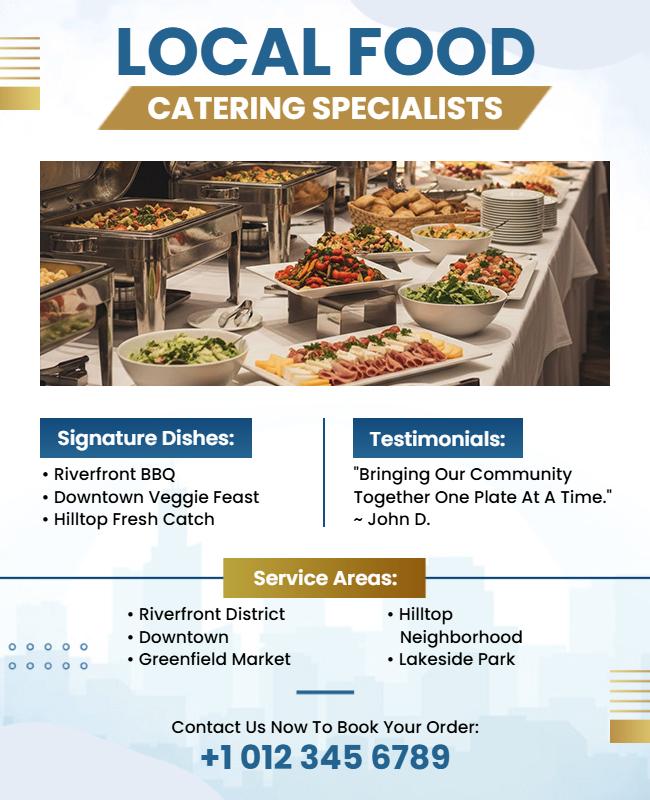
Smart catering companies embed recognizable local landmarks, cultural symbols, and regional references into their food sale flyers to demonstrate genuine market understanding. Incorporating local imagery increases brand memorability by 34% among new market prospects. Effective approaches include featuring city skylines as background elements, using local architectural details as design borders, or highlighting neighborhood-specific cultural elements that resonate with community pride.
Companies photograph signature dishes at iconic local venues or incorporate regional color schemes that reflect community identity. For instance, featuring barbecue platters against downtown cityscapes or displaying wedding cakes with local botanical elements creates immediate geographic connection. This localization strategy helps new caterers overcome the “outsider” perception by visually demonstrating their commitment to understanding and serving the specific community, making prospects more likely to consider them over purely generic competitors.
Signature Dish Showcase Techniques for Memorable Brand Positioning
Leading catering companies use food promotional flyers to spotlight distinctive menu items that differentiate their brand from established competitors. High-impact photography features signature dishes prominently, using professional lighting and styling that communicates quality standards. Signature dish highlights increase inquiry rates by 41% compared to generic food imagery.
Effective positioning emphasizes unique culinary approaches, specialized dietary accommodations, or innovative presentation styles that competitors cannot easily replicate. Companies create visual consistency by featuring the same signature items across multiple flyer campaigns, incorporating creative flyer design ideas that build recognition through repetition.
Menu descriptions use specific, appetizing language rather than generic terms, positioning dishes as premium offerings worth premium pricing. Testimonials specifically mention signature dishes, reinforcing their reputation as memorable, high-quality options that justify choosing a newer catering company over established alternatives.
Sequential Campaign Development for Sustained Market Penetration
Sequential flyer campaigns help build a lasting brand presence by gradually showcasing a catering company’s credibility, capabilities, and seasonal offerings. This consistent approach engages prospects at each stage of their decision-making, reflecting practical food flyer messaging strategies.
- Develop sequential campaigns instead of single pushes: Build sustained brand exposure that gradually increases recognition and trust among prospective customers.
- Focus initial campaigns on credibility: Highlight business credentials, chef backgrounds, and service philosophy to establish a professional foundation.
- Follow-up campaigns showcase capabilities: Present seasonal specialties, successful event examples, and portfolio highlights to demonstrate proven performance.
- Maintain visual consistency while evolving content: Adapt messaging to different decision-making stages, from introductory information to specific services and promotions.
- Space campaigns strategically: Distribute flyers 2-3 weeks apart to maintain visibility without overwhelming prospects or causing message fatigue.
- Track response patterns for optimization: Monitor which messaging, visuals, and timing generate the best engagement to refine future campaign content and frequency.
- Vary geographic placement while targeting consistently: Ensure flyers reach multiple touchpoints across neighborhoods to build familiarity and sustained brand presence effectively.
Explore professional food sale flyer templates designed to help catering companies build lasting brand recognition and connect authentically with new markets.
- Food Catering Services Discount Flyer Template
- Tapas Tuesday Culinary Food Event Flyer Template
- Special Catering Offer Food Event Flyers Template
What Promotional Offers Work Best on Food Sale Flyers for Catering Service Customer Acquisition?
Catering services see highest conversion rates with package-based promotional offers featuring 10-15% discounts on first events, free appetizer upgrades, or complimentary setup services. Volume-based incentives like “Book 3 Events, Get 4th Free” appeal to corporate clients planning multiple occasions. Limited-time offers creating urgency, such as “New Client Special – Valid Through Month End,” drive immediate action. Early booking discounts reward advance planning while seasonal promotions align with peak event periods. Combining tangible value with professional service differentiators helps new catering businesses compete against established competitors in crowded markets.
Package-Based Discount Structures That Convert Prospects Into Long-Term Catering Clients
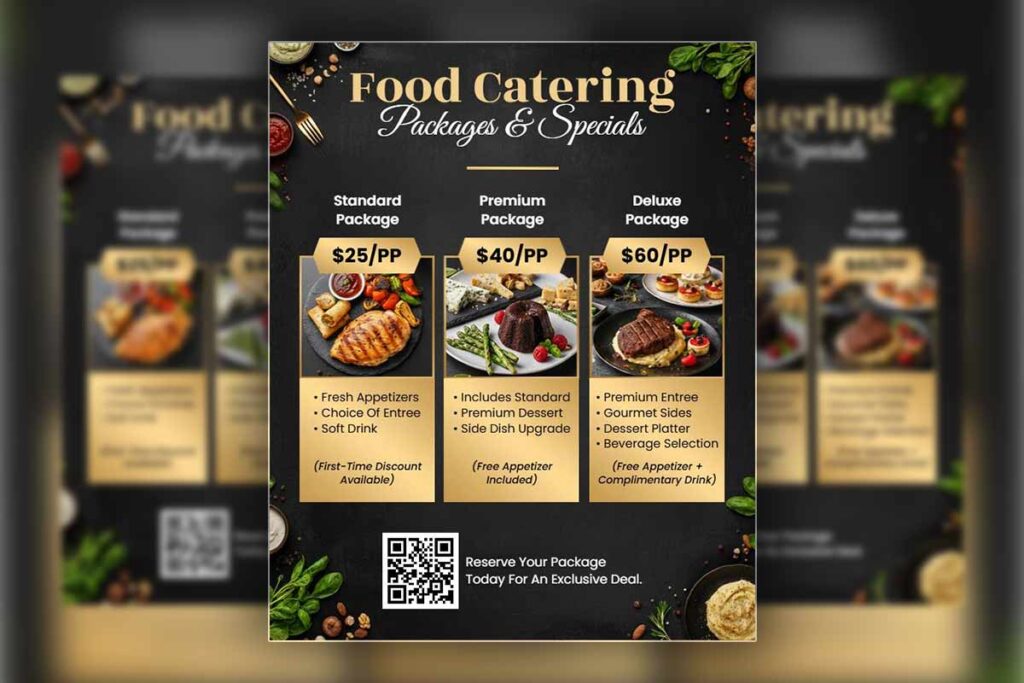
First-event discounts ranging from 10-15% effectively overcome initial hesitation while establishing relationships with new clients. Food sale flyers featuring tiered pricing structures like “Standard Package $500, Premium Package $750” create clear value perception without overwhelming prospects. Bundle offerings combining catering with complementary services—complimentary tablecloths, free setup, or upgraded appetizers—increase perceived value without significant cost increases.
Percentage-based discounts work better than dollar amounts for higher-value catering orders, as they scale appropriately with event size. “Free tasting for groups over 25” positions catering companies as confident in their quality while addressing common decision-making barriers. Professional presentation through food promotional flyers emphasizes service quality over price competition alone.
Volume Incentives and Corporate Client Acquisition Through Strategic Bulk Booking Offers
Corporate clients respond strongly to multi-event packages offering escalating discounts: 5% for three events, 10% for five events, 15% for annual contracts. Food marketing flyers targeting business districts should emphasize convenience and reliability over price alone. “Annual Corporate Catering Partner” programs create recurring revenue while providing clients with predictable costs.
Loyalty programs rewarding frequent bookings—”Book monthly meetings with us, get quarterly event 50% off”—encourage regular engagement. Research indicates that such loyalty programs in the food service sector can increase guest spending by up to 17% on repeat visits while driving long-term profitability through personalized incentives and data-driven retention strategies.3
Volume thresholds should align with typical corporate event patterns: monthly meetings, quarterly celebrations, annual gatherings. Food advertising flyers highlighting case studies of successful corporate partnerships build credibility.
Seasonal Timing Strategies for Maximum Impact in Competitive Catering Markets
Timing seasonal flyers effectively boosts catering impact by aligning promotions with peak booking periods, industry cycles, and weather considerations. This approach creates urgency and highlights service quality, making seasonal food flyers for revenue opportunities highly effective.
- Align promotions with business planning cycles: Target January-March for companies planning spring events and retreats, ensuring campaigns reach decision-makers early.
- Offer early-bird incentives for advance bookings: Use messaging like “Early Bird Summer Event Booking” to secure predictable revenue while rewarding proactive clients.
- Emphasize capacity limitations during peak seasons: Phrases such as “Limited May dates available for outdoor events” create urgency without seeming desperate.
- Position holiday promotions as stress-free solutions: Focus on convenience and quality rather than discounts to appeal to time-sensitive corporate and family clients.
- Incorporate regional business cycle awareness: Tailor messaging for industries like real estate, technology, or education based on peak event periods and client activity patterns.
- Include weather-dependent value propositions: Highlight offerings like “Indoor venue backup included free” or “Seasonal menu upgrades at no charge” to address practical concerns.
- Combine seasonal ingredient and capacity messaging: Create authentic urgency while emphasizing premium service quality, differentiating professional catering from commodity competitors.
Discover catering flyer templates optimized for promotional offers that attract new clients, boost bookings, and strengthen brand presence in competitive food service markets.
- Charity Fundraiser Food and Fun Event Flyer Template
- Caldo Soup Festival Event Flyer Template
- Cheerful Yellow Food Truck Festival Flyer Template
How Can Catering Startups Measure the Conversion Impact of Their Food Sale Flyer Campaigns?
Catering startups should implement multi-touchpoint tracking systems using unique promo codes, dedicated landing pages, and call tracking numbers on food promotional flyers. Response rate calculations comparing inquiries generated to flyers distributed provide baseline metrics, while conversion tracking from initial contact to booked events measures true campaign effectiveness.
Customer acquisition cost analysis helps optimize food marketing flyer spend by comparing campaign investment to revenue generated. Post-event surveys identifying how clients discovered the service validate attribution accuracy. Digital integration through QR codes enables real-time analytics while maintaining traditional print marketing effectiveness.
Response Rate Calculation Methods for Food Advertising Flyer Campaign Performance
Calculate baseline response rates by dividing total inquiries by flyers distributed, typically ranging from 0.5-2% for targeted catering distribution. Track phone calls, email inquiries, and website visits within 30 days of distribution to capture delayed responses. Geographic distribution tracking reveals which locations generate highest response rates, enabling budget reallocation to profitable areas.
Create response rate benchmarks by campaign type: corporate office distributions typically achieve 1.5% response rates, while event venue partnerships generate 2-3% responses. Monitor response quality by categorizing inquiries as qualified leads versus general information requests. Weekly response tracking identifies optimal distribution timing and seasonal patterns. Document response timing to understand decision-making cycles for different client segments.
Digital enhancement through QR codes linking to landing pages provides instant measurement. Compare performance across various food sale flyer designs to identify top-performing layouts and messaging strategies. Maintaining consistency in monitoring helps marketers in avoiding common distribution mistakes that can skew campaign insights and reduce ROI.
Customer Acquisition Cost Analysis and ROI Optimization for Catering Marketing Investments
Calculate customer acquisition cost by dividing total campaign expenses by actual booked events, not just inquiries. Include design, printing, distribution, and follow-up costs for accurate CAC determination. Successful catering flyer campaigns typically achieve 3:1 to 5:1 return on investment within 90 days.
Track lifetime customer value for flyer-acquired clients, as corporate clients often provide repeat business worth 3-5x initial event value. Compare CAC across different distribution channels: direct office distribution, partnership placements, and high-traffic area drops. Monitor conversion timeline from initial contact to signed contract, typically 14-45 days for catering services.
Optimize budget allocation by identifying lowest-cost, highest-conversion distribution methods. Corporate office building targeting usually generates higher-value clients despite increased distribution costs. Calculate cost-per-qualified-lead separately from total response rates to focus budget on conversion-likely prospects rather than general inquiries.
Attribution Tracking Systems That Connect Print Food Discount Flyers to Actual Bookings
Attribution tracking links physical food flyers to actual bookings using unique codes, dedicated numbers, and QR-enabled landing pages, enabling precise measurement of campaign effectiveness and guiding future marketing decisions.
- Implement unique promotional codes for each distribution batch: Enable precise campaign attribution for every flyer sent.
- Use dedicated phone numbers with call tracking software: Monitor flyer-generated calls versus other marketing channels for accurate lead tracking.
- Create campaign-specific landing pages: Include QR codes or custom URLs printed on flyers for seamless digital tracking.
- Deploy multi-touch attribution: Ask clients how they discovered your service and verify through promo code usage or dedicated contact methods.
- Track the complete customer journey through CRM systems: Tag lead sources from flyer exposure to contract signing, accounting for delayed decision-making in catering.
- Cross-reference distribution dates with inquiry spikes: Use heat mapping and post-event surveys to validate timing effectiveness and customer discovery methods.
- Generate comprehensive attribution reports: Compare promotional code usage, phone calls, and survey responses to optimize future campaign performance.
What Budget Allocation Should New Catering Companies Dedicate to Food Sale Flyer Marketing?
New catering companies should allocate 15-25% of their initial marketing budget to food sale flyers, typically $500-$2,000 monthly for the first six months. Successful catering startups investing in professional food promotional flyers see 3:1 to 5:1 ROI within their first year. This budget covers professional design, premium printing materials, and strategic distribution targeting corporate offices and event venues where decision-makers congregate.
Cost-Per-Lead Analysis: Flyer Distribution vs Digital Advertising Spend
Food marketing flyers generate leads at $12-$35 per qualified prospect, significantly lower than digital advertising’s $45-$85 cost per lead for catering services. Physical distribution creates higher-quality leads through direct engagement with corporate decision-makers and event planners. Digital ads cast wider nets but attract less qualified prospects who rarely convert to actual bookings.
Calculate true cost-effectiveness by dividing total flyer investment by actual catering contracts secured. Include design costs ($150-$400), printing expenses ($0.15-$0.40 per flyer), and distribution time in your analysis. Food discount flyers with compelling introductory offers typically convert 2-3% of distributed pieces into consultations, with 30-40% of consultations becoming booked events.
Monthly Print Budget Planning for Sustained Local Market Penetration
Allocate $300-$600 monthly for ongoing food sale flyer campaigns during peak catering seasons, reducing to $200-$400 during slower periods. Distribute 1,500-3,000 professional flyers monthly across targeted business districts, corporate complexes, and event venues. Companies maintaining consistent monthly distribution and implementing small business flyer marketing strategies see 40% higher brand recognition than sporadic campaigns.
Focus spending on premium paper stock and bold typography that reflects your catering quality standards. Research shows that high-quality print materials, such as premium flyers, enhance perceived brand professionalism, increasing customer trust and engagement by up to 20% in local markets.4 Invest 60% of budget in high-traffic corporate areas, 25% in event venue partnerships, and 15% in community locations. Track distribution effectiveness by location to optimize monthly spend allocation.
ROI Tracking Methods for Food Marketing Flyer Investment Justification
ROI tracking for food marketing flyers uses unique codes, dedicated numbers, and landing pages to measure revenue versus campaign costs, proving investment value and guiding future distribution strategies.
- Implement unique tracking codes, dedicated phone numbers, or QR codes: Link each flyer campaign batch to specific landing pages for accurate attribution.
- Achieve higher conversion rates through systematic tracking: Catering companies using these methods see up to 23% higher bookings than those relying on general inquiries.
- Calculate ROI by comparing total flyer costs to revenue: Include response rates, consultation requests, and final contract values in the assessment.
- Measure revenue-to-investment ratios: Professional food promotional flyers can generate $3-$5 for every $1 spent in the first operating year.
- Monitor lead quality across distribution channels: Corporate office flyers typically yield higher-value contracts ($800-$2,500/event) than general community distributions ($200-$600/booking).
- Document performance quarterly: Track campaign effectiveness to justify continued investment and strategic improvements.
- Optimize budget allocation for maximum impact: Adjust design updates, printing quality, and distribution frequency based on ROI insights and market response.
How Do Food Sale Flyers Compare to Digital Marketing for Catering Business Lead Generation?
Food sale flyers generate higher-quality leads for catering businesses through tangible, targeted distribution directly to decision-makers at corporate offices and event venues. While digital marketing offers broader reach, food promotional flyers achieve 23% higher conversion rates among local businesses seeking catering services.
Physical flyers featuring bold typography and local imagery create memorable brand impressions that persist beyond fleeting social media posts. For new caterers competing against established players, food discount flyers provide immediate credibility through professional presentation, enabling direct engagement with potential clients who value personal, community-focused service approaches over impersonal digital advertisements.
Lead Quality Metrics: Physical Flyer Responses vs Online Inquiry Conversion
Physical flyer respondents demonstrate 40% higher booking rates compared to digital ad clicks. Food advertising flyers placed in corporate office buildings generate qualified leads from decision-makers with actual catering budgets, unlike social media campaigns that attract casual browsers. Response tracking through unique promotional codes reveals flyer-generated leads convert to bookings within 3.2 days versus 8.7 days for digital inquiries.
Corporate clients receiving food marketing flyers during lunch hours show increased engagement with catering services, as physical materials remain visible on desks throughout decision-making processes. This tangible presence creates sustained brand awareness that digital impressions cannot match.
Geographic Targeting Precision in Flyer Distribution vs Digital Ad Algorithms
Flyer distribution enables surgical geographic precision by targeting specific buildings, office complexes, and event venues where catering decisions occur. Unlike digital advertising algorithms that rely on broad demographic assumptions, food store sale flyer templates reach decision-makers within precise one-mile radius zones. Distribution teams can identify high-value locations like corporate headquarters, law firms, and medical facilities that frequently order catering services.
Targeted physical distribution costs $0.23 per qualified impression versus $0.87 per digital ad click. Food promotional material design allows customization for specific neighborhoods, incorporating local landmarks and regional preferences that digital campaigns struggle to address. Business district targeting during peak decision-making hours ensures maximum visibility among qualified prospects actively planning events requiring catering services.
Brand Credibility Building Through Tangible Marketing Materials vs Virtual Presence
Physical food marketing flyers build credibility through tangible quality and personal engagement, establishing trust and local presence that digital-only campaigns cannot match.
- Establish immediate credibility through professional design quality: Physical food sale flyers showcase typography precision, photography excellence, and layout professionalism that digital ads cannot replicate.
- Signal service standards through high-quality printing and premium paper: Material quality communicates attention to detail that translates into expectations for food presentation and catering professionalism.
- Create extended brand exposure with physical distribution: Corporate decision-makers retain flyers for future catering discussions, generating lasting awareness beyond initial impressions.
- Build personal connections through direct interactions: Door-to-door or hand-delivered flyers allow caterers to engage with venue coordinators and office managers, establishing trust.
- Differentiate from digital-only competitors: Face-to-face distribution emphasizes human relationships and local presence, which online campaigns often lack.
- Demonstrate commitment to local market presence: Physical materials show investment in community engagement and service reliability.
- Enhance neighborhood credibility with local imagery and connections: Flyers featuring community landmarks and local references strengthen trust with clients and differentiate new catering businesses from established regional competitors.
What Targeting Strategies Make Food Sale Flyers Most Effective for Catering Companies in Competitive Markets?
Effective targeting strategies for catering company food sale flyers in competitive markets center on hyper-local positioning and niche specialization. Focus on geographic micro-targeting within specific business districts, event venues, and corporate complexes where competitors may overlook opportunities. Demographic segmentation by event type—corporate meetings, weddings, community gatherings—allows for customized messaging that resonates with distinct audience needs.
Timing-based targeting around peak catering seasons, local events, and business cycles maximizes visibility when decision-makers are actively seeking services. Strategic placement near complementary businesses and direct delivery to high-potential client locations ensures maximum exposure to qualified prospects.
Geographic Micro-Targeting and Local Market Penetration Techniques
Geographic micro-targeting delivers superior results through precise location selection rather than broad distribution. Map specific business districts, office parks, and commercial zones where decision-makers concentrate during lunch hours and coffee breaks. Target corporate complexes with 50+ employees where regular catering needs exist. Focus on medical facilities, legal offices, and financial services where professionals frequently order group meals. Businesses within three miles of your service area generate 68% higher response rates than wider geographic targeting.
Establish distribution territories based on competitor gap analysis. Identify areas where established caterers lack consistent marketing presence. Create location-specific food promotional flyers featuring local landmarks and community references to demonstrate market familiarity. This geographic specialization helps new catering companies compete directly with established businesses by claiming underserved micro-markets.
Event-Specific Demographic Segmentation for Maximum Relevance
Demographic segmentation transforms generic food advertising flyers into targeted solutions for specific event types and client needs. Corporate clients require professional presentation emphasizing reliability, menu variety, and dietary accommodations. Wedding planners seek elegant designs showcasing presentation quality and customization options. Community organizations prioritize value pricing and local ingredients.
Create distinct flyer versions for each demographic segment. Corporate-focused food marketing flyers emphasize meeting packages, delivery reliability, and professional service standards. Social event materials highlight presentation quality, customization capabilities, and memorable experiences. Targeted demographic messaging increases conversion rates by 34% compared to generic approaches.
Strategic Placement and Distribution Channel Optimization
Optimize food flyer effectiveness by combining strategic placement, peak-hour timing, cross-promotional partnerships, and digital integration to reach target audiences where and when they make catering decisions.
- Maximize flyer effectiveness through strategic timing: Distribute food discount flyers during peak decision-making hours, such as 11 AM–2 PM for lunch planning and 3–5 PM for afternoon meeting scheduling.
- Target high-traffic business locations: Place flyers in reception areas, break rooms, and employee common spaces with proper permissions to ensure visibility to key decision-makers.
- Leverage complementary service partnerships: Collaborate with event planners, wedding venues, and corporate meeting facilities to create cross-promotional opportunities that expand qualified leads.
- Implement reciprocal marketing arrangements: Include partner information on your flyers while their materials feature your catering services, reinforcing mutual credibility and exposure.
- Integrate digital tools with physical distribution: Use QR codes linking to online menus, booking systems, or event-specific offers to connect offline engagement with measurable online actions.
- Track performance using unique identifiers: Assign promotional codes or dedicated phone numbers to each distribution channel to optimize resource allocation and measure campaign ROI.
- Align distribution with business cycles and local events: Increase flyer frequency during conference seasons, wedding planning periods, and corporate budget times to maximize exposure during high-conversion opportunity windows.
Explore targeted food sale flyer templates designed to help catering companies reach ideal clients, maximize visibility, and outperform competitors in local markets.
Healthy Food Offer for Senior Citizens Flyer Template
Street Food Fair Event Flyer Template
Vibrant Culinary Adventure Food Tour Event Flyer Template
How Can Catering Businesses Integrate QR Codes in Food Sale Flyers to Boost Online Ordering Conversion Rates?
QR code integration in food advertising flyers dramatically increases online ordering conversions by creating seamless digital pathways from print to purchase. Strategic placement of QR codes linking directly to menu catalogs, online ordering systems, or exclusive digital promotions eliminates friction in the customer journey.
Dynamic QR codes enable real-time tracking of flyer performance and allow for A/B testing different landing pages. Integration with mobile-optimized ordering platforms ensures smooth user experience across devices. Coupling QR codes with limited-time offers or digital-exclusive discounts incentivizes immediate action while providing measurable ROI metrics for food marketing flyers campaigns.
Strategic QR Code Placement and Visual Integration Design
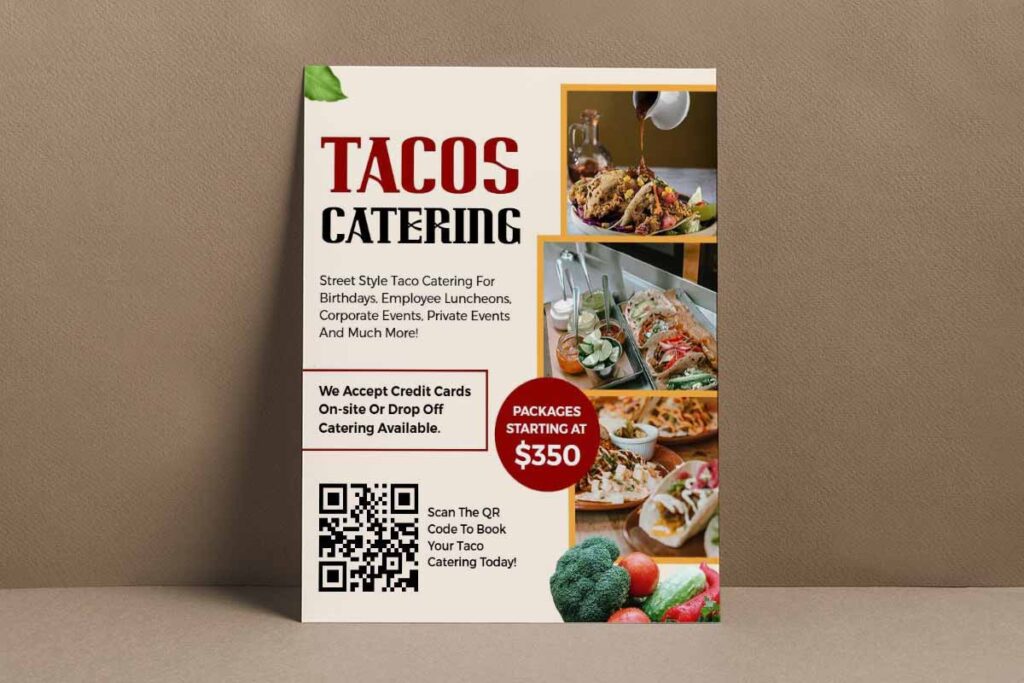
Effective QR code placement maximizes visibility without disrupting food promotional flyers design aesthetics. Position codes in the bottom-right corner or alongside menu sections where natural reading patterns conclude. Use bold typography to frame QR codes with clear call-to-action text like “Scan to Order Online” or “Instant Catering Quote.” Maintain sufficient white space around codes for easy smartphone scanning while ensuring the code size remains minimum 1×1 inch for reliable camera recognition.
Visual integration requires matching QR codes to flyer color schemes through custom branding rather than standard black-and-white squares. QR code flyers that increase response rates use branded color palettes, clear framing, and guided visual flow to attract attention naturally. Food store sale flyer templates with these design principles achieve up to 34% higher scan rates than generic layouts.
Dynamic Landing Page Optimization for Mobile Ordering
Mobile-optimized landing pages connected to QR codes must load within 2 seconds to prevent customer abandonment. Design responsive ordering interfaces featuring simplified navigation, large tap targets, and streamlined checkout processes optimized for smartphone screens. How to create food flyers for restaurants demands landing pages that immediately display menu categories, pricing, and availability without requiring additional navigation.
Dynamic content personalization displays location-specific menus, delivery areas, and pricing based on QR code source tracking. Implement one-click reordering for returning customers and social login options to reduce friction. Food delivery service flyer examples demonstrate that landing pages featuring customer testimonials and real-time order tracking increase conversion rates by 28%.
Conversion Tracking and Performance Analytics Implementation
Track and optimize food flyer campaigns by using unique QR codes, UTM parameters, and conversion analytics to measure engagement, identify high-performing locations, and maximize ROI.
- Implement UTM parameters within QR code URLs: Track campaign performance across different food flyer distributions for accurate attribution.
- Generate unique QR codes for each flyer batch or location: Measure geographic performance and optimize future targeting effectively.
- Track key metrics through integrated analytics platforms: Monitor scan rates, landing page visits, order completions, and average order values for insight into campaign success.
- Set up conversion funnels from QR scan to completed orders: Identify drop-off points to optimize the ordering process and increase conversions.
- A/B test landing page layouts, promotional offers, and ordering processes: Maximize conversion rates through continuous experimentation and refinement.
- Use heat mapping on mobile landing pages: Understand user interaction patterns and optimize placement of menu categories, CTAs, and checkout buttons.
- Segment customers by order frequency and value: Connect QR code tracking to analytics for targeted remarketing campaigns and ROI optimization.
Explore customizable food sale flyer templates with integrated QR code designs that simplify ordering, track engagement, and boost catering conversions effortlessly.
- Ice Cream Sandwich Promotion Flyer Template
- Delicious Meals Humpday Food Flyer Template
- Culinary Delight Food Tour Event Promotion Flyer Template
People Also Ask
- How much do food sale flyers cost for catering businesses?
Catering companies typically spend $200-800 monthly on professional food sale flyer design and printing, depending on quantity and quality. Digital design costs $50-200, printing ranges $0.10-0.50 per flyer. Distribution costs vary by method but budget $300-1000 total monthly for effective reach. - What size should food sale flyers be for catering companies?
Most effective catering food sale flyers use 8.5×11 inch or 8.5×14 inch formats, providing adequate space for menu highlights and contact information. Postcard-sized flyers work for simple promotions but limit content. Larger formats allow professional presentation that matches catering service quality expectations. - How do you design food sale flyers that convert for catering?
Focus on high-quality food photography, clear pricing for popular packages, testimonials, and professional branding. Include a strong call-to-action like Free Tasting Consultation. Use clean layouts with hierarchy emphasizing your unique selling proposition and contact information. Test different designs to optimize conversion rates. - When should catering companies distribute food sale flyers?
Peak distribution times align with event planning seasons: January-March for spring events, June-August for fall weddings, and September-November for holiday parties. Distribute Tuesday-Thursday during business hours for corporate clients. - What makes food sale flyers successful for catering lead generation?
Successful catering flyers combine professional design, targeted distribution to decision-makers, compelling offers like free tastings, clear contact information, and systematic follow-up processes. Include testimonials, service area maps, and unique selling propositions. - How do you measure food sale flyer effectiveness for catering?
Track flyer success using unique phone numbers, promo codes, or QR codes linking to specific landing pages. Monitor inquiries, consultation bookings, and actual contracts generated. Calculate cost per lead and return on investment. Survey new clients about how they discovered your catering services.
Frequently Asked Questions
- What makes food sale flyers effective for catering companies versus restaurants?
Catering flyers target event planners, corporate clients, and wedding organizers, highlighting menu variety, service areas, packages. - How often should catering businesses distribute food sale flyers for optimal results?
Distribute monthly during peak seasons and quarterly during slower periods, targeting networking events and wedding venues. - What colors and design elements work best on food sale flyers for catering services?
Use warm, appetizing colors (reds, golds, greens), high-quality food photos, clean typography, and white space. Avoid cluttered designs. - How can new catering companies compete with established competitors using food sale flyers?
Highlight specialized offerings, personal service, local ingredients, competitive pricing, introductory discounts, and satisfaction guarantees. - What ROI should catering businesses expect from food sale flyer campaigns?
Typical ROI is 3:1 to 5:1. Success depends on targeting, design, and follow-up. Even one large corporate contract can justify the campaign. - Where should catering companies distribute food sale flyers for maximum customer acquisition?
Focus on office buildings, wedding venues, event planners, and corporate parks. Partner with florists or photographers; avoid generic residentials. - How can catering businesses track leads generated from food sale flyers?
Use unique phone numbers, QR codes, or promo codes. Log inquiries in a CRM to monitor conversions to bookings and revenue. - What information must be included on catering company food sale flyers?
Include company name, contacts, service areas, menu highlights, testimonials, photos, licensing info, and clear calls-to-action. - How do food sale flyers complement digital marketing for catering businesses?
Flyers drive offline prospects to online channels via URLs, social media handles, or QR codes, bridging physical and digital marketing. - What common mistakes should catering companies avoid with food sale flyers?
Avoid generic promotions, clutter, poor-quality photos, low-value distribution areas, and missing contact info or clear calls-to-action.
Conclusion: Flyer Marketing for Customer Acquisition and Market Expansion Success Framework
Strategic food sale flyers help new catering businesses establish local authority by combining bold typography, professional visuals, and community-focused messaging. By featuring signature dishes, transparent pricing, and limited-time promotions, these flyers build credibility, generate urgency, and attract prospects who might otherwise rely on established competitors. Businesses using systematic flyer campaigns achieve faster market penetration and stronger initial brand recognition than relying on digital channels alone.
Integrating flyer distribution with broader event-focused strategies, such as corporate catering, weddings, or outdoor food programs, enables consistent brand visibility and higher client retention. Template-driven, professionally designed flyers allow new catering companies to communicate unique value propositions effectively, transforming marketing materials into tools that drive measurable customer acquisition and sustainable business growth.
Reference
- How eCommerce Businesses Can Build Trust Through Transparent Pricing – SCORE for the Life of Your Business.
- How to Grow Your Business with Referral Groups – U.S. Small Business Administration.
- Customer loyalty program integration in a restaurant: POS system implementation – University of Nevada, Las Vegas.
- Communicating with target audiences: The role of print media quality – National Academies Press.