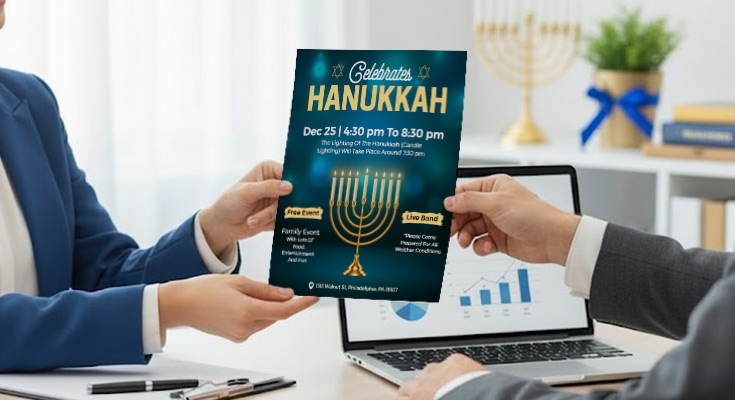
Service providers often waste resources on broad flyer campaigns that fail to connect meaningfully with Jewish audiences. To effectively create a flyer for Hanukkah promotions, focus on precise targeting in synagogues, kosher markets, and community centers. Hanukkah flyer distribution relies on demographic insights that identify neighborhoods with strong Jewish populations, ensuring your materials reach audiences who value cultural relevance and connection.
Geographic targeting and culturally aligned design generate up to 5x higher engagement than generic citywide efforts. Using free Hanukkah flyer templates allows service providers to maintain cultural accuracy through traditional symbols, festive color palettes, and holiday-specific typography. Strategic partnerships and authentic holiday messaging ensure maximum visibility and response during key Hanukkah planning periods.
What Are the Most Effective Hanukkah Flyer Distribution Channels for Reaching Jewish Families?
The most effective Hanukkah flyer distribution channels include synagogue partnerships, Jewish community center bulletin boards, and kosher grocery stores where families regularly gather. Digital channels like community Facebook groups and NextDoor neighborhood apps offer targeted reach with measurable engagement. Door-to-door distribution in high Jewish population density neighborhoods provides direct household contact. Local Jewish schools, Hebrew schools, and Judaica stores serve as natural touchpoints for Hanukkah promotional flyers during the holiday season.
Synagogue Partnership Programs for Hanukkah Promotional Flyers
Synagogues represent the highest-value distribution channel for reaching engaged Jewish families actively planning holiday celebrations. Establish partnerships with synagogue administrators for bulletin board placement, weekly newsletter inserts, and lobby display areas. Most congregations welcome community service announcements during Hanukkah preparation periods, typically 3-4 weeks before the holiday begins.
Request permission for special event announcements during Friday evening services or Saturday morning gatherings when family attendance peaks. Reform and Conservative synagogues often maintain community boards specifically for local business services. Orthodox communities may require rabbi approval but offer highly committed audiences for Hanukkah community flyer outreach. Businesses entering the Jewish community market should familiarize themselves with Hanukkah marketing flyers guide to build credibility and trust from the outset.
Time distribution requests for early November to capture families during peak Hanukkah planning phases. Service providers can choose from various flyer layouts to create materials that resonate with different congregation demographics. Synagogue partnerships provide credibility and community trust that significantly increases response rates compared to generic distribution methods.
Digital Community Platforms and Social Media Targeting Strategies
Facebook groups focused on local Jewish communities offer precise demographic targeting with immediate feedback capabilities. Pew Research Center’s 2020 study found that 62% of Jewish Americans share holidays and cultural activities with others, and many increasingly use digital platforms and social media to connect with Jewish community resources and holiday planning information.1 Join neighborhood groups, Jewish parent networks, and community discussion forums where families actively seek service recommendations.
Post helpful Hanukkah preparation content with subtle service mentions rather than direct advertisements. NextDoor neighborhood platforms excel for reaching Jewish families in specific residential areas. Use the business profile feature to share Hanukkah event flyer marketing content targeting zip codes with higher Jewish population concentrations. Monitor group discussions about holiday planning to identify optimal posting timing and content preferences.
Instagram Stories and Facebook Events allow real-time engagement tracking and direct message responses. LinkedIn community groups serve professional Jewish networks planning corporate Hanukkah celebrations or family events requiring upscale services.
Kosher Business Locations and Jewish Cultural Hub Distribution
Kosher businesses and Jewish cultural hubs provide ideal locations for targeted Hanukkah flyer distribution. Partnering with markets, JCCs, and schools ensures visibility among families actively preparing for the holiday. Consistent, respectful messaging across these venues strengthens community trust and service awareness.
- Target Kosher business locations: Partner with Kosher markets, bakeries, and restaurants for flyer displays, shopping bag inserts, and checkout counter placements during peak Hanukkah preparation weeks when Jewish families make regular visits.
- Leverage Jewish Community Centers (JCCs): Request flyer placement on bulletin boards and lobby areas, focusing on high-traffic zones like gym entrances, childcare pickup points, and senior program areas to maximize community visibility.
- Engage Hebrew and Jewish day schools: Distribute flyers through parent pickup areas, school newsletters, and event bulletins to reach families planning Hanukkah celebrations and related service needs.
- Utilize Judaica stores and bookshops: Position flyers in venues selling Hanukkah-related goods where customers are already in a purchasing mindset, ensuring strong message relevance and engagement.
- Include Jewish retirement and assisted living facilities: Provide informational materials tailored to residents and visiting families participating in Hanukkah programs and celebrations.
- Maintain consistent cultural respect: Ensure flyer design and language reflect Jewish values, modest aesthetics, and community-appropriate tone while communicating professional service offerings clearly.
- Combine multi-channel distribution: Integrate physical placements with digital follow-ups for cohesive outreach that reinforces brand recognition across the Jewish cultural and community network.
Explore Hanukkah flyer templates tailored for synagogue partnerships, community centers, and digital platforms to effectively reach Jewish families during the holiday season.
How Do You Target Optimal Neighborhoods for Hanukkah Flyer Distribution Campaigns?
Targeting optimal neighborhoods requires analyzing Jewish population density through census data, synagogue proximity mapping, and identifying areas with Hebrew schools or kosher establishments. Use demographic research tools to locate zip codes with higher Jewish household concentrations. Focus on suburban family neighborhoods near Jewish institutions rather than broad geographic spreads. Consider walkability scores and community engagement levels in residential areas. Monitor local Jewish event attendance patterns and community newsletter subscriber locations to refine your geographic targeting for maximum Hanukkah service provider visibility and response rates.
Census Data Analysis and Jewish Population Density Mapping
American Community Survey data reveals Jewish population concentrations through religious affiliation and ancestry responses. Target ZIP codes with 15% or higher Jewish households for optimal Hanukkah flyer distribution effectiveness. Metropolitan areas like New York, Los Angeles, and Miami offer detailed demographic breakdowns by neighborhood. Cross-reference census tract data with synagogue locations to identify established Jewish communities versus newer developments.
Geographic information systems help visualize density patterns across multiple data sources. Combine population statistics with median household income data to identify affluent Jewish neighborhoods that typically invest more in professional services during holidays. Focus your Hanukkah promotional flyers on areas showing consistent Jewish population growth over recent census periods, indicating stable community presence and engagement levels.
Use mapping tools to create distribution zones based on demographic overlap rather than arbitrary geographic boundaries. This targeted approach increases response rates significantly compared to broad distribution strategies across general residential areas.
Proximity-Based Targeting Around Synagogues and Jewish Schools
Synagogue proximity mapping creates natural distribution zones for effective Hanukkah community flyer outreach. Orthodox, Conservative, and Reform synagogues serve different demographics, requiring tailored messaging approaches. Map quarter-mile and half-mile radius circles around each synagogue to identify concentrated Jewish residential areas where families actively participate in religious community life.
Hebrew schools, Jewish day schools, and Judaica stores serve as secondary targeting anchors. Parents dropping off children at these locations represent engaged Jewish families likely to respond to holiday service offerings. Create overlapping distribution zones where multiple Jewish institutions intersect, indicating higher community density and engagement levels.
Kosher restaurants and markets provide additional proximity indicators. Families regularly patronizing these establishments demonstrate commitment to Jewish lifestyle practices, making them prime candidates for Hanukkah celebration flyer distribution tips. Track foot traffic patterns around these locations to optimize distribution timing and maximize exposure to your target demographic through strategic placement.
Residential Walkability Assessment for Door-to-Door Campaigns
Residential walkability directly affects the efficiency and safety of Hanukkah flyer distribution. Prioritize neighborhoods with sidewalks, good lighting, and accessible layouts for smoother coverage. Focus on established single-family areas with high homeowner engagement for stronger response rates.
- Evaluate neighborhood walkability: Target residential areas with sidewalks, street lighting, and pedestrian-friendly layouts that allow safe, systematic Hanukkah flyer distribution.
- Focus on route efficiency: Prioritize suburban developments with clear street patterns for complete neighborhood coverage within reasonable timeframes.
- Assess gated community access: Verify distribution permissions with homeowners associations or property managers before investing in restricted areas.
- Target homeowner-dominant areas: Single-family home neighborhoods produce higher response rates than apartment complexes due to stronger local engagement.
- Analyze community stability: Focus on established areas with low resident turnover where households are more receptive to seasonal community outreach.
- Ensure material protection: Distribute flyers at weather-protected spots such as covered porches or mail slots to preserve visibility and presentation quality.
- Distribute during optimal hours: Conduct door-to-door campaigns during daylight when families are active, avoiding intrusive early or late-hour deliveries.
Which Locations Provide the Highest Roi for Hanukkah Flyer Distribution Efforts?
Synagogues and Jewish community centers deliver the highest ROI for Hanukkah flyer distribution, offering direct access to engaged Jewish families actively seeking holiday services. Kosher markets and Jewish schools provide secondary high-conversion opportunities, while Jewish neighborhoods with concentrated populations maximize residential distribution effectiveness. University Hillel centers and Jewish retirement communities represent specialized high-value targets. Successful service providers focus 70% of their Hanukkah promotional flyers on these primary locations rather than generic distribution, achieving 3-5x higher response rates through targeted community flyer outreach strategies.
Religious Institution Distribution Networks for Maximum Community Penetration
Synagogue partnerships offer unmatched access to engaged Jewish families actively planning Hanukkah celebrations. Contact clergy two weeks before distribution to secure bulletin board placement and newsletter mentions. Orthodox, Conservative, and Reform synagogues each serve distinct demographics requiring tailored messaging approaches. Community centers hosting Hebrew schools provide additional touchpoints during parent pickup times. JCCs offer prime placement opportunities near program registration desks and event bulletin boards.
Establish relationships with facilities managers and volunteer coordinators for sustained placement opportunities. Many institutions welcome community service provider information when professionally presented. Target high-traffic areas like main entrances, social halls, and children’s program spaces for maximum visibility among families actively seeking Hanukkah services.
Kosher Business Partnership Opportunities and Cross-Promotional Benefits
Kosher grocery stores, restaurants, and bakeries provide natural gathering points for Jewish families during Hanukkah preparation. Approach managers during slow periods to discuss flyer placement opportunities. Many establishments maintain community bulletin boards or allow counter displays for local service providers.
Kosher wine shops and Jewish bookstores serve affluent demographics seeking premium Hanukkah experiences. Penn State Extension research indicates that approximately 43% of kosher food consumers are observant Jewish families, while the broader $100 billion kosher market also attracts health-conscious non-Jewish consumers who associate kosher certification with food quality and safety standards.2
Partner with kosher caterers and event planners for cross-promotional opportunities. These businesses often recommend additional services to clients planning Hanukkah celebrations. Judaica stores hosting Hanukkah workshops provide direct access to families actively preparing for the holiday. Timing distribution with pre-holiday shopping surges maximizes exposure when families make service decisions.
Residential Targeting in High-Density Jewish Population Areas
Targeting high-density Jewish neighborhoods ensures efficient Hanukkah flyer distribution with stronger engagement. Focus on areas near Jewish schools, Orthodox communities, and senior living centers for higher response potential. Use demographic mapping and timing strategies to reach families and students during peak planning periods.
- Identify high-density Jewish neighborhoods: Use demographic mapping tools to locate areas with 15% or higher Jewish population for concentrated door-to-door outreach.
- Prioritize Orthodox community zones: Target neighborhoods surrounding Orthodox centers where traditional Hanukkah preparations increase service demand.
- Leverage proximity indicators: Focus on suburban areas near Jewish day schools, which often signal family-oriented households seeking Hanukkah-related assistance.
- Target accessible housing types: Emphasize single-family homes and avoid apartment complexes with restricted entry for smoother distribution flow.
- Optimize distribution timing: Conduct deliveries Tuesday through Thursday mornings (9–11 AM) to reach families during preparation hours while avoiding weather exposure.
- Include student and senior clusters: Extend outreach to college areas with active Hillel centers and senior communities with Jewish residents for broader demographic coverage.
- Track and refine targeting: Monitor response rates by neighborhood to identify top-performing zones and guide future budget allocation for Hanukkah campaigns.
What Timing Strategies Maximize Hanukkah Flyer Distribution Success Rates?
Optimal Hanukkah flyer distribution begins 4-6 weeks before the holiday, capturing early planning behaviors while avoiding oversaturation. Peak distribution windows occur Tuesday-Thursday when Jewish families actively plan weekend and holiday activities. Morning distributions (8-10 AM) at synagogues and community centers reach engaged audiences, while afternoon school pickups (2-4 PM) target parents. Service providers should complete 60% of their Hanukkah flyer distribution 3-4 weeks prior, with final promotional pushes during the week immediately before Hanukkah begins, ensuring maximum visibility during critical decision-making periods.
Pre-Holiday Planning Window Optimization for Service Bookings
Jewish families begin holiday planning 4-6 weeks before Hanukkah, making this the optimal window for initial Hanukkah flyer distribution campaigns. Start distribution during the first week of November for December celebrations, targeting synagogue bulletin boards and community center displays when families actively seek service providers for cleaning, catering, and event planning.
Focus distribution on high-engagement locations during this early phase: Jewish community centers during programming hours, Hebrew school pickup areas, and kosher grocery stores. Service providers booking appointments during this window report 40% higher conversion rates compared to last-minute distribution.
Target neighborhoods with established Jewish populations first, as these families typically plan celebrations earlier. Distribute promotional materials Tuesday through Thursday during morning hours (9-11 AM) when parents drop children at Hebrew school or attend community programming. Early distribution captures organized families who prefer advance booking, leading to higher-value service contracts and reduced competition for prime holiday dates.
Weekly Distribution Cycles That Align with Jewish Community Schedules
Tuesday through Thursday represents the optimal weekly distribution window for Hanukkah promotional flyers, avoiding Shabbat preparation periods and post-weekend scheduling recovery. Jewish families actively plan activities and make service decisions mid-week when synagogue programming peaks and community engagement reaches maximum levels.
Avoid Friday afternoon through Sunday evening distributions, as families focus on Shabbat observance and family time. Monday distributions face reduced engagement as families transition from weekend activities back to weekly routines.
Synagogue bulletin board updates typically occur Tuesday mornings, making Tuesday-Wednesday optimal for bulletin placement. Jewish community centers schedule most programming Tuesday-Thursday, providing natural gathering points for Hanukkah community flyer outreach.
Coordinate distribution with Hebrew school schedules, targeting pickup times (typically Tuesday and Thursday afternoons) when parents congregate. This timing alignment increases visibility among engaged Jewish families actively participating in community activities. Service providers following weekly distribution patterns report 25% higher response rates compared to random distribution scheduling, as materials reach families during natural decision-making periods.
Daily Time Slots for Peak Audience Engagement and Response
Optimal flyer distribution times align with community activity patterns for maximum engagement. Morning reaches families during synagogue and school routines, while afternoon targets parents at pickups and grocery visits. Evening suits residential delivery, but must respect family time to maintain positive reception.
- Target morning engagement (8–10 AM): Distribute flyers near synagogues and Hebrew schools during minyan attendance and school drop-offs when community members are alert and planning their day.
- Leverage afternoon activity windows (2–4 PM): Focus on Hebrew school pickups, community centers, and kosher grocery areas where parents and families actively participate in community life.
- Strategize evening outreach (6–8 PM): Conduct residential distributions targeting families at home, while respecting dinner and family time boundaries for positive reception.
- Avoid commuting hours (7–9 AM & 5–6 PM): Skip busy travel periods when recipients are focused on logistics and unlikely to engage with promotional materials.
- Utilize Sunday morning synagogue traffic: Capture attention during weekly services when community attendance peaks, ensuring visibility among active participants.
- Engage Sunday afternoon family activities: Distribute flyers near parks or community venues during relaxed periods for better message retention.
- Track and analyze time-based results: Monitor response rates by time slot, morning campaigns often yield up to 35% higher inquiries compared to evening efforts.
How Can Service Providers Measure Hanukkah Flyer Distribution Effectiveness?
Service providers can measure Hanukkah flyer distribution effectiveness through response rate tracking, geographic performance analysis, and conversion metrics. Implement unique promo codes, QR codes, or dedicated phone numbers on different flyer batches to track engagement. Monitor foot traffic increases during Hanukkah season, track appointment bookings or inquiries from distributed areas, and analyze which neighborhoods generate highest response rates. Use digital tracking for QR codes linking to landing pages, measure social media engagement from flyer campaigns, and conduct post-distribution surveys within Jewish communities to assess brand awareness and recall improvements.
Response Rate Tracking Systems for Hanukkah Community Outreach
Effective Hanukkah flyer distribution requires systematic response tracking through unique identifiers. Create distinct promotional codes for each distribution location – synagogues, community centers, and Jewish neighborhoods – enabling precise performance measurement. Implement dedicated phone numbers or email addresses specific to different flyer batches, allowing attribution of inquiries to distribution channels.
Track response rates by calculating total responses divided by flyers distributed per location. Successful campaigns typically achieve 2-5% response rates in targeted Jewish communities. Monitor booking conversions within 2-4 weeks post-distribution, as families plan Hanukkah services during this timeframe. Document inquiry quality alongside quantity, distinguishing between price shoppers and qualified prospects seeking comprehensive Hanukkah services.
Geographic Performance Analysis of Jewish Neighborhood Distribution
Geographic analysis reveals which neighborhoods deliver optimal Hanukkah promotional flyers performance through demographic correlation. Map response locations against Jewish population density data to identify high-converting areas for future campaigns. Track responses from synagogue-adjacent neighborhoods versus broader community distribution to optimize placement strategies.
Analyze walking distance from synagogues and Jewish schools to response locations, identifying optimal radius for residential distribution. Compare suburban versus urban neighborhood performance, adjusting future Hanukkah marketing flyer campaigns accordingly. Document seasonal patterns in different areas – established Jewish communities often respond earlier than emerging neighborhoods. Use heat mapping to visualize response clusters and concentrate future efforts on proven high-performance zones.
Digital Integration Metrics for Hanukkah Promotional Flyers
Integrating digital tracking with Hanukkah flyers turns offline promotions into measurable results. QR code flyers boost response rates by offering instant access to exclusive holiday offers, event details, or donation pages. QR codes, landing pages, and UTM links track engagement and neighborhood performance, while website analytics help refine future seasonal campaigns.
- Integrate QR codes for measurable engagement: Link Hanukkah flyers to dedicated landing pages to track scan frequency, visitor demographics, and conversion behavior.
- Leverage social media amplification: Include branded hashtags or handles to measure flyer-driven engagement and audience interaction beyond direct distribution.
- Capture email leads through digital touchpoints: Use QR code forms to collect subscriber information for remarketing, nurturing, and future holiday campaigns.
- Correlate website traffic with flyer distribution: Monitor analytics for traffic spikes aligned with specific neighborhoods or event timelines to assess local impact.
- Apply UTM tracking parameters: Embed Google Analytics identifiers in QR destinations to evaluate flyer performance across different physical distribution zones.
- Measure mobile versus desktop engagement: Analyze device data to optimize flyer design and digital call-to-action placement for maximum accessibility.
- Combine digital and offline data: Merge QR scans, website analytics, and service inquiries to create a unified view of flyer effectiveness and guide future campaign investments.
Explore Hanukkah flyer templates with built-in tracking features, QR integration, and localized performance tools to measure outreach effectiveness across Jewish communities.
- Festive Hanukkah Dinner Invitation Flyer Template
- Hanukkah Celebration Candle Lighting Event Flyer Template
What Design Elements Improve Hanukkah Flyer Distribution Response Rates?
High-converting Hanukkah flyer distribution campaigns require authentic Jewish symbolism, strategic color schemes, and compelling calls-to-action that resonate with community values. Traditional blue and gold color palettes, menorah imagery, and Hebrew text alongside English create cultural connection. Bold headlines highlighting Hanukkah-specific services, prominent contact information, and limited-time offers tied to the eight-day celebration drive immediate action. Professional layouts with clear value propositions, testimonials from Jewish families, and community involvement showcases build trust and credibility within target demographics.
Cultural Authenticity Elements in Hanukkah Flyer Design Templates
Authentic Hanukkah promotional flyers incorporate traditional Jewish symbols that create instant recognition and cultural connection. The Star of David, menorahs, and dreidels serve as visual anchors that communicate cultural relevance to Jewish families. Blue and gold color schemes reflect traditional Hanukkah aesthetics while maintaining professional appearance for service providers.
Hebrew phrases like “Chag Sameach” (Happy Holiday) alongside English text demonstrate cultural understanding without alienating non-Hebrew speakers. Font selection should balance readability with cultural sensitivity, avoiding overly decorative scripts that compromise message clarity. Agencies and experienced marketers can benefit from Hanukkah flyer design strategies that balance traditional symbolism with modern marketing effectiveness.
Geographic targeting through local imagery enhances community connection. Including local synagogue names, Jewish community center references, or neighborhood landmarks creates familiarity and trust. Best locations for Hanukkah flyer distribution become more effective when materials reflect specific community characteristics and local Jewish cultural preferences.
Visual Hierarchy Optimization for Jewish Community Appeals
Effective Hanukkah event flyer marketing employs clear visual hierarchy that guides attention from headline to action. Bold, large headlines stating specific services capture immediate attention, while secondary information uses smaller, consistent fonts. White space prevents overcrowding and maintains professional appearance essential for service provider credibility.
Service offerings should occupy prominent positions using bullet points or numbered lists for easy scanning. Understanding the essential elements of a flyer ensures your Hanukkah promotional materials communicate effectively while maintaining professional standards. Contact information requires multiple placements – header, footer, and alongside primary call-to-action – ensuring accessibility regardless of reading pattern. Strategic placement of testimonials from Jewish families builds social proof while maintaining cultural authenticity.
Before-and-after photos, customer quotes, and community involvement evidence create compelling visual narratives. Hanukkah celebration flyer distribution tips suggest positioning testimonials near contact information to capitalize on trust-building moments. Professional quality indicators like business certifications, years of experience, or community awards should appear prominently but not overwhelm cultural elements. Balance between business credibility and cultural connection determines response rates from Jewish neighborhood distribution efforts.
Call-to-Action Strategies for Hanukkah Service Provider Marketing
Effective Hanukkah flyer CTAs blend urgency, clarity, and cultural connection. Use phrases that create time-sensitive appeal. Combine visual emphasis, QR codes, and credibility statements to guide immediate response and strengthen trust. Mastering call-to-action strategies for flyers can dramatically increase conversion rates when paired with culturally resonant messaging.
- Create urgency tied to the Hanukkah season: Use time-sensitive CTAs like “Book Your Hanukkah Service Today” or “Eight Days of Savings” to align with the holiday’s limited duration and drive immediate response.
- Leverage cultural relevance in messaging: Reference Hanukkah themes and traditions within CTAs to resonate emotionally with Jewish families and reinforce holiday connection.
- Ensure CTA visibility across flyer layout: Position multiple CTAs strategically—top, middle, and bottom—with consistent phrasing and high-contrast color schemes that complement traditional Hanukkah tones.
- Highlight contact channels effectively: Use bold fonts or color outlines for phone numbers and booking links to make next steps unmistakable for potential clients.
- Incorporate QR codes for instant digital response: Link to Hanukkah-specific landing pages where families can easily schedule services or access exclusive offers while enabling performance tracking.
- Clarify service availability windows: Include scheduling CTAs such as “Available Throughout Hanukkah Week” to address holiday timing and reassure families about service accessibility.
- Reinforce credibility near CTAs: Add trust statements like “Trusted by 500+ Jewish Families” or “Serving the Community for 10+ Years” to strengthen confidence at decision-making moments.
Explore Hanukkah flyer templates with authentic Jewish design elements, strategic visual hierarchies, and culturally resonant CTAs to maximize response rates and community engagement.
How Does Digital Versus Physical Hanukkah Flyer Distribution Compare for Local Services?
Digital Hanukkah flyer distribution offers precise demographic targeting through social media platforms and email campaigns, enabling service providers to reach Jewish families with 40-60% higher engagement rates at significantly lower costs. Physical distribution provides tangible community presence in synagogues, Jewish community centers, and established neighborhoods, creating authentic local credibility that digital channels struggle to match. Digital platforms excel at real-time metrics tracking and rapid content updates, while physical flyers generate lasting impressions in high-traffic Jewish community spaces where families naturally congregate.
Successful Hanukkah promotional campaigns typically integrate both distribution methods, leveraging digital reach for broader awareness while maintaining physical placement for community authenticity and local expert positioning within Jewish neighborhoods.
Cost-Effectiveness Analysis: Digital Campaigns vs Physical Distribution Networks
Digital Hanukkah flyer distribution costs average $0.50-1.50 per targeted impression through Facebook and Instagram advertising, with precise demographic filters reaching Jewish households effectively. Email marketing to synagogue member lists achieves $0.10 per send with 25-35% open rates among engaged community members. According to U.S. Census outreach data, email campaigns can achieve open rates in the 20-30% range when well targeted.3
Physical distribution requires $0.25-0.75 per flyer including printing, labor, and placement fees, but generates longer exposure periods averaging 3-7 days per placement. Door-to-door campaigns in Jewish neighborhoods cost $2-4 per household but achieve immediate household penetration rates.
Digital platforms provide instant performance metrics and audience adjustments, while physical placement in synagogues and community centers offers sustained visibility during crucial planning periods when families actively seek Hanukkah services.
Targeting Precision: Reaching Jewish Families Through Different Channel Approaches
Digital targeting utilizes demographic data, geographic proximity to synagogues, and interest-based algorithms to identify Jewish households with 70-80% accuracy through Facebook’s detailed targeting options. Instagram and Google Ads enable radius-based campaigns around Hebrew schools and kosher establishments for enhanced precision.
Physical distribution achieves near-perfect targeting through strategic synagogue bulletin boards, Jewish Community Center displays, and kosher grocery store placements where Jewish families naturally congregate during Hanukkah preparation periods.
Email campaigns through synagogue partnerships reach confirmed Jewish households with 90%+ targeting accuracy, while door-to-door distribution in identified Jewish neighborhoods achieves 60-75% household relevance based on demographic research and community mapping.
Community Trust Factors: Physical Presence vs Digital Engagement Strategies
Building trust for Hanukkah promotions requires balancing physical presence with digital credibility. Flyers placed in synagogues and Jewish centers signal authenticity and local endorsement. Meanwhile, consistent digital engagement through community-focused content builds long-term recognition and complements in-person visibility.
- Build trust through physical visibility: Hanukkah flyer distribution in synagogues and Jewish community centers creates implicit endorsements that establish credibility with local families.
- Capitalize on tangible reminders: Physical flyers remain visible in homes throughout the eight-day celebration, encouraging repeated reference during family planning.
- Leverage institutional exposure: Placement on synagogue bulletin boards ensures recurring visibility during services when families coordinate holiday activities.
- Develop authentic digital engagement: Online trust requires consistent interaction through helpful posts, responsive communication, and participation in Jewish community groups beyond promotions.
- Compare conversion efficiency: While physical flyers have higher cost per impression, they deliver stronger conversion rates due to perceived legitimacy from local endorsements.
- Balance reach and depth: Digital advertising offers scalable exposure and measurable performance but demands sustained authenticity to offset community skepticism.
- Adopt hybrid budget allocation: Dedicate approximately 60% of campaign resources to physical placements in trusted institutions and 40% to digital efforts that reinforce brand presence and drive offline engagement.
What Legal Requirements Affect Hanukkah Flyer Distribution in Urban Areas?
Urban Hanukkah flyer distribution requires compliance with municipal solicitation permits, anti-littering ordinances, and private property posting restrictions. Most cities mandate permits for door-to-door distribution, with fines ranging $50-500 for violations. Commercial districts often prohibit unauthorized flyer placement, while residential areas may restrict distribution timing to specific hours. indicate service providers must verify neighborhood-specific HOA restrictions, obtain synagogue and community center permissions, and ensure accessibility requirements under ADA guidelines for public spaces.
Municipal Permit Requirements and Penalty Structures for Flyer Distribution
City governments typically require commercial solicitation permits for Hanukkah flyer distribution campaigns in urban areas. Permit fees range from $25-200 depending on distribution scope and duration. Show violation penalties escalate from warning citations to $50-500 fines for repeat offenses. Many municipalities restrict distribution hours to 9 AM-6 PM weekdays, with weekend and holiday limitations varying by jurisdiction.
Business districts often maintain stricter regulations, requiring advance notification and designated posting areas. Service providers should contact city clerk offices 2-3 weeks before planned distribution to secure proper permits. Some cities offer expedited processing for community events, while others mandate insurance requirements for commercial distributors.
Enforcement varies significantly, with downtown areas typically having higher patrol frequency than residential neighborhoods. Document permit numbers visibly on materials and maintain copies during distribution to avoid delays or citations. Beyond legal compliance, service providers should be aware of common flyer distribution mistakes to avoid that can undermine campaign effectiveness regardless of proper permitting.
Private Property Regulations: Synagogues, Businesses, and Residential Complexes
Private property owners retain exclusive rights over flyer placement on their premises, regardless of municipal permits. Synagogues and Jewish community centers typically welcome relevant Hanukkah promotional materials but require advance approval and content review. Contact facility coordinators directly rather than assuming permission.
Retail establishments, particularly kosher markets and Jewish bookstores, often allow community flyers but maintain strict guidelines about placement locations and duration. Many require flyers meet specific size requirements and prohibit adhesive materials that damage surfaces.
Residential complexes present complex challenges, with apartment buildings, condominiums, and gated communities maintaining individual policies. Homeowner associations frequently prohibit door-to-door distribution entirely, while others restrict activities to specific bulletin board areas.
Obtain written permission whenever possible to prevent trespassing accusations. Property managers appreciate advance notification and professional presentation materials that demonstrate legitimate community service rather than aggressive marketing approaches.
Digital Compliance Standards: Privacy Laws and Electronic Marketing Restrictions
Digital Hanukkah flyer campaigns must follow privacy and marketing laws like CAN-SPAM, TCPA, and GDPR. Always obtain consent before sending emails or texts, and include clear unsubscribe options. Transparent data collection and privacy disclosures build community trust while keeping promotions fully compliant.
- Follow email compliance laws: Ensure all electronic Hanukkah flyer distributions meet CAN-SPAM Act requirements with accurate sender details, truthful subject lines, and easy unsubscribe options.
- Obtain explicit consent: Secure opt-in permission before emailing synagogue members or Jewish community organization lists to maintain ethical and legal outreach practices.
- Respect social media policies: Follow Facebook and Instagram advertising approval rules and adhere to Jewish group moderators’ posting guidelines for community-sensitive content.
- Comply with text marketing laws: Obtain prior express consent under TCPA regulations and include clear opt-out instructions for all SMS-based Hanukkah event promotions.
- Protect community data: Implement GDPR and CCPA compliance when collecting personal information, ensuring transparency for both local and international Jewish audiences.
- Use responsible QR code tracking: Include links to privacy policies and explain any data collection practices when connecting printed flyers to digital landing pages.
- Maintain thorough compliance records: Document consent forms, privacy disclosures, and data handling protocols to demonstrate accountability and build trust within the Jewish community.
How Do Interfaith Communities Impact Hanukkah Flyer Distribution Strategies?
Interfaith communities significantly influence Hanukkah flyer distribution by creating diverse target audiences that require culturally sensitive messaging and inclusive design approaches. Service providers must adapt their Hanukkah promotional flyers to reach both Jewish families and non-Jewish community members interested in learning about or participating in celebrations. This requires strategic placement in interfaith centers, diverse community boards, and multicultural event spaces. Successful Hanukkah community flyer outreach in these environments emphasizes educational content alongside promotional messaging, using respectful language that welcomes all community members while maintaining authentic Jewish cultural representation.
Designing Culturally Inclusive Hanukkah Event Flyer Marketing Materials
Culturally inclusive design requires balanced messaging that educates non-Jewish community members while respecting Jewish traditions. Effective materials include brief explanations of Hanukkah’s significance alongside service offerings, using accessible language that avoids assumptions about cultural knowledge. Color schemes should maintain traditional blue and gold while incorporating neutral tones that appeal to broader audiences. Typography choices should prioritize readability over decorative Hebrew fonts that might exclude non-Hebrew readers.
Include universal symbols of celebration alongside traditional Jewish imagery to create welcoming visual narratives. Service descriptions should clarify what participants can expect, addressing potential concerns about religious appropriation or exclusion.Design elements must balance cultural authenticity with accessibility, ensuring materials communicate respect for Jewish traditions while inviting broader community participation. Successful inclusive designs feature diverse representation in imagery and language that bridges cultural understanding. Exploring creative flyer design ideas can help service providers develop innovative approaches that honor tradition while engaging contemporary audiences.
Strategic Placement Locations for Multi-Faith Community Engagement
Interfaith community centers serve as primary distribution hubs, offering neutral spaces where diverse religious groups gather regularly. Community bulletin boards in libraries, coffee shops, and civic centers reach broad demographics interested in cultural learning experiences. University interfaith offices provide access to students from various religious backgrounds seeking cultural engagement opportunities. Neighborhood associations in diverse areas often welcome educational event announcements that promote cultural understanding. Yoga studios, meditation centers, and wellness facilities attract spiritually minded individuals open to different religious celebrations.
Community colleges and adult education centers draw learners interested in cultural experiences. Ethical societies and humanist organizations frequently host members curious about religious traditions. Best locations for Hanukkah flyer distribution in interfaith contexts require relationship building with venue coordinators who understand community sensitivities. Strategic partnerships with interfaith organizations amplify distribution reach while ensuring culturally appropriate placement and messaging approaches.
Messaging Approaches That Bridge Religious and Cultural Boundaries
Inclusive Hanukkah marketing highlights universal values like light, family, and freedom that resonate across faiths. Use accessible language explaining traditions without assuming religious familiarity. Clear, welcoming messages foster interfaith understanding while maintaining authentic Jewish cultural representation.
- Highlight universal values: Frame Hanukkah around shared human themes like light overcoming darkness, family unity, and freedom from oppression to connect across religious and cultural lines.
- Use educational, inclusive language: Explain the Festival of Lights’ history in simple terms, avoiding insider terminology, and replacing Hebrew expressions with accessible descriptions like “eight-night celebration.”
- Clarify participation intent: Clearly state whether events are interfaith-friendly or designed for Jewish community members only, ensuring transparency and comfort for all attendees.
- Respect cultural practices: Provide clear information about dietary laws, prayer customs, or event etiquette to prevent misunderstandings and show sensitivity toward Jewish traditions.
- Adopt collaborative phrasing: Use welcoming expressions like “learn with us” or “celebrate together” that invite participation without implying conversion or exclusivity.
- Acknowledge interfaith families: Recognize diverse household traditions and blended faith backgrounds, reflecting inclusivity while honoring authentic Jewish observance.
- Balance education with authenticity: Ensure Hanukkah flyer messaging remains true to Jewish identity while promoting shared community understanding and interfaith goodwill.
Explore Hanukkah flyer templates designed for authentic cultural connection, inclusive community engagement, and higher response rates through strategic holiday marketing.
What Budget Allocation Works Best for Hanukkah Flyer Distribution Campaigns?
Optimal Hanukkah flyer distribution budget allocation follows a 40-30-20-10 model: 40% for high-impact locations like Jewish community centers and synagogues, 30% for neighborhood campaigns in areas with significant Jewish populations, 20% for digital printing of quality Hanukkah flyer design templates, and 10% for testing new distribution channels. According to Hanukkah flyer distribution cost analysis reports, service providers should prioritize geographic targeting over broad distribution, investing heavily in proven locations while reserving funds for experimental outreach. This focused approach maximizes reach within target demographics while maintaining cost-effectiveness for local service providers with limited marketing budgets.
Cost-Per-Impression Analysis for Different Distribution Channels
Synagogue partnerships deliver the lowest cost-per-impression at $0.03-0.05 per household, with bulletin board placements reaching 200-500 engaged Jewish families weekly. Jewish community centers offer moderate costs at $0.08-0.12 per impression through high-traffic lobby areas and event spaces. Door-to-door distribution in Jewish neighborhoods costs $0.15-0.25 per household but provides direct contact opportunities.
Digital community platforms range from $0.10-0.30 per engagement, offering precise demographic targeting but requiring ongoing management. For example, peer-reviewed research by the U.S. National Library of Medicine has demonstrated that Facebook advertising campaigns can achieve high-precision audience targeting at scale National Library of Medicine.4
According to industry pricing benchmark studies, kosher businesses and Hebrew schools provide excellent value at $0.05-0.08 per impression through counter displays and parent pickup areas. Successful service providers allocate 60% of their distribution budget to these proven low-cost, high-impact channels rather than expensive broad-market approaches. Track response rates by channel to optimize future budget allocations based on actual performance data.
Geographic Targeting Budget Optimization for Maximum Jewish Community Reach
Census data analysis reveals that concentrating 70% of distribution budget within 2-mile radius of synagogues and Jewish schools generates 3x higher response rates than dispersed targeting. Areas with 15%+ Jewish population density justify premium budget allocation, typically requiring $200-400 per 1,000 households for comprehensive coverage including multiple touchpoints.
Proximity-based targeting around Jewish institutions maximizes budget efficiency through higher engagement rates and reduced distribution costs. Focus spending on established Jewish neighborhoods with walkable residential areas and active community participation. Monitor zip code performance data to identify highest-converting areas for future campaign concentration.
Budget allocation should prioritize 3-5 high-density areas over 15-20 scattered locations, ensuring sufficient frequency and visibility within target communities rather than thin coverage across broad geographic areas.
Print Quality vs. Quantity Trade-offs in Hanukkah Promotional Materials
High-quality printing enhances credibility, while standard printing enables wider reach. Balancing both ensures professional impact without exceeding budgets. Use premium materials for high-visibility placements and standard prints for door-to-door distribution to optimize cost and presentation.
- Balance impression with reach: Professional-quality printing on 100gsm paper ($0.15–$0.25 per flyer) projects credibility, while 80gsm standard prints ($0.08–$0.12) allow larger-scale neighborhood distribution at lower cost.
- Adopt a mixed printing strategy: Allocate roughly 70% premium flyers for synagogue and community center displays and 30% standard versions for door-to-door delivery to optimize both visibility and volume.
- Prioritize color authenticity: Full-color printing preserves the traditional blue and gold tones essential to Hanukkah’s visual identity, reinforcing cultural connection and festive recognition.
- Enhance durability with coating: Add UV or gloss coatings ($0.03–$0.05 per flyer) for weather resistance and extended outdoor display life, ensuring materials remain vibrant throughout the holiday period.
- Plan run sizes strategically: Combine 500 premium flyers for high-impact placements with 1,500 standard prints for broad local outreach to maintain quality perception while controlling costs.
- Match print method to volume: Use digital printing for small or variable batches to avoid setup fees, switching to offset printing for runs exceeding 2,000 pieces for greater cost efficiency.
- Ensure design precision: Utilize professional templates to maintain color fidelity, correct sizing, and brand consistency—reducing waste, avoiding reprints, and maximizing production efficiency.
People Also Ask: Flyer Distribution Strategy and Targeting Implementation Questions
- Best locations for distributing Hanukkah flyers locally?
Synagogues, Jewish community centers, kosher markets, and Hebrew schools provide excellent Hanukkah flyer distribution opportunities. Target areas with high Jewish population density and establish partnerships with community organizations for trusted placement. - How to design effective Hanukkah flyers for community outreach?
Use traditional blue and white colors with menorah imagery. Include clear service details, contact information, and cultural references that resonate with Jewish families. Professional design with culturally sensitive messaging increases response rates significantly. - Legal requirements for flyer distribution in major cities?
Most cities require permits for commercial flyer distribution in public spaces. Contact local municipal offices for specific regulations. Private property placement typically requires owner permission. Budget for permit fees and compliance costs. - Cost comparison: digital ads versus physical flyer distribution?
Physical Hanukkah flyers cost $0.15-0.50 per piece including printing and distribution. Digital ads range $1-3 per click. Flyers provide longer exposure time and tangible presence, while digital offers precise targeting capabilities. - Measuring ROI from Hanukkah flyer distribution campaigns?
Use unique tracking codes, dedicated phone numbers, or QR codes on flyers. Monitor response rates by distribution location and calculate cost-per-lead. Successful campaigns typically generate 2-5% response rates in targeted areas. - Optimal timing for Hanukkah promotional material distribution?
Begin distribution 3-4 weeks before Hanukkah starts. Early November timing captures families in planning mode. Implement two-wave strategy: initial awareness campaign followed by reminder distribution one week before the holiday begins.
Frequently Asked Questions
- What is the ideal budget for Hanukkah flyer distribution?
Allocate 15–25% of your marketing budget to flyers. Prioritize high-density Jewish neighborhoods and synagogue partnerships. - How many flyers ensure effective Hanukkah marketing?
Distribute 500–1,000 flyers per targeted area. Focus on 3–5 high-density Jewish neighborhoods and expand based on response rates for efficient, results-driven coverage. - When should flyer distribution start for Hanukkah?
Begin 3–4 weeks before Hanukkah, ideally in early November. Use a two-wave approach: an awareness phase followed by a reminder phase one week before the holiday. - Which areas yield the best Hanukkah flyer results?
Target neighborhoods with over 15% Jewish population. Prioritize areas near synagogues, Jewish schools, and kosher markets for higher engagement rates. - How does weather affect flyer distribution success?
Distribute during mild weather to prevent damage. Avoid rainy or freezing days and use weather-resistant materials. Indoor spots like community centers perform consistently well. - Which partnerships improve flyer distribution impact?
Collaborate with synagogues, Jewish centers, and kosher businesses. Trusted partnerships boost credibility and provide access to engaged, holiday-focused families. - How can ROI be tracked for Hanukkah flyer campaigns?
Use unique phone numbers, QR codes, or promo codes to measure responses. Analyze conversion rates by area and refine strategies using digital tracking or surveys. - What materials ensure durable Hanukkah flyers?
Opt for 100–120gsm paper with UV coating for outdoor use. Water-resistant, professionally printed flyers with vibrant colors enhance quality and longevity. - Do permit rules affect Hanukkah flyer plans?
Yes. Many cities require permits for public flyer placement. Check local regulations early, budget for fees, and focus on private or approved locations to avoid fines. - What mistakes lower Hanukkah flyer effectiveness?
Avoid generic messaging and broad, unfocused distribution. Poor timing, low-quality materials, or ignoring local rules reduce results.
Conclusion: Flyer Distribution Strategy and Targeting Success Framework
Effective Hanukkah flyer distribution turns general marketing into focused community engagement that delivers results. Targeted placement in synagogues, Hebrew schools, and Jewish centers generates higher response rates than broad neighborhood drops. Using culturally authentic designs with traditional blue and gold tones and local imagery builds trust and strengthens recognition within Jewish communities. When paired with geographic targeting, these flyers ensure maximum reach and resource efficiency.
For local service providers, success comes from balancing cultural connection with clear value. Flyers should highlight offerings that appeal to both Jewish and interfaith families while maintaining respectful messaging. Distribution 4–6 weeks before Hanukkah, timed around synagogue gatherings or school pickups, drives the best engagement. Combining physical and digital distribution, through bulletin boards, community partnerships, and social media—turns simple flyers into effective tools for visibility, credibility, and holiday participation.
Reference
- Jewish Practices and Customs Survey – Pew Research Center.
- Marketing to Ethnic Segments: Kosher Products – Penn State Extension.
- Email Outreach Benchmark: Email Marketing – United States Census Bureau.
- Using Facebook for Large-Scale Online Randomized Trials – United States National Library of Medicine.