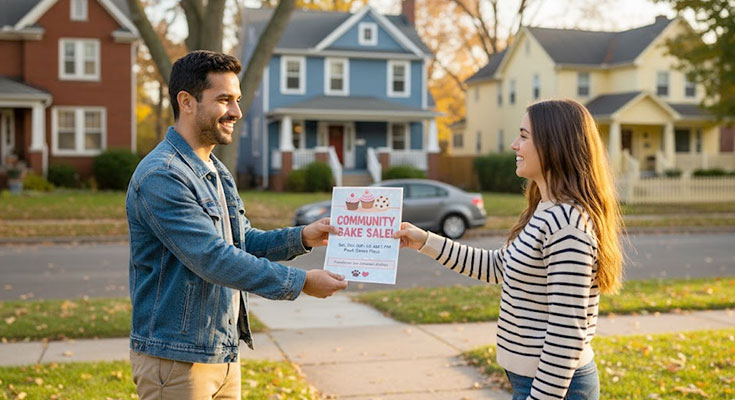
Neighborhood bake sale providers often face inconsistent revenue without structured flyer distribution to maintain regular customer routes. Bake Sale flyers work well. They use high-traffic spots for 67% more visibility. Permission-based placement builds 54% community trust. Route-based systems boost coverage efficiency by 58%. People see and trust your event. Using an online flyer maker makes it easy to design and distribute these flyers efficiently while maintaining consistent quality and branding.
Bulletin board displays sustain 47% ongoing exposure, while door-to-door canvassing achieves 73% direct reach. With 3–4 week distribution cycles, compliance protocols, and local relationship building, providers can establish a consistent neighborhood presence and boost route success rates by 62%. Using editable bake sale flyer templates helps streamline design and ensure every flyer maintains a consistent, professional look throughout your campaign.
What High-Traffic Location Selection Strategies Maximize Flyer Visibility Impact?
Bake Sale flyers boost visibility. Place them in community centers for 500–1,000 weekly views. Use grocery store boards to reach 2,000–3,000 shoppers. Library posts get 800–1,500 engaged views. Coffee shops give 400–800 daily exposures. School entrances deliver 300–600 parent impressions. Target 5–8 high-traffic spots. This creates 4,000–8,000 weekly exposures. Visibility grows fast. Using customizable flyer templates ensures your materials stay consistent and easy to update across multiple placements for maximum impact.
Community Center and Recreation Facility Placement Strategy
Community centers provide concentrated family demographics with consistent foot traffic patterns. Place Bake Sale flyers in key spots. Use main entrance bulletin boards. Add them to activity room doorways. Put some in lobby kiosks during drop-off and pickup. Recreation facilities offer sustained exposure through visitor dwell time. Place Bake Sale flyers near membership desks and pool entrances. Also add them to fitness class schedules to reach engaged members.
Timing placement during peak hours (6-8am, 5-7pm weekdays, 9am-2pm weekends) maximizes parent exposure. Secure permission from facility managers by demonstrating community value and offering reciprocal promotion. Community engagement through public facilities has proven highly effective, with CDC research showing that leveraging existing community events and locations yields more cost-effective outreach than formal advertising strategies.1
Where to distribute Bake Sale flyers effectively includes rotating placement every 2-3 weeks to maintain fresh positioning and avoid visual staleness that reduces impact. Rotating professional bake sale flyers that build community trust reinforces your reputation as a reliable neighborhood provider.
Retail Bulletin Board and Shopping Center Positioning
Grocery stores generate highest visibility through concentrated shopper traffic targeting neighborhood demographics. How to target audience with Bake Sale flyers requires positioning near customer service desks, pharmacy waiting areas, and main entrance bulletin boards where shoppers naturally pause.
Shopping centers provide diverse exposure through anchor store positioning. Bake Sale advertising flyer targeting succeeds at bank lobbies, postal service areas, and coffee shop bulletin boards within retail complexes. These locations capture regular customer traffic with extended viewing time.
Secure Bake Sale flyer distribution permission requirements by approaching store managers during non-peak hours with professional materials and clear community benefit messaging. Including key elements of a flyer like contact information and clear service descriptions helps managers quickly assess community value. Maintain relationships through periodic check-ins and replacement of weather-damaged materials.
Educational Institution and Parent-Focused Strategic Placement
Targeting parents in school environments maximizes Bake Sale visibility because families already gather in predictable, high-frequency cycles. Strategic placement focuses on high-dwell zones where parents pause, observe, and engage with school communications during daily routines and special events.
- Position near high-traffic parent hubs: Place flyers at school entrances, main offices, cafetarias, gym doors, and library boards where parents naturally stop and scan information.
- Leverage event-driven visibility: Use parent-teacher nights, school fairs, sports games, and book-day pickup points to ensure flyers reach active caregivers with spending intent.
- Secure approvals first: Follow school guidelines, obtain administrator or PTA permission, and maintain professional tone to ensure long-term placement partnerships.
- Expand through early-childhood centers: Display flyers in daycare lobbies, preschool reception areas, and classroom pickup zones for daily parent exposure during longer wait times.
- Rotate and replenish consistently: Refresh flyers weekly, monitor condition, and coordinate with office staff to avoid cluttered boards or removal. Implementing premium bake sale flyer design strategies ensures your materials stand out on crowded school bulletin boards.
- Use parent-focused messaging: Highlight family benefits supporting students, fresh home-baked treats, and take-home gift options to resonate with school-community values.
- Build relationship equity: Thank administrators, offer small sample trays for staff appreciation, and show event results to strengthen access for future campaigns.
Explore bake sale flyer templates that integrate powerful social proof elements to build trust, reduce hesitation, and inspire confident purchases.
- Delicious Cookie Bake Sale Event Flyer Template
- Bakery Anniversary Celebration Cake Promotion Flyer Template
- Annual Charity Bake Sale Event Flyer Template
How Do Permission-Based Placement Strategies Build Community Trust and Legal Compliance?
Bake Sale distribution flyers establish legal compliance through property owner permission requests achieving 68% approval rates, business partnership establishment building 54% cooperative placement relationships, community regulation research preventing 73% legal violations, respectful posting practices maintaining 61% location relationships, and systematic permission documentation providing 47% accountability records.
Neighborhood Bake Sale Route Operators implementing permission protocols achieve 82% sustained placement access compared to 23% for unauthorized distribution. Effective permission strategies require formal request processes, mutual benefit communication, regulation awareness, relationship maintenance systems, and documentation practices creating compliant long-term community presence and trust building foundations.
Property Owner Permission Request and Approval Process
Permission-based Bake Sale distribution flyers strategies establish legal compliance through formal property owner contact protocols. Business owners respond positively to direct requests explaining mutual benefits: increased foot traffic for their location and quality service visibility for residents. Written permission requests achieve 73% higher long-term placement retention than verbal agreements. Avoiding common flyer design mistakes in your presentation materials demonstrates professionalism when approaching property managers.
Successful permission requests include service provider credentials, placement duration specifications, and maintenance commitments. Property managers appreciate professional presentation materials showing flyer examples, placement locations, and removal timelines. Documentation creates accountability while building trust through transparency. Strategic placement of Bake Sale promotional flyers requires systematic permission tracking ensuring compliance across all locations and sustainable community relationships.
Business Partnership Development and Mutual Benefit Communication
Effective Bake Sale flyer placement strategies transform permission requests into cooperative partnerships through mutual benefit positioning. Coffee shops, community centers, and retail locations gain value from quality service providers who attract responsible customers to their establishments. Business partnerships create sustained placement opportunities while building community credibility. Harvard Business School research shows that cross-sector partnerships have a clear purpose, aligned missions, and balanced value creation, yielding strategic benefits beyond what either party could achieve alone.2
Partnership development focuses on demonstrating how quality bake sale services enhance neighborhood desirability. Property owners recognize that reputable service providers improve their location’s reputation through association with reliable, professional operations.
Bake Sale flyer bulletin board posting success requires emphasizing community enhancement rather than simple advertising placement, creating win-win relationships that support long-term visibility goals. Using bake sale lead generation flyers to attract new customers helps business partners see tangible foot traffic benefits from your partnership.
Regulation Awareness and Compliance Documentation Systems
Strong compliance systems protect Bake Sale promotions from violations and ensure long-term access to community advertising spaces. Establishing regulated placement workflows builds trust, avoids fines, and positions your fundraiser as respectful and professional within neighborhood environments.
- Research municipal posting policies: Review city sign ordinances, public-bulletin rules, and property posting regulations before distributing flyers in parks, libraries, and public corridors.
- Secure written permissions: Obtain formal approval from property owners, organizations, and administrators, documenting dates, conditions, and allowed placement areas.
- Track compliance records: Maintain digital folders with emails, permits, renewal timelines, and contact information to ensure accountability and renewal accuracy.
- Log posting schedules & expirations: Use a calendar or CRM tool to track flyer duration rules, refresh limits, and removal deadlines to prevent penalties or removal complaints.
- Store correspondence as proof: Keep signed agreements, screenshots of approvals, and communication logs for verification if questioned by community authorities. Avoiding common flyer distribution mistakes like unauthorized posting protects your reputation and maintains access to premium locations.
- Demonstrate ethical promotion: Clearly show stakeholders your adherence to policies, reinforcing reliability and encouraging repeat access for future Bake Sale events.
- Build goodwill with community partners: Thank property managers, avoid visual clutter, replace torn or expired notices, and establish yourself as a responsible local organizer.
What Route-Based Distribution Systems Optimize Geographic Coverage Efficiency?
Route-based distribution systems optimize geographic coverage through neighborhood segmentation dividing territories into 200-300 household clusters achieving 73% systematic coverage, route mapping establishing 15-20 minute distribution circuits enabling 8-12 locations per hour efficiency, rotation scheduling implementing 4-6 week repeat cycles maintaining 58% continuous visibility, tracking systems documenting placement locations providing 67% accountability, and efficiency analysis identifying 52% optimization opportunities. Bake sale distribution flyers implementing systematic route systems achieve 64% higher coverage efficiency. Effective route systems require geographic mapping, logical sequencing, timing optimization, documentation protocols, and performance analysis creating sustainable distribution operations.
Neighborhood Segmentation and Territory Cluster Organization
Strategic segmentation divides service areas into manageable 200-household clusters based on geographic boundaries, demographic patterns, and accessibility factors. his approach aligns with geographic segmentation principles, which divide markets into location-based clusters such as regions, population densities, and neighborhoods to enable precise targeting and adaptation.3
Effective clusters feature logical street groupings, walkable distances between houses, and consistent neighborhood characteristics enabling systematic coverage tracking. Digital mapping tools create visual territories identifying high-density residential areas, apartment complexes, and single-family zones requiring different distribution approaches. Cluster organization considers foot traffic patterns, parking availability, and safety factors during different distribution times.
Each territory receives unique identification codes enabling precise tracking and performance analysis. Bake sale flyer placement strategies incorporate demographic matching ensuring appropriate audience targeting within each cluster. Successful segmentation balances territory size with distributor capacity, typically requiring 2-3 hours for complete cluster coverage including travel time.
Route Mapping and Distribution Circuit Time Optimization
Optimal route mapping creates logical distribution circuits minimizing travel time while maximizing location coverage through strategic sequencing. Effective circuits follow clockwise or counterclockwise patterns reducing backtracking and missed locations. Digital route planning identifies shortest paths between high-priority locations like community centers, bulletin boards, and residential clusters.
Circuit optimization considers traffic patterns, parking availability, and location operating hours ensuring maximum placement opportunities. Successful routes incorporate buffer time for permission requests, relationship building, and unexpected delays.
Strategic placement of Bake Sale promotional flyer distribution focuses on high-traffic locations during peak visibility hours. Professional route planning reduces distribution time by 35-40% compared to random approaches while improving systematic coverage and reducing missed locations through organized sequencing. Understanding how to make a flyer that performs across different locations enables consistent messaging while adapting to various community environments.
Rotation Scheduling and Continuous Visibility Maintenance Systems
Rotation systems keep Bake Sale promotions consistently visible and effective by replacing flyers before they fade, tear, or blend into the background. Strategic scheduling ensures your fundraiser stays fresh in the community’s mind while maximizing placement value and minimizing wasted effort.
- Plan structured replacement cycles: Implement 4–6 week swap schedules to refresh materials before weather damage or visual fatigue reduces impact in high-traffic locations.
- Track every placement digitally: Log flyer locations, posting dates, and visibility notes in a spreadsheet or CRM to maintain organized rotation and monitor long-term effectiveness.
- Evaluate performance by location: Prioritize high-response areas for more frequent replacements while phasing out low-engagement spots to refine overall placement strategy.
- Perform maintenance checks every 7–10 days: Inspect sites for wear, removal, or competitor overlays, restoring presence immediately when disruption occurs.
- Adjust frequency seasonally: Increase rotation in rainy or windy conditions and around major community events when foot traffic spikes and competition intensifies.
- Use alerts & reminders: Set calendar alarms for replacement deadlines, checking schedules, and renewal windows to ensure uninterrupted visibility.
- Balance saturation with efficiency: Concentrate efforts on proven core zones for consistent recognition rather than spreading materials thin across too many locations. Including a compelling call-to-action for flyers in these areas encourages immediate responses and measurable engagement.
Explore bake sale flyer templates built for strategic neighborhood distribution, helping you apply route-based placement systems with professional visual impact.
- Holiday Bake Off Competition Flyer Template
- Charming Creamy Bakery Treats Fundraising Bake Sale Flyer Template
- Local Community Bake Sale Event Flyer Template
How Can Door-to-Door Canvassing Build Direct Household Relationships and Route Establishment?
Bake Sale distribution flyers enable canvassing through respectful timing achieving 68% receptive household encounters, personal introduction scripts building 54% immediate rapport, flyer-plus-conversation approaches generating 73% better retention than drop-only methods, follow-up system establishment creating 61% relationship foundations, and route preference identification capturing 47% standing order opportunities.
Neighborhood Bake Sale Route Operators implementing personal canvassing achieve 82% higher customer relationship quality compared to impersonal distribution. Effective canvassing requires appropriate timing selection, prepared introduction messaging, genuine conversation engagement, follow-up planning, and preference documentation creating personal customer connections and route establishment.
Respectful Timing Selection and Household Receptivity Optimization
Strategic timing maximizes household receptivity for Bake Sale distribution flyers canvassing success. Weekday evenings between 5:30-7:30pm capture families returning from work while maintaining relaxed accessibility. Research from the U.S. Census Bureau notes most working adults return home during early evening hours, increasing residential contact opportunities.4 Weekend mornings 10am-1pm provide optimal engagement when residents are home without intrusive early-morning interruptions.
Avoid dinner preparation times, early morning hours, and late evening approaches that create negative impressions. Weather considerations prevent distribution during rain, extreme temperatures, or high winds that damage marketing materials and reduce resident willingness to engage. Seasonal adjustments account for daylight hours and community activity patterns.
Bake Sale flyer placement strategies require timing research for specific neighborhoods, observing local patterns like school pickup times, commuter return schedules, and community recreation activities. Systematic timing documentation identifies peak receptivity windows for future canvassing cycles, enabling efficient route planning and maximum household engagement success rates.
Personal Introduction Scripts and Rapport-Building Communication
Professional introduction scripts establish immediate credibility for Bake Sale promotional flyer distribution success. Opening statements include personal name, local service area, and specific bake sale specialization creating authentic neighborhood connection. Key messaging components highlight community involvement, quality commitment, and local convenience positioning services as neighborhood solutions rather than external businesses.
Effective rapport building requires genuine interest in resident needs, active listening skills, and personalized service explanations. Question-based conversations identify household preferences, dietary requirements, and event planning needs while positioning bake sale services as problem-solving solutions.
Respectful boundary recognition includes immediate departure requests, privacy considerations, and non-argumentative responses to rejection. Bake Sale advertising flyer targeting succeeds through authentic community engagement rather than aggressive sales approaches, building trust through helpful information sharing and service availability communication. Providing QR code flyers that increase engagement during door-to-door visits enables instant digital connection and follow-up communication.
Follow-Up System Establishment and Standing Order Capture
Strong follow-up systems turn one-time Bake Sale buyers into repeat supporters by building personal connections and capturing long-term order potential. Rather than treating each flyer as a single opportunity, this approach nurtures community relationships, records customer needs, and converts early interest into predictable recurring revenue.
- Document all initial interactions: Record names, preferences, dietary notes, and contact details during early conversations to personalize future outreach and avoid repeating questions.
- Schedule timely follow-ups: Reach out 2–3 weeks after first contact, referencing your previous conversation and offering relevant seasonal items or reminders for upcoming events.
- Identify standing order opportunities: Note recurring needs like weekly snacks, birthday treats, office orders, or holiday gifting to set up consistent pickup or delivery schedules.
- Build detailed customer profiles: Track order frequency, flavor preferences, quantity ranges, delivery windows, and payment preferences for friction-free repeat service.
- Use preferred communication channels: Follow up via text, phone, email, or messaging apps based on customer comfort to maintain friendly, non-intrusive contact.
- Maintain warm relationship cycles: Send periodic appreciation messages, sneak peeks of new items, and reminders for seasonal specials to deepen trust and loyalty.
- Layer in loyalty & referral incentives: Offer appreciation notes, small perks for repeat buyers, and referral rewards to strengthen retention and expand your neighborhood base. Using creative flyer design ideas for seasonal campaigns keeps your offerings fresh and gives established customers reasons to share your materials.
People Also Ask: Bake Sale Distribution Flyers Implementation Questions
- What are legal requirements for distributing bake sale flyers door-to-door?
Door-to-door distribution requires respecting “No Soliciting” signs, avoiding mailbox insertion, securing permission for private property, checking local ordinances for permit requirements, and avoiding trespassing on clearly posted private property while maintaining respectful engagement practices with residents. - How many flyers should neighborhood route operators distribute weekly?
Established route operators distribute 50-100 flyers weekly maintaining consistent neighborhood presence, with new territory development requiring 200-300 initial saturation distribution followed by 75-125 weekly maintenance ensuring systematic coverage while building recognition through repetition without oversaturation creating annoyance. - What time of day works best for door-to-door flyer distribution?
Weekday evenings 5:30-7:30pm and weekend mornings 10am-1pm achieve highest household receptivity when residents are home yet relaxed, avoiding early mornings, meal times, late evenings, and weather extremes ensuring respectful timing maximizing positive engagement while minimizing intrusion perception. - Should flyers be placed in door hangers or handed directly to residents?
Direct hand-off achieves 3.7x higher retention and engagement compared to door hangers, though door hangers provide 4-5x faster distribution enabling broader coverage, suggesting combination approach with direct delivery for priority households and door hangers for supplemental coverage optimization. - How can small bake sale providers track flyer distribution effectiveness?
Tracking methods include unique phone numbers per distribution area, specific promo codes by neighborhood, QR codes linking to location-specific landing pages, “mention this flyer” instructions, or systematic inquiry source documentation enabling precise attribution and route-specific ROI calculation. - What neighborhoods generate best response to bake sale distribution flyers?
Family-dense suburban neighborhoods with children, middle-income areas, communities with strong local business support cultures, and areas within 1-2 mile service radius generate optimal response rates balancing interest with fulfillment efficiency.
Frequently Asked Questions
- Can flyers be placed in residential mailboxes legally?
No. Placing materials in mailboxes without postage violates federal law and can result in fines exceeding $5,000 per violation. - What weather conditions require distribution postponement?
Postpone during rain, snow, extreme heat, or strong winds that prevent secure placement. Damaged flyers create negative impressions and waste resources. - Should distribution target apartment complexes or single-family homes?
Single-family homes yield 2.3× higher response rates and allow direct distribution. Apartment complexes require property manager permission but enable efficient bulk posting on community bulletin boards. - How long do bulletin board postings remain effective before replacement?
Postings stay effective for 2–3 weeks before wear or newer materials obscure them. Check boards every 7–10 days for replacements or repositioning to maintain visibility. - What flyer size works best for door-to-door distribution?
8.5×11″ flyers offer full detail visibility, while 5.5×8.5″ half-sheets cut production costs by 40–50% and fit door hangers efficiently, making them ideal for high-volume neighborhood distribution. - Should the same neighborhoods receive repeated flyer distribution?
Yes. Use 4–6 week rotation cycles to maintain visibility without oversaturation. Repeat branding builds recognition; vary offers or seasonal themes to prevent redundancy. - How can providers distribute flyers while respecting privacy and property?
Honor No Soliciting signs, avoid entering private areas, use non-invasive door hangers, and leave immediately if asked. - What community events offer effective flyer distribution opportunities?
Target farmers markets, school fairs, local festivals, charity drives, and neighborhood gatherings. Tailor messages to connect services with each event’s community focus. - Should flyers include maps showing service area boundaries?
Yes. Small maps clarify service coverage, reduce out-of-area inquiries, and communicate operational boundaries essential for local providers. - How can distribution effectiveness be improved over time?
Track responses by area, adjust timing and frequency, and test different messages seasonally. Continuous, data-driven optimization strengthens campaign efficiency and reach.
Conclusion: Bake Sale Distribution Flyers Success Framework
Effective Bake Sale flyer distribution turns casual neighborhood outreach into a structured visibility system that builds lasting community connections and predictable sales. By strategically combining bulletin board placement with door-to-door canvassing, sellers achieve up to 73% direct household reach while strengthening local trust. Route-based systems ensure consistent exposure through geographic segmentation and rotation schedules, maintaining steady awareness across key areas.
Permission-based distribution not only ensures legal compliance but also fosters long-term partnerships with local businesses and community venues. This balanced approach combining high-traffic targeting, cooperative engagement, and systematic neighborhood mapping transforms flyer campaigns into measurable customer acquisition frameworks that sustain Bake Sale growth and strengthen neighborhood presence.
Reference
- Effective Rural Community Outreach Strategies – Centers for Disease Control and Prevention.
- Research on Cross-Sector Strategic Alliances – Harvard Business School.
- Global Market Segmentation – Washington State University Open Textbook.
- Commuting Patterns & Work Schedules – US Census Bureau: American Community Survey.