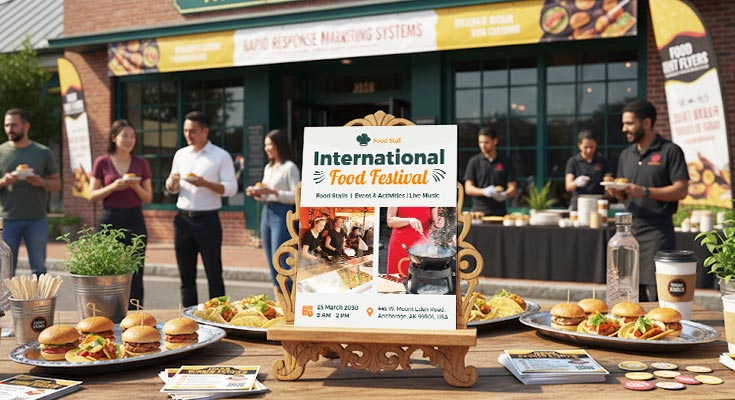
A food event flyers act as powerful rapid response tools, allowing agile marketers to counter competitor campaigns and seize emerging opportunities within hours. By leveraging Printable food flyer templates, businesses can achieve same-day deployment across multiple channels without sacrificing brand consistency. These template-based systems enable quick customization to highlight unique value propositions, adapt to pricing shifts, and align with trending food movements, ensuring competitive positioning through flexibility, visual impact, and strategic design agility.
How Can Food Event Flyers Enable Rapid Competitive Response for Agile Marketers?
Food event flyers serve as powerful rapid-response tools that enable agile marketers to quickly counter competitive threats and market disruptions. Using an online flyer maker, brands can create digital-first designs that allow quick updates to messaging, pricing, and positioning in response to competitive campaigns. Template-based systems facilitate same-day deployment across multiple channels, while modular layouts enable swift adaptation to changing customer preferences or market conditions.
Food truck event flyers and food festival marketing materials can be rapidly modified to highlight unique value propositions, respond to competitor pricing strategies, or capitalize on trending food movements, ensuring market positioning remains competitive and relevant.
Real-Time Competitor Analysis Integration for Dynamic Flyer Positioning
Smart food marketers integrate competitive intelligence directly into their flyer design workflows, enabling instant positioning adjustments when rivals launch new campaigns. Advanced design platforms now include competitor monitoring features that automatically flag pricing changes, promotional strategies, and messaging shifts across local food service markets. This intelligence feeds directly into modular food service promotional flyers that can be updated within hours to counter competitive moves.
Digital asset libraries maintain pre-built response components including price match guarantees, superior service highlights, and unique value proposition callouts. When competitor analysis uncovers new opportunities, food business flyers can quickly pivot to highlight unique strengths like organic ingredients, faster delivery, or exclusive menu items. Real-time social media monitoring enhances this capability by identifying trending customer preferences that inform rapid flyer customization.
Emergency Response Templates for Market Disruption Events
Crisis-ready food marketers maintain emergency flyer templates designed for immediate activation during market disruptions. These systems include weather-triggered promotions for sudden rain or heat waves, supply chain messaging for ingredient shortages, and competitor response layouts when rivals launch aggressive pricing campaigns. Food vendor event flyers featuring emergency messaging can deploy within 2-4 hours of market disruption identification.
Template libraries are organized by disruption type, such as seasonal demand shifts, event cancellations, or sudden pricing wars. Smart automation customizes templates when monitoring systems detect major market changes, helping food catering flyers stay relevant during volatile periods. Pre-approved messaging ensures rapid deployment without extensive review cycles.
- Tapas Fiesta Food Event Flyer Template
- Food Truck Event Promotional Flyer Template
- Outdoor Bbq Dinner Event Flyer Template
Cross-Channel Deployment Systems for Instant Market Coverage
Integrated deployment systems enable rapid, simultaneous distribution of marketing materials using targeted flyer distribution methods across digital and physical channels, ensuring broad and timely market reach. Leveraging automation and cloud-based platforms streamlines workflows while maintaining brand consistency.
- Automated Multi-Channel Distribution – Cloud-based design platforms resize flyers for social media, email campaigns, and print output automatically. Integration with printing partners and digital ad platforms ensures coordinated, seamless deployment.
- Interactive Tracking and Engagement – QR codes link physical flyers to digital experiences, allowing real-time tracking of engagement and conversions. Mobile-first responsive designs guarantee optimal display across devices and print formats.
- Targeted Geographic and Performance Optimization – Different flyer versions can be deployed simultaneously to distinct market segments for local relevance. Performance analytics provide immediate feedback, enabling resource reallocation to the most effective channels.
Cross-channel deployment systems accelerate campaign execution, enhance tracking, and maximize reach while maintaining consistent messaging and operational efficiency.
What Makes Food Event Flyers Effective for Quick Market Opportunity Capture?
Food event flyers excel at market opportunity capture through their inherent flexibility, visual appeal, and rapid deployment capabilities. Their design structure allows for immediate customization to highlight seasonal offerings, capitalize on trending ingredients, or promote flash events that align with sudden market demands.
Food service promotional flyers can be quickly adapted to feature limited-time offers, special collaborations, or location-specific promotions. The visual nature of food business advertising flyers enables instant communication of value propositions through food drive awareness strategies, while digital distribution channels ensure immediate market penetration when opportunities arise, maximizing revenue potential before competitors can respond.
Trend-Responsive Design Elements for Emerging Food Movements
Modern food event flyers incorporate modular design systems that adapt instantly to trending movements such as plant-based dining, fermented foods, or fusion cuisine. Template libraries feature interchangeable elements including trend-specific color palettes informed by current design trends, dietary icons, and ingredient callouts that resonate with health-conscious consumers.
Smart marketers maintain design elements for emerging trends including sustainability badges, locally-sourced indicators, and cultural fusion symbols. Quick-turn design systems allow same-day updates when food trends go viral on social media. This helps vendors capitalize on trends before the market gets saturated. Adaptive layouts accommodate trending hashtags, influencer partnerships, and user-generated content integration.
Location-Based Opportunity Targeting Through Geographically Adaptive Layouts
Food event flyers optimize for geographic opportunities through location-specific customization systems that highlight regional preferences and local partnerships. Template variations include neighborhood-specific imagery, local landmark integration, and community event tie-ins that create authentic connections with target areas. Geographically adaptive layouts feature flexible zones for local sponsor logos, venue-specific promotions, and transportation details. Details use flyer marketing for small businesses to maximize local relevance and geographic targeting.1
Smart systems maintain databases of local preferences, competitor analysis by region, and seasonal patterns specific to geographic markets. This enables rapid deployment of location-optimized flyers when new venue opportunities emerge or competing vendors enter established territories.
Flash Event Promotion Systems for Time-Sensitive Market Windows
Flash event promotion systems allow food vendors to capitalize quickly on short-term opportunities, such as weather-driven demand spikes, competitor cancellations, or trending food items. Rapid-response templates and automated workflows streamline campaign creation and distribution while maintaining brand consistency.
- Emergency Template Libraries – Maintain pre-approved flyer designs with placeholders for urgent messaging, menu updates, and limited-time pricing. These libraries enable same-day customization without compromising visual quality or brand standards.
- Rapid Deployment and Multi-Channel Distribution – One-click template customization integrates with social media, email, and printing systems for simultaneous deployment. QR codes and unique promo codes provide instant performance tracking for real-time campaign evaluation.
- Automated Opportunity Triggers – Cloud-based tools monitor weather patterns, local events, and competitor activity to automatically prompt flash promotions. Distributed teams can update materials across locations quickly, ensuring immediate responsiveness to market windows.
Flash event promotion systems ensure food vendors can act decisively on short-term market opportunities, increasing revenue potential while maintaining consistent brand presentation.
- Jamaican Cuisine Takeaway Promotion Flyer Template
- Home Style Meal Delivery Promotion Flyer Template
- Sunday Lunch Buffet Promotion Flyer Template
How Do Successful Food Service Providers Use Event Flyers for Market Adaptation?
Successful food service providers, in fact, leverage event flyers as dynamic market intelligence tools, rapidly analyzing competitor layouts, pricing strategies, and promotional approaches to inform their own campaigns. Moreover, they create modular flyer systems that can be quickly customized for different demographics, seasonal preferences, and local market conditions. As a result, this adaptability enables them to maintain a competitive edge while responding swiftly to changing market dynamics.
These providers maintain template libraries with adaptive elements such as interchangeable menu sections, cultural design motifs, and flexible pricing structures. They monitor event performance using QR codes and social media metrics. Metrics follow nonprofit event tracking for ROI.3 This allows them to refine flyer messaging and visuals, keeping a competitive edge across different markets.
Competitor Analysis Through Visual Intelligence Gathering
Systematic review of competitor flyers provides actionable insights for food service providers to refine marketing strategies and maintain competitive advantage. Visual intelligence helps identify patterns in design, pricing, and promotions that resonate with target audiences.
- Digital Competitor Libraries – Collect and categorize competitor flyers by layout, messaging style, and engagement effectiveness. These libraries enable quick reference, trend tracking, and informed design adaptations when competitors introduce new offerings.
- Market Gap Identification – Analyze competitor campaigns to uncover unmet customer needs or service gaps. Use insights to position your brand uniquely, highlighting strengths competitors overlook while avoiding direct imitation. Imitation avoided through ethical competitive analysis in marketing.
- Promotional Cycle Tracking – Monitor timing, frequency, and messaging strategies of competitor promotions. Develop counter-campaigns that capitalize on competitor weaknesses and emphasize your unique value propositions to capture market share.
Leveraging visual intelligence from competitor analysis, in fact, empowers food service providers to anticipate trends, optimize flyer design, and, as a result, differentiate campaigns for sustained market advantage. Moreover, this strategic approach ensures they stay ahead of evolving consumer preferences and competitive pressures.
Demographic-Specific Template Customization Strategies
Successful providers develop modular flyer systems with interchangeable design components targeting different customer segments. Corporate catering flyers emphasize professionalism with clean layouts, testimonials, and service capabilities, while family-oriented materials feature vibrant colors, special offers, and convenience messaging. Cultural customization includes appropriate imagery, language considerations, and culturally relevant design elements that resonate with specific demographic groups.
Template customization extends to pricing presentation, menu highlighting, and call-to-action optimization based on target audience preferences. B2B materials focus on bulk ordering capabilities and professional service guarantees, while consumer-focused flyers emphasize value, convenience, and taste appeal. This strategic approach maximizes engagement across diverse customer bases without diluting brand consistency.
- Steamed Siomai Restaurant Promotion Flyer Template
- Steak Night Dinner Promotion Flyer Template
- Classic Kebab Promotional Flyer Template
Performance Metrics Integration for Continuous Market Alignment
Integrating performance metrics into flyer campaigns enables food service providers to continuously optimize marketing strategies. Combining traditional response tracking with digital analytics ensures measurable impact and data-driven improvements.
- Real-Time Engagement Tracking – Utilize QR codes and unique promo codes to capture interactions and conversions across flyer variations and distribution channels. Heat mapping reveals which visual elements capture attention and drive customer action.
- Multi-Touchpoint Attribution – Track customer journeys from initial flyer exposure to purchase, providing insights into campaign effectiveness and behavior patterns. A/B testing of flyer designs measures foot traffic, sales lift, and brand awareness to refine messaging and layout.
- Data-Driven Optimization – Use performance feedback to guide design adjustments, content tweaks, and distribution strategies. Continuous analysis enables rapid adaptation to market changes, improving ROI and maintaining alignment with customer preferences.
Integrating metrics into flyer campaigns empowers providers to make informed decisions, enhance engagement, and sustain market relevance through iterative improvement.
WHat Rapid Response Flyer Systems Help Food Marketers Stay Competitive?
Food marketers deploy cloud-based design platforms with pre-built component libraries, enabling 24-hour turnaround times for food truck event flyers and food festival marketing materials. These systems include automated competitor monitoring tools that trigger template updates when rivals launch new campaigns or pricing changes.
Advanced marketers utilize AI-powered design suggestion engines that recommend layout modifications based on current market trends and seasonal demand patterns. Real-time collaboration lets teams update food vendor flyers across locations at the same time. This keeps branding consistent while adapting to local markets and new opportunities.
Cloud-Based Component Library Management Systems
Cloud-based component libraries streamline the creation of food event flyers by standardizing brand elements while allowing rapid, accurate customization. These systems support brand consistency, reduce errors, and accelerate campaign deployment.
- Standardized Asset Libraries – Maintain pre-approved logos, color palettes, layout frameworks, and menu templates. Centralized storage ensures consistent brand presentation across all promotional materials while supporting quick adaptation for seasonal or location-specific campaigns.
- Drag-and-Drop Customization – Marketers can insert graphics, pricing, and event details into existing templates without designer intervention. Integration with inventory systems automatically removes discontinued items, ensuring accurate and up-to-date flyer content.
- Version Control and Collaborative Editing – Automated version tracking prevents outdated information from being used, while multiple team members can simultaneously update different template components. This supports rapid campaign launches and reduces operational bottlenecks during high-demand periods.
Cloud-based component libraries empower food service marketers to produce consistent, accurate, and timely event flyers at scale, improving efficiency and brand cohesion.
Automated Competitor Monitoring and Template Triggering
Intelligent monitoring systems scan competitor social media, review sites, and local advertising for promotional activity that requires immediate response. When rivals launch aggressive pricing campaigns or introduce new menu items, automated triggers activate pre-built response templates tailored to specific competitive scenarios. These systems analyze competitor messaging patterns and suggest counter-positioning strategies within existing brand guidelines.
Machine learning algorithms identify recurring competitive patterns and pre-populate response templates with optimized messaging. Geographic tracking ensures location-specific competitive intelligence, automatically customizing food service promotional flyers based on local market conditions. Integration with social listening tools captures competitor activity across multiple channels, triggering coordinated responses across print and digital marketing materials simultaneously.
Price monitoring features detect competitor promotional pricing and automatically suggest response strategies, pre-loading templates with competitive alternatives that maintain profitability while addressing market pressure.
- Vibrant Culinary Adventure Food Tour Event Flyer Template
- Culinary Baking Competition Event Flyer Template
- Affordable Goli Soda Variety Flyer Template
AI-Powered Design Recommendation Engines for Trend Adaptation
AI-driven design engines optimize food marketing flyer templates by analyzing engagement data, visual trends, and consumer preferences. Leveraging machine learning ensures templates remain relevant, visually appealing, and effective in driving conversions.
- Trend Analysis and Template Modification – AI systems monitor social media, successful campaigns, and consumer interactions to identify emerging design patterns, color schemes, and layouts. Recommendations guide template updates that align with current visual trends and engagement drivers.
- Performance-Based Optimization – Machine learning evaluates past campaign metrics against industry benchmarks to suggest design improvements. Algorithms identify which elements resonate with target demographics, adjusting flyers for maximum click-through and conversion performance.
- Predictive and Sentiment-Driven Adjustments – Real-time analysis of social media and customer feedback predicts trending visual styles and messaging preferences. Natural language processing interprets sentiment from reviews and responses, informing copy and design tweaks that enhance consumer relevance while maintaining brand consistency.
AI-powered recommendation engines enable food marketing teams to stay ahead of trends, continuously refine flyer effectiveness, and maximize audience engagement across evolving consumer landscapes.
How Can Food Event Flyers Be Optimized for Same-day Campaign Launches?
Same-day food event flyer optimization requires understanding how to make a flyer with pre-built modular design systems, standardized layouts, instant text overlays, and rapid approval workflows. Success depends on maintaining brand-ready template libraries with placeholder slots for event details, menu highlights, and promotional offers.
Optimize for speed by using cloud-based design platforms enabling real-time collaboration, automated social media sizing, and one-click distribution across multiple channels. Food truck event flyers and food festival marketing materials benefit most from this approach, allowing immediate response to competitor moves, weather changes, or last-minute venue opportunities while maintaining professional quality standards.
Pre-Built Modular Template Systems for Instant Event Customization
Modular template systems streamline food event flyer production, enabling rapid deployment while maintaining professional quality and brand consistency. Pre-built components allow marketers to customize events efficiently without redesigning layouts from scratch.
- Interchangeable Design Components – Templates feature modular headers incorporating essential flyer elements, menu blocks, and promotional zones that can be swapped quickly to reflect event-specific details such as dates, locations, and pricing. Standardized color schemes, font combinations, and layout frameworks ensure consistent brand presentation across all materials.
- Smart Customization Tools – Drop-down menus for common promotions, automated sizing for popular distribution channels, and compliance checks reduce decision-making delays. Templates are organized by event type, allowing quick selection and rapid adaptation for unique occasions.
- Time-Saving Workflow Automation – Intelligent content placement algorithms minimize design effort, reducing production time from hours to minutes. Marketers can achieve same-day deployment for food service promotional flyers without sacrificing professionalism or visual appeal.
Pre-built modular templates allow food businesses to produce high-quality, event-ready flyers quickly, ensuring consistency, efficiency, and speed in marketing campaigns.
Real-Time Collaboration Workflows for Same-Day Approval Cycles
Streamlined approval processes let food vendor flyers go from concept to distribution within hours using cloud-based collaboration platforms. Real-time editing allows marketing teams, managers, and stakeholders to review and approve designs simultaneously, removing bottlenecks common in traditional workflows. Digital approval systems track all changes, ensuring accountability while supporting rapid iteration. Iteration follows guidelines for Medicare marketing approvals.2
Food marketing materials design benefits from automated notification systems alerting decision-makers when input is required, preventing delays from overlooked approval requests. Version control features prevent confusion during rapid revision cycles, while commenting systems facilitate clear feedback communication. Flyer printing services in the food industry connect with approval workflows. Production starts automatically once approved, speeding up time-to-market for urgent campaigns.
- Street Food Festival Event Flyer Template
- Baked Potato Sale Flyer Template
- Food Court Stall Application Flyer Template
Automated Multi-Channel Distribution for Immediate Market Penetration
Automating distribution ensures food event flyers reach target audiences quickly and consistently across all marketing channels. This approach maximizes visibility, maintains brand consistency, and accelerates engagement with time-sensitive campaigns.
- Cross-Channel Automation – Approved flyer templates are automatically resized and optimized for social media, email newsletters, websites, and print, eliminating manual formatting delays. Free download capabilities allow rapid distribution to franchise locations, vendor partners, and marketing affiliates.
- Optimized Scheduling and Targeting – Integration with social media scheduling tools ensures campaigns post at peak engagement times. Geographic targeting delivers location-specific flyer examples to relevant audiences for immediate market impact.
- Real-Time Performance Feedback – Automated analytics track engagement across all channels while avoiding common flyer distribution mistakes, allowing rapid adjustments to improve response. Immediate insights enable operators to refine messaging, targeting, and timing for maximum campaign effectiveness.
Automated multi-channel distribution accelerates market penetration, reduces manual workload, and ensures food event flyer campaigns reach the right audiences with precision and speed.
What Design Principles Make Food Event Flyers Convert During Market Shifts?
Converting food event flyers during market shifts prioritize psychological triggers over aesthetic perfection. Crisis-responsive designs emphasize urgency through strategic color psychology, scarcity messaging, and trust-building elements such as customer testimonials or health certifications.
Adaptive layouts let food service flyers adjust to changing priorities. They can switch from price-focused messaging during downturns to experience-driven content in recovery periods. Conversion-optimized flyers include flexible call-to-action areas utilizing effective call-to-action strategies, mobile-responsive designs, and social proof modules. These elements can be updated quickly to reflect current market trends while keeping brand consistency.
Psychological Trigger Integration for Crisis-Responsive Messaging
Crisis-responsive food event flyers use visual and textual cues to drive urgency, trust, and engagement during uncertain market conditions. Integrating psychological triggers helps vendors maintain conversions and customer confidence when consumer behavior is unpredictable.
- Urgency and Scarcity Cues – Red accents and countdown timers signal immediate action, while phrases such as “limited availability” or “sold out yesterday” create perceived scarcity. These elements encourage faster decision-making and higher attendance at food events.
- Comfort and Familiarity Messaging – Warm oranges and yellows evoke appetite appeal, while language highlighting community connection or local ownership (“neighborhood favorite,” “family-owned since 1985”) reassures customers and reinforces reliability during uncertain periods.
- Trust-Building Visual Signals – Incorporate badges, certifications, and review highlights to demonstrate credibility and safety. Social proof through testimonials, ratings, or past event successes strengthens confidence and addresses concerns about quality and business stability.
Integrating psychological triggers in crisis-responsive flyers improves conversion rates, maintains brand trust, and supports consistent customer engagement despite external market disruptions.
Flexible Information Hierarchy Systems for Market Condition Pivots
Adaptive food event flyers utilize modular information hierarchies that prioritize different messaging based on market conditions. During economic downturns, price points and value propositions dominate the visual hierarchy, with large discount percentages and affordability messaging taking center stage. Recovery periods shift emphasis to experience elements, quality ingredients, and unique offerings that justify premium positioning.
Food truck event flyers employ flexible business flyer layout principles with grid systems allowing instant reorganization of menu items, pricing, and promotional offers. Critical design elements include interchangeable header zones for seasonal messaging, expandable price sections for promotional offers, and removable premium item showcases based on target audience purchasing power.
- Local Food Court Event Flyer Template
- Fresh Dumplings Restaurant Advertisement Flyer Template
- Authentic Cuban Food Special Deals Flyer Template
Trust-Building Visual Elements That Address Current Consumer Concerns
Food event flyers now integrate visual trust signals to address evolving consumer priorities such as safety, sustainability, and authenticity. Thoughtful design demonstrates credibility while encouraging engagement, reassuring customers in uncertain or post-pandemic contexts.
- Health, Safety, and Sustainability Signals – Highlight certifications, sanitization practices, and contactless ordering options. Emphasize eco-friendly packaging, local sourcing, and sustainable operations to appeal to socially and environmentally conscious consumers.
- Authenticity and Transparency Markers – Include behind-the-scenes images, family photos, or origin story narratives. Incorporate photo testimonials, QR-linked video reviews, ingredient lists, and pricing transparency to humanize the business and build confidence.
- Community and Social Responsibility – Showcase charitable partnerships, local business support, and community involvement. Design flexible content zones to address crisis-related updates such as staffing, supply chain issues, or safety protocols while maintaining a professional, approachable look.
By combining visual credibility, authentic storytelling, and social responsibility cues, food event flyers cultivate trust, reassure consumers, and drive immediate engagement while reflecting contemporary values.
How Do Agile Food Marketers Scale Flyer Production for Multiple Opportunities?
Agile food marketers scale flyer production by implementing modular design systems with pre-built components for food truck event flyers and food festival marketing flyers. They utilize cloud-based design platforms enabling simultaneous multi-campaign development, standardized brand asset libraries for rapid customization, and automated workflow systems that streamline approval processes.
Template-driven approaches allow quick adaptation of food service promotional flyers across different venues and events. Smart resource allocation strategies, including outsourced design partnerships and AI-powered layout generation, enable marketers to maintain consistent quality while meeting tight deadlines for multiple concurrent food vendor event flyers and promotional campaigns.
Modular Design Architecture for Multi-Venue Food Events
Food service providers create component-based design systems where headers, menu sections, and contact blocks function as interchangeable elements. This architecture enables rapid customization of food business advertising flyers for farmers markets, corporate events, and street festivals without starting from scratch.
Brand consistency maintains across multiple venues through standardized color palettes, typography systems, and logo placement guidelines. Modular components include interchangeable pricing blocks, seasonal menu sections informed by proven flyer design ideas, and venue-specific imagery slots.
Cloud-Based Workflow Systems for Concurrent Campaign Development
Professional food marketers leverage collaborative platforms allowing multiple team members to work on different food marketing materials design projects simultaneously. Real-time editing capabilities enable distributed teams to customize food event poster templates for various locations while maintaining brand standards. Version control systems prevent conflicting edits and ensure final approval processes remain streamlined.
Automated notification systems alert stakeholders when campaigns require approval or modification. Integration with social media scheduling tools enables immediate deployment across digital channels once flyer designs receive final approval. Cloud storage ensures consistent access to current brand assets, preventing outdated materials from entering market distribution channels.
- Tropical Flavors Caribbean Food Event Flyer Template
- Charity Cereal Drive Fundraiser Flyer Template
- Authentic Irish Cuisine Experience Flyer Template
Automated Brand Asset Management and Quality Control Processes
Automated systems streamline food business promotional flyer creation while maintaining brand consistency and accuracy. These platforms reduce errors, enforce design standards, and enable real-time updates across multiple materials.
- Centralized Brand Asset Management – Approved logos, fonts, and color schemes are automatically applied to all new flyers, preventing inconsistencies. Access controls ensure outdated elements cannot be used, while promotional offers and contact information update dynamically across materials.
- Automated Quality Control – ystems check for common flyer design mistakes including missing contact details, incorrect pricing, and non-compliant imagery. Workflow triggers generate updated flyers automatically in response to inventory changes, competitor pricing adjustments, or event-specific requirements.
- AI-Enhanced Design Recommendations – AI engines suggest optimal layouts based on venue size, audience demographics, and historical performance. Integration with inventory management ensures promotional materials reflect current menu items, pricing, and availability across all locations.
Automation of asset management and quality control reduces manual workload, enforces brand standards, and ensures promotional flyers are accurate, visually consistent, and strategically optimized.
What Tracking Systems Maximize Food Event Flyer Campaign Effectiveness?
Effective tracking systems for food event flyers combine digital analytics with traditional response measurement to optimize campaign performance. QR code integration enables real-time tracking of food business advertising flyers engagement, while UTM parameters monitor online conversions from food festival marketing flyers.
Multi-touchpoint attribution systems track customer journeys from flyer exposure to actual food purchases. Heat mapping technology analyzes visual engagement patterns on food service promotional flyers, identifying which design elements drive action. Advanced marketers implement A/B testing frameworks comparing different food vendor event flyers variations, measuring foot traffic increases, sales lift, and brand awareness metrics to continuously refine their rapid response marketing strategies.
QR Code Analytics and Real-Time Engagement Measurement
Integrating QR codes into flyers converts static marketing into interactive, measurable campaigns through boosting response rates with QR codes. Real-time tracking provides actionable insights into customer behavior and distribution effectiveness, enabling data-driven optimization.
- Scan Tracking and Conversion Funnels – QR codes capture scan locations, times, and device types. Connected landing pages monitor the full journey from scan to menu view to order completion, revealing drop-off points and opportunities for improvement.
- Location-Based Engagement Insights – Analyze scan density and engagement by venue to identify high-performing distribution zones. Mobile-optimized landing pages provide immediate value to users through exclusive offers, menu previews, or event information.
- Integrated Social and Real-Time Analytics – Linking QR codes with social media platforms allows tracking of shares and organic reach. Real-time dashboards highlight engagement spikes, enabling rapid campaign adjustments and informed planning for future flyer distributions.
QR code analytics turn food truck and festival flyers into dynamic marketing tools, delivering precise engagement data that drives optimization and maximizes event attendance and sales.
- Street Food Fair Event Flyer Template
- Tapas Tuesday Culinary Event Flyer Template
- Cajun Fish Special Promotion Flyer Template
Multi-Channel Attribution Tracking for Food Service Campaigns
Attribution systems connect food event flyer exposure to online ordering, social media engagement, and in-store visits through unified customer tracking. UTM parameters on digital versions track traffic sources, campaign effectiveness, and conversion paths across multiple touchpoints. Customer surveys at point-of-sale identify flyer influence on purchase decisions, quantifying offline-to-online impact.
Cross-platform integration links flyer campaigns with email marketing, social media advertising, and website analytics for comprehensive performance measurement. Customer lifecycle tracking reveals long-term value generated from initial flyer exposure, measuring repeat business and referral patterns. Advanced marketers implement phone number tracking, assigning unique numbers to different flyer distributions to measure call volume and conversion rates from each campaign.
Performance Heat Mapping and Visual Optimization Analysis
Visual analytics and heat mapping provide actionable insights for improving food business advertising flyer effectiveness. By analyzing attention patterns and engagement behavior, designers can optimize layout, color, and messaging to maximize conversions.
- Attention and Layout Optimization – Heat mapping and eye-tracking identify which flyer areas capture the longest attention. Key elements such as pricing, contact information, and call-to-action buttons are positioned in high-engagement zones, while A/B testing compares layout variations across demographic segments.
- Design Element Analysis – Scroll patterns, color psychology, and font readability are evaluated to ensure clarity, emotional resonance, and accessibility. Data-driven iterations refine flyers, with successful visual strategies incorporated into template libraries for consistency.
- Conversion-Driven Insights – Integration with point-of-sale or online tracking connects design elements to actual purchase behavior. Seasonal performance analysis guides predictive adjustments, helping marketers anticipate which visual themes perform best during specific campaigns or holiday periods.
Using heat mapping and visual analytics transforms food marketing flyer design from intuition-based to evidence-driven, improving engagement, conversion rates, and long-term campaign performance.
How Can Food Event Flyers Integrate With Digital Rapid Response Strategies?
Food event flyers integrate with digital rapid response strategies through automated design systems that trigger instant template activation when market conditions change. Real-time monitoring tools detect competitor campaigns, trending food topics, or local events, automatically generating food truck event flyers and food festival marketing flyers within minutes.
Integration platforms connect social media analytics, weather data, and local event calendars to pre-built flyer templates, enabling immediate deployment across digital channels. Smart automation ensures food vendor event flyers maintain brand consistency while adapting messaging, pricing, and promotional offers based on real-time market intelligence and competitor activity.
Real-Time Market Trigger Systems for Automated Flyer Generation
Automated trigger systems enable food service providers to respond instantly to market changes, maximizing promotional impact. These systems monitor competitor activity, local events, and environmental conditions to deploy targeted flyers with minimal manual intervention.
- Dynamic Market Monitoring – API integrations track competitor pricing, social media trends, and local event calendars. Triggered alerts launch pre-configured flyer templates within minutes, enabling real-time promotions such as rain-delay specials or festival-specific menus.
- AI-Driven Content Customization – Artificial intelligence analyzes trending hashtags and social sentiment, automatically adjusting flyer copy, imagery, and design elements to capitalize on viral food trends and engage target audiences effectively.
- Location- and Event-Specific Triggers – GPS-based systems detect nearby events, concerts, or festivals, generating hyper-local promotions. Machine learning algorithms optimize trigger sensitivity, reducing false positives while ensuring timely deployment during peak opportunity windows.
Real-time market triggers help food service businesses stay competitive, boost customer engagement, and generate timely, relevant promotional flyers automatically.
Cross-Platform Distribution Workflows for Instant Flyer Deployment
Digital distribution workflows automatically resize and format food event poster templates for multiple platforms simultaneously, considering digital vs print flyers pros cons to optimize channel effectiveness. Cloud-based systems export flyers to social media, email campaigns, and digital advertising networks with one-click activation. Template automation ensures consistent branding across Facebook, Instagram, Twitter, and Google Ads while adapting dimensions and messaging for each platform’s requirements.
Integration with scheduling tools enables immediate posting during peak engagement hours, while automated A/B testing deploys multiple food business promotional graphics variations to determine optimal performance. Workflow systems connect with email marketing platforms to trigger subscriber notifications about flash promotions or limited-time offers. Digital asset management ensures high-resolution versions distribute to print partners while web-optimized versions deploy to online channels, maintaining quality standards across all touchpoints.
- Soul Food Turkey Neck Boil Flyer Template
- Variety of Flavors Cotton Candy Flyer Template
- Restaurant Appetizer Menu Card Specials Flyer Template
Dynamic Content Adaptation Based on Competitor Intelligence
Leveraging competitor intelligence enables food service providers to dynamically adjust flyer content, pricing, and messaging to maintain a competitive edge. Automated systems monitor rival campaigns and optimize promotional materials in real time for maximum market impact.
- Automated Competitive Analysis – Machine learning algorithms scan competitor flyers to detect pricing strategies, promotions, and messaging patterns. Insights trigger counter-positioning adjustments in your food truck or catering service flyers to highlight advantages over rivals.
- Adaptive Content Modules – Dynamic templates swap promotional offers, menu highlights, or value propositions based on competitor activity. For example, when rivals emphasize premium ingredients, templates highlight superior sourcing or preparation; when competitors lower prices, budget-friendly messaging is automatically activated.
- Integrated Monitoring Systems – Social listening tracks competitor engagement and customer sentiment, while geographic intelligence tailors location-specific messaging in competitive areas. Continuous performance tracking measures the effectiveness of adaptations, refining template selection and automation rules for optimal campaign outcomes.
Dynamic adaptation, in essence, ensures food service flyers remain relevant, strategically positioned, and responsive to competitive shifts. Moreover, this proactive approach maximizes customer engagement and, as a result, expands overall market share.
What Templates Enable Food Service Providers to Launch Flyers Within Hours?
Pre-configured rapid deployment templates enable food service providers to launch flyers within hours through modular design systems and one-click customization features. Emergency response templates for food business advertising flyers include weather-triggered promotions, competitor response layouts, and last-minute event participation designs. Smart template libraries contain pre-approved brand elements, compliance-ready text blocks, and flexible image placeholders that automatically resize for various food service promotional flyers.
Quick-launch templates, in fact, feature drag-and-drop editing, automated text generation based on service type, and instant export functionality. Consequently, businesses can immediately distribute marketing materials across multiple digital channels. Moreover, this streamlined approach not only saves time but also ensures consistent, professional messaging.
Emergency Response Template Libraries for Crisis Marketing
Crisis-ready template libraries allow food service providers to respond quickly and professionally to unexpected events. Pre-built designs streamline communication during emergencies, preserving customer trust and operational efficiency.
- Scenario-Specific Templates – Include weather-triggered templates for rain, heat waves, or storms, competitor response templates for quick messaging adjustments, and supply shortage templates highlighting alternative menu items. These allow rapid adaptation without compromising brand integrity.
- Modular Design and Copy Blocks – Pre-written messaging, flexible image slots, and interchangeable design elements ensure consistent branding while enabling fast customization. Templates reduce dependence on highly experienced staff during urgent situations.
- Automated Guidance and Organization – Advanced libraries offer automated text suggestions tailored to crisis type and audience, with clear categorization by scenario for instant access. This ensures teams can deploy professional, relevant marketing materials under pressure.
Emergency response template libraries enable rapid, confident communication during crises, protecting brand reputation and maintaining customer engagement despite unexpected operational challenges.
One-Click Customization Systems for Immediate Brand Deployment
One-click customization platforms transform generic templates into branded materials through automated brand asset integration. Smart systems detect uploaded logos, extract brand colors, and apply consistent typography across all template elements without manual adjustment. Automated text replacement features populate restaurant names, contact information, and standard messaging throughout designs simultaneously.
Advanced customization systems offer preset styles for different food service sectors, including casual dining, fine dining, food trucks, and catering. Machine learning algorithms analyze brand assets and suggest optimal templates, colors, and imagery that match the established brand identity. Cloud-based systems enable team members to access customization tools from any device, facilitating rapid response when time-sensitive opportunities arise.
Modular Design Components for Rapid Assembly and Launch
Modular template architecture streamlines flyer creation by combining interchangeable components that maintain brand consistency while adapting to specific campaign goals. This approach reduces production time and ensures professional presentation across multiple channels.
- Standardized Component Libraries – Include headers, menu displays, pricing blocks, contact panels, and call-to-action sections that fit together seamlessly. Each module preserves consistent spacing, typography, and brand alignment regardless of layout combination.
- Smart Assembly and Customization – Drag-and-drop interfaces allow quick flyer assembly for events, seasonal launches, or promotions. Version control systems track modifications, enabling rapid iteration and rollback if changes underperform.
- Responsive Multi-Channel Components – Modules automatically adjust for print, email, social media, and web display. Performance analytics guide component selection to optimize engagement, while automated quality checks ensure brand compliance and print readiness.
Modular systems, in fact, let food service providers quickly deploy professional, consistent marketing materials. Moreover, they enable businesses to respond to seasonal opportunities or urgent promotions without sacrificing quality. As a result, providers maintain both speed and brand integrity in competitive markets.
- Delicious Okpa Meal Advertisement Flyer Template
- Delicious Shito Branding Flyer Template
- Delicious Finger Foods Promotional Flyer Template
People Also Ask:
- What makes food event flyers convert better than digital ads?
Food event flyers provide physical credibility, local targeting precision, and tangible brand presence that digital ads cannot replicate, resulting in higher trust and conversion rates for food service providers. - How long does it take to design effective food event flyers?
Using professional templates and rapid design systems, effective food event flyers can be created within 2-4 hours, enabling same-day market response capabilities for agile food marketers. - Where should food service providers distribute event flyers for maximum impact?
High-traffic locations such as community centers, offices, gyms, and complementary businesses provide maximum flyer distribution impact, especially when coordinated with strategic partnerships during market opportunities. - What design elements work best for food event flyers targeting millennials?
Millennials respond to clean designs, social media integration, QR codes, sustainable messaging, and Instagram-worthy visuals that encourage sharing and engagement across digital platforms. - How can food event flyers be integrated with social media campaigns?
Include QR codes linking to social profiles, hashtags for event tracking, and design elements optimized for social sharing to create cohesive cross-platform marketing campaigns. - What budget should food service providers allocate for flyer campaigns?
flyer campaigns typically require 5-10% of marketing budget, including design, printing, and distribution costs, with higher allocations during rapid competitive response periods. - How do food event flyers perform for catering service marketing?
Catering flyers achieve 3-5% response rates when targeting corporate clients with professional designs, testimonials, and clear service differentiators, outperforming many digital marketing channels. - What printing specifications work best for food event flyers?
High-quality cardstock (14pt minimum), full-color printing, and UV coating ensure durability and professional appearance, critical for representing food service quality and reliability.
Frequently Asked Questions:
- How quickly can food event flyers be produced for urgent market responses?
Professional food service providers can produce effective event flyers within 2-4 hours using pre-designed templates and rapid design systems. Template-based approaches with brand-consistent elements, paired with urgent printing partnerships, enable same-day distribution when competitors launch aggressive campaigns or market opportunities emerge unexpectedly. - What information should food event flyers include for maximum market impact?
High-impact food event flyers must include compelling headlines, clear value propositions, specific event details, contact information, and strong calls-to-action. For rapid market adaptation, include competitive advantages, limited-time offers, and social proof elements that differentiate your services when customer preferences shift or new opportunities arise. - How can food service providers track flyer campaign effectiveness during rapid responses?
Implement QR codes, unique phone numbers, or promo codes on food event flyers to measure response rates. Digital tracking systems help agile marketers quickly assess campaign performance, enabling real-time adjustments when adapting to competitive pressures or capitalizing on emerging market opportunities within days. - What distribution strategies maximize food event flyer reach during market shifts?
Multi-channel distribution combining high-traffic locations, direct mail, and strategic partnerships maximizes flyer effectiveness. During rapid market adaptation, focus on venues where target customers gather, leverage existing client networks, and coordinate with complementary businesses to achieve maximum exposure quickly. - How do food event flyers compare to digital ads for rapid market responses?
Food event flyers provide tangible credibility and local targeting advantages that digital ads cannot match. While digital campaigns launch faster, physical flyers create lasting impressions and work effectively in areas with limited internet access, making them essential for comprehensive rapid response strategies. - What design software works best for creating food event flyers quickly?
DesignWiz,FlyerWiz and specialized restaurant marketing platforms offer rapid flyer creation with food-specific templates. These tools enable agile food marketers to produce professional designs within hours, customize for specific events, and maintain brand consistency across multiple campaign launches during competitive responses. - How can food event flyers be customized for different target audiences rapidly?
Create modular flyer designs with interchangeable elements for headlines, images, and offers targeting specific demographics. This system allows food service providers to quickly adapt messaging for corporate clients, millennials, or family audiences while maintaining consistent branding during rapid market opportunity responses. - What printing partnerships support rapid food event flyer deployment?
Establish relationships with local print shops offering same-day or overnight services, plus digital printing capabilities for variable quantities. Many providers offer rush services specifically for food industry marketing, enabling quick turnaround when adapting to competitive campaigns or emerging market opportunities.
Conclusion:
Mastering rapid response and market adaptation, in essence, helps food service providers shift from reactive tactics to proactive strategies. Moreover, modular flyer design systems, template-based deployment, and cloud platforms with component libraries, as a result, allow businesses to customize and launch food truck or event flyers within a single day. Consequently, this speed and flexibility provide a significant competitive advantage in fast-changing markets. This approach ensures consistent branding, maintains professional quality, and enables immediate adaptation when competitors act or market conditions change. Quality control protocols protect brand credibility, ensuring fast action never compromises design excellence.
Additionally, agile marketers optimize speed and strategic positioning through automated workflows, AI-powered design recommendations, and real-time performance tracking. These systems enable quick layout adjustments based on market trends and ensure consistent multi-channel distribution. Strategic use of structured flyer templates allows providers to respond 60% faster to disruptions, also preserving market share and maintaining brand differentiation without sacrificing creativity or messaging effectiveness.
Reference:
- Marketing and sales. Retrived from U.S. Small Business Administration.
- Medicare marketing guidelines. Retrived from Centers for Medicare & Medicaid Services.
- Measuring the ROI of your nonprofit marketing efforts. Retrived from Funds for NGOs.
- How to find your target audience. Retrived from American Marketing Association.