
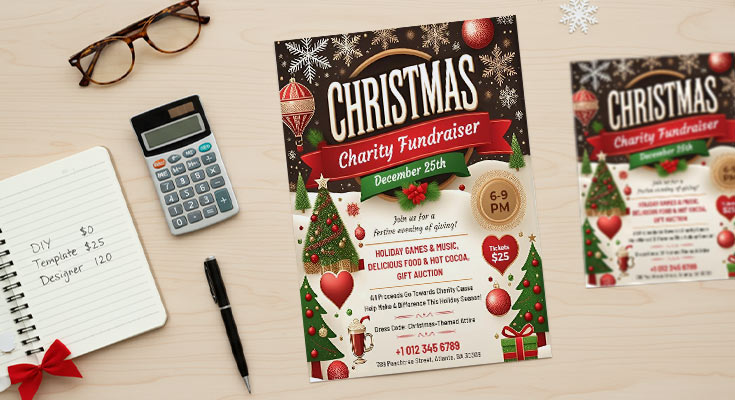
Many service providers overspend on Christmas marketing without achieving real results, while strategic budget planning ensures measurable returns during the holiday season. Smart Christmas flyer budget strategies focus on balancing design quality, printing, and distribution for maximum customer acquisition during peak periods.
Effective budget management allocates spending across free Christmas flyer templates, targeted distribution, and performance tracking, delivering higher ROI with lower costs. This guide highlights proven methods for cost optimization, bulk printing discounts, and smart spending frameworks that help businesses achieve impactful results without overspending on Christmas marketing flyers.
What Should Your Christmas Flyer Budget Include For Maximum ROI?
A strategic Christmas flyer budget should dedicate 40–50% to quality design and printing, 25–30% to targeted distribution, and 20–25% to performance tracking and testing (Harvard Business School).1 Include contingency funds for rush orders or premium paper upgrades to boost perceived value. Factor in design tools, stock photography, and copywriting costs to ensure measurable results. Marketing specialists can optimize the budget by creating flyers using a flyer maker that balances quality and cost efficiency.
Design and Production Cost Allocation for Professional Results
Allocate 45% of your Christmas flyer budget to design and printing expenses for maximum visual impact. Professional design services cost $150-400, while template-based solutions reduce expenses to $25-75. Printing costs vary significantly, standard 100gsm paper runs $0.10-0.15 per flyer, while premium cardstock increases costs to $0.25-0.40 per piece. Color printing adds $0.05-0.15 per flyer compared to black-and-white options.
Factor in finishing options like UV coating or lamination, which increase costs by 20-30% but significantly enhance perceived value. Budget Christmas flyer design should prioritize clean layouts and compelling headlines over complex graphics that inflate production costs without improving response rates.
Access DesignWiz professionally designed flyers featuring clean layouts, compelling headlines, and festive aesthetics that reduce design costs while maintaining visual impact.
- Christmas Quiz Night Event Flyer Template
- Christmas Eve to Go Dinner Promotion Flyer Template
- Festive Christmas Celebration Greeting Flyer Template
Distribution Channel Investment for Targeted Reach
Reserve 30% of your budget for strategic distribution that maximizes customer acquisition. Door-to-door distribution costs $0.05-0.10 per flyer, while direct mail averages $0.15-0.25 per piece including postage. Digital distribution through social media and email costs virtually nothing but requires time investment.
Strategic placement in high-traffic locations like coffee shops and community centers provides free exposure when combined with permission-based placement. Partner with complementary businesses for cross-promotion opportunities that reduce individual distribution costs by 40-50%. Affordable Christmas flyers achieve better ROI when distributed to pre-qualified audiences rather than blanket neighborhoods.
Track response rates by location to optimize future distribution investments and eliminate underperforming channels. Avoiding common flyer distribution mistakes prevents wasted budget on ineffective placement strategies, ensuring Christmas marketing dollars reach high-conversion audiences during peak shopping periods.
Performance Testing and Optimization Reserve Funds
Maintain 25% of your Christmas flyer budget for testing, optimization, and contingency expenses that protect profit margins. A/B testing requires printing smaller batches of different designs, typically 500-1,000 pieces per variation at higher per-unit costs. Rush printing during peak November-December periods incurs 15-30% premium charges, making contingency funds essential for last-minute adjustments.
Include tracking mechanisms like unique promo codes, dedicated phone numbers, or QR codes linking to specific landing pages, these cost $0.02-0.05 per flyer but enable precise ROI measurement. Monitor cost-per-acquisition weekly during campaigns, reallocating budget from underperforming channels to high-converting distribution methods. Professional Christmas flyers should achieve 3:1 to 5:1 return ratios when budgets include adequate testing and optimization reserves (University of Oregon).2
How Much Does a Professional Christmas Flyer Budget Typically Cost?
Professional Christmas flyer budgets range from $500–2,500 for small service providers, covering design, printing, and distribution costs. Mid-tier campaigns ($1,000–3,500) include premium materials and wider reach, while enterprise projects can reach $5,000–15,000 for multi-location efforts. Budget options using templates start at $75–150, with custom designs costing $300–800. Bulk printing and digital distribution can lower overall expenses to $200–600 for effective seasonal marketing.
Small Business Christmas Flyer Investment Ranges
Small businesses typically allocate $300-800 for complete Christmas marketing campaigns, representing 3-5% of projected holiday revenue (University of Rhode Island).3 This budget breakdown includes template-based design ($50-150), standard printing for 1,000-2,500 copies ($100-250), and targeted distribution ($150-400). Service providers like landscaping, cleaning, and home maintenance companies find success with $500 budgets when prioritizing quality over quantity. Specialized businesses like tree lots can benefit from guidance on Christmas tree shop marketing with flyers that addresses seasonal timing and location-specific budget strategies.
Smart small businesses maximize impact by ordering early to avoid December rush fees that increase costs 25-40%. Budget Christmas flyer design through template customization reduces design expenses while maintaining professional appearance. Local printing partnerships and DIY distribution keep total investments under $600 while achieving neighborhood-level market penetration for seasonal services.
Browse DesignWiz’s affordable Christmas flyer templates specifically tailored for small businesses.
- Christmas Catering Services Promotional Flyer Template
- Festive Christmas Cookie Baking Class Flyer Template
- Christmas Holiday Market Event Flyer Template
Professional Design vs Template Cost Comparison
Custom Christmas flyer design ranges from $200-800 depending on complexity and designer experience, while professional templates cost $25-75 for comparable visual impact. Template-based Christmas marketing flyer budget allocation allows 80% spending on printing and distribution versus 40% with custom design projects (University of Denver).4
Professional designers charge $50-150 per hour with typical Christmas flyers requiring 4-8 hours for concept development, revisions, and final files. Template customization takes 30-90 minutes, dramatically reducing labor costs while accessing proven design frameworks. Template solutions include multiple size formats, seasonal color schemes, and industry-specific messaging that custom projects charge extra to develop. Understanding the fundamentals of how to make a flyer empowers service providers to evaluate whether DIY template customization or professional design services offer better value within their Christmas budget constraints.
Save 80% on design costs with DesignWiz’s customizable Christmas flyer templates that deliver professional results.
- Cowboy Christmas Event Flyer Template
- Christmas Lights Installation Service Flyer
- Country Christmas Holiday Event Flyer Template
Bulk Printing and Distribution Pricing Tiers
Understanding how printing and distribution costs scale with volume helps businesses plan efficient and cost-effective Christmas flyer campaigns. The key is balancing quality, timing, and strategy to maximize value without overspending.
- Volume Discounts: Printing prices drop with higher quantities — 1,000 pieces cost $0.15–$0.25 each, while 5,000 pieces lower costs to $0.08–$0.12 per flyer on quality paper stock.
- Premium Add-ons: Enhance flyer appeal with UV coating (+$0.03 per piece) or heavyweight cardstock (+$0.05–$0.10 per flyer) for added durability and premium look.
- Mailing Costs: Bulk mail distribution costs $0.02–$0.05 per piece, requiring mailing permits and targeted address lists.
- Door-to-Door Distribution: Expect $0.10–$0.25 per flyer, depending on neighborhood density and coverage area.
- Digital Distribution: Social media and email channels are low-cost or free, though they rely on an existing customer database.
- Seasonal Timing Impact: October orders secure standard rates, while December printing can increase costs by 15–30% due to holiday demand.
- Quality vs. Budget: Focus on professional design rather than expensive paper to maintain perceived value while controlling costs.
- Performance Tracking: Measure success by cost-per-lead, not total spend, to ensure every dollar contributes to effective customer acquisition.
What Christmas flyer budget mistakes drain seasonal profits?
Christmas flyer budget mistakes often cost service providers thousands due to poor allocation and lack of performance tracking. Many waste 40–60% of their budgets on overprinting, unnecessary premium materials, and unmeasured campaigns. Common errors include printing beyond demand, overspending on paper quality, and ignoring cost-per-lead data. Smarter budgeting relies on data-driven printing, practical material choices, and tracking acquisition costs to protect profit margins during the holiday season. Beyond budget allocation errors, avoiding common flyer design mistakes prevents wasted spending on ineffective layouts and visual elements that fail to convert holiday shoppers.
Overestimating Print Quantities Without Market Testing
Service providers commonly print 5,000-10,000 Christmas flyers based on optimistic projections rather than validated demand data. This mistake stems from excitement about holiday opportunities and fear of running out during peak season. However, leftover inventory represents pure loss – unused flyers have zero value after Christmas passes.
Smart budget allocation involves testing smaller batches first. Print 1,000 pieces initially, distribute strategically, and measure response rates before scaling. This approach reduces waste by 70% while providing actual conversion data for informed scaling decisions.
Track distribution effectiveness by neighborhood, method, and timing. Some areas generate 5x higher response rates than others, making targeted reprints more profitable than blanket distribution. Businesses using test-batch methodology achieve 35% better ROI than those printing full quantities upfront.
Ignoring Cost-Per-Lead Tracking in Christmas Campaigns
Most service providers calculate total flyer costs but fail to measure actual customer acquisition expenses. This oversight leads to continued investment in ineffective campaigns while profitable channels remain underutilized. Without cost-per-lead tracking, expensive premium flyers may generate fewer customers than budget alternatives.
Implement unique tracking methods for each flyer batch: dedicated phone numbers, specific promo codes, or custom landing pages. Calculate true acquisition costs by dividing total campaign expenses by new customers gained. Include design, printing, distribution, and staff time in total investment calculations.
Profitable Christmas campaigns typically achieve acquisition costs below 20% of customer lifetime value (Monash University).5 Track weekly performance during peak season, adjusting distribution based on neighborhood-specific response rates and conversion patterns.
Premium Material Selection That Exceeds Customer Value
Choosing the right printing materials plays a crucial role in balancing cost and perceived quality. Many businesses overspend on premium materials that don’t significantly impact customer response or conversion rates.
- Cost vs. Perception: Premium cardstock, specialty finishes, or advanced printing options often raise costs by 40–80% but improve response rates by only 5–15%.
- Optimal Standard Quality: Standard 100gsm paper with full-color printing provides a professional look without unnecessary expenses.
- Limited Value of Upgrades: Premium 170gsm cardstock or specialty coatings increase expenses without proportional conversion benefits for most service businesses.
- Customer Priorities: Audiences focus more on content clarity, design balance, and compelling offers rather than paper weight or texture.
- Strategic Premium Use: Reserve high-end materials for premium service promotions where elevated presentation reinforces brand positioning.
- Smarter Budget Allocation: Redirect funds from costly materials toward broader distribution, multiple flyer versions, or A/B testing for higher overall ROI.
- Conversion-Driven Focus: Invest in proven success elements, clear headlines, persuasive offers, and strategic placement, over luxury finishes that don’t guarantee stronger results.
How Do You Calculate Christmas Flyer Budget Per Customer Acquisition?
Calculate your Christmas flyer budget per customer by dividing total campaign costs by new customers acquired. Track conversions using unique codes or landing pages for accuracy. Aim to keep acquisition costs below 20% of customer lifetime value while including all design, printing, and distribution expenses. Test small batches first to refine performance before scaling your Christmas marketing campaign.
Essential Metrics for Tracking Christmas Flyer Performance
Monitor response rate percentages, conversion ratios, and cost-per-lead metrics to optimize your Christmas flyer budget allocation. Track unique promo codes redemption rates, dedicated phone line calls, and specific landing page visits to attribute sales directly to flyer campaigns. Effective Christmas flyer tracking systems capture 85% of customer attribution data through multiple touchpoint analysis.
Measure geographic performance variations by distribution area, identifying high-converting neighborhoods for future budget allocation. Calculate average order value from flyer-generated customers versus other marketing channels. Budget Christmas flyer design elements should include clear tracking mechanisms without cluttering the visual appeal. Document response timing patterns—Christmas campaigns typically peak 3-5 days after distribution, with secondary spikes during weekend shopping periods.
Breaking Down Total Campaign Investment Beyond Printing
Total Christmas flyer budget encompasses design costs ($75-300), printing expenses ($150-600 for 2,500 copies), distribution fees ($200-500), and hidden costs like staff coordination time. Include photography licensing, copywriting services, and rush order premiums in comprehensive budget calculations.
Factor distribution method expenses, door-to-door delivery costs $0.15-0.25 per piece, while bulk mail averages $0.08-0.12 per flyer. Affordable Christmas flyers require strategic cost management across all expense categories, not just printing savings. Account for design revision cycles, which add 15-25% to initial estimates when clients request multiple changes.
Include contingency funds for seasonal price surges during November-December when printing demand peaks. Professional design services range from template customization ($50-150) to full custom creation ($200-500), significantly impacting customer acquisition calculations.
Setting Profitable Customer Acquisition Cost Thresholds
Establishing the right customer acquisition cost (CAC) benchmarks ensures your Christmas flyer campaigns remain profitable and scalable. Understanding these financial thresholds helps optimize budgets while maintaining strong returns on marketing investment.
- Define Acquisition Cost Goals: Service providers should maintain acquisition costs at 15–25% of first-year customer revenue, while product sellers can manage 30–40% due to inventory factors.
- Calculate Lifetime Value: Evaluate average purchase size, repeat frequency, and referral rates from previous Christmas clients to determine true long-term value.
- Understand Seasonal Behavior: Christmas customers often spend more initially but show lower retention compared to year-round clients, requiring careful ROI analysis.
- Start with Test Campaigns: Print and distribute 500–1,000 flyers in targeted areas to gauge conversion rates before committing to large-scale runs.
- Balance Quality and Cost: Cheap flyers with poor design or printing often increase acquisition costs, while premium, well-designed flyers can lower them through higher conversion.
- Track Performance by Timing: Monitor weekly trends—late November offers lower costs but less urgency, while early December brings higher conversions amid stronger competition.
- Optimize Budget Dynamically: Adjust spending based on real-time data instead of fixed schedules to maximize cost efficiency and conversion outcomes.
- Measure Success Rates: Effective Christmas flyer campaigns typically achieve 2–4% response rates, resulting in $25–$75 acquisition costs for services priced at $300–$500.
What Printing Costs Should Factor Into Your Christmas Flyer Budget?
Christmas flyer printing costs depend on paper quality, quantity, and finishing options. Basic paper costs around $0.10–$0.15 per flyer, while premium cardstock ranges from $0.25–$0.40. Bulk orders over 5,000 flyers can cut costs by up to 60%, though finishes like UV coating or lamination raise prices by 20–30%. Seasonal demand and distribution choices—such as bulk mail or door-to-door delivery—also impact total expenses.
Paper Stock and Quality Grade Cost Analysis
Paper stock selection dramatically impacts your Christmas flyer budget and customer perception. Standard 100gsm paper costs $0.10-0.15 per flyer for full-color printing, providing professional appearance without premium pricing. Mid-grade 130gsm stock increases costs to $0.18-0.25 per flyer but offers better durability for door-to-door distribution. Premium 170gsm cardstock ranges from $0.30-0.45 per flyer, creating luxury perception that justifies higher service pricing for upscale Christmas marketing.
Matte finish adds $0.02-0.04 per flyer but reduces glare for better readability. Gloss coating costs $0.03-0.06 extra per piece while enhancing color vibrancy for Christmas themes. Smart budget allocation focuses spending on paper quality rather than oversized formats, as tactile perception influences customer trust more than dimensions.
Volume Discounts and Bulk Printing Savings
Bulk printing delivers substantial Christmas flyer budget savings through quantity breaks. Printing 1,000 pieces typically costs $0.20-0.35 per flyer, while 5,000 pieces drop to $0.12-0.18 each – nearly 50% savings. Orders of 10,000+ flyers achieve $0.08-0.12 per piece rates, making large campaigns surprisingly affordable.
Digital printing works best for quantities under 2,500, while offset printing becomes cost-effective at higher volumes. October ordering secures standard rates, avoiding December’s 25-40% seasonal surcharges. Rush orders under 48 hours incur 30-50% premium fees that devastate tight budgets. Smart planning includes 10% overprint buffer to avoid expensive reprints for distribution errors or damage.
Color vs Black-and-White Printing Economics
Choosing between color and black-and-white printing can significantly affect both the budget and effectiveness of Christmas flyer campaigns. Understanding these trade-offs helps strike the right balance between cost efficiency and audience engagement.
- Color Printing Impact: Full-color printing costs $0.08–$0.15 more per piece than black-and-white, representing a 40–80% price increase depending on paper quality.
- Engagement Advantage: Color flyers deliver 60–80% higher response rates for seasonal services, making the additional expense worthwhile for most Christmas promotions.
- Two-Color Printing Option: A practical middle ground, adding $0.04–$0.08 per flyer while maintaining visual appeal—ideal for brands seeking balance between cost and design.
- Seasonal Color Benefits: Christmas themes gain impact from red and green spot colors printed on affordable white stock for festive appeal at lower cost.
- Black-and-White Suitability: Ideal for text-heavy professional services or campaigns under $200, maintaining a professional look at $0.05–$0.10 per piece.
- High-Contrast Design Strategy: Effective black-and-white flyers use strong contrast and white space to ensure clarity and sophistication without added cost.
- Accent Color Compromise: Adding single accent colors like red headlines on black-and-white designs increases cost by just $0.02–$0.04 while preserving the Christmas spirit affordably.
Achieve 60-80% higher response rates with DesignWiz’s vibrant full-color Christmas flyer templates designed to justify the additional printing investment through superior engagement.
- Christmas Stocking Stuffing Event Flyer Template
- Christmas Home Decorating Contest Flyer Template
- Christmas Dinner Promotion Flyer Template
How Can You Stretch A Tight Christmas Flyer Budget Effectively?
Maximizing Christmas flyer budget efficiency involves using templates, bulk printing, and digital distribution to reduce costs. Partnering with local businesses for shared printing and promotions can cut expenses by up to 50%. Standard paper and simple designs lower production costs, while early planning avoids rush fees. Focus spending on high-traffic areas and track response rates to refine future campaigns.
Template-Based Design Cost Reduction Strategies
Professional template designs eliminate the need for expensive custom design work while maintaining visual appeal. Template-based approaches save service providers 65-85% on design costs compared to hiring freelancers or agencies. Pre-designed templates cost $15-50 versus $200-500 for custom work, allowing budget allocation toward printing and distribution instead.
Choose templates with customizable text fields and color schemes to match brand requirements without additional design fees. Many template platforms offer seasonal collections specifically optimized for Christmas marketing, providing professional-quality designs at fraction of custom costs.
Reduce design expenses by 65-85% with DesignWiz’s extensive Christmas flyer template library featuring seasonal collections, customizable color schemes, and brand-ready layouts.
- Small Town Christmas Celebration Flyer Template
- Christmas Bonfire Event with Santa Flyer Template
- Christmas Charcuterie Workshop Event Flyer Template
Strategic Distribution Channel Prioritization
Effective distribution prioritizes high-conversion locations over broad coverage to maximize budget impact. Door-to-door distribution in targeted neighborhoods costs $0.05-0.10 per flyer compared to mass mailing at $0.25-0.40 per piece. Focus on locations with demonstrated customer demographics rather than blanket distribution.
Digital distribution through social media, email lists, and website placement costs virtually nothing while reaching engaged audiences. Combining 70% digital distribution with 30% strategic print placement optimizes reach while maintaining budget constraints. Evaluating digital vs. print flyers pros and cons helps service providers allocate Christmas marketing budgets strategically between traditional physical distribution and cost-effective digital channels. Test small geographic areas first to identify highest-responding locations before expanding distribution efforts.
Maximize distribution ROI with DesignWiz’s conversion-optimized Christmas flyer templates featuring clear calls-to-action and strategic layouts designed for high-traffic placement locations.
- Christmas Baseball Tournament Event Flyer Template
- Holiday Stocking Stuffer Sale Flyer Template
- Candy Cane Fundraiser Event Flyer Template
Partnership and Cross-Promotion Budget Sharing
Collaborative marketing can greatly reduce Christmas flyer campaign expenses while extending your brand’s reach. Partnering with complementary businesses creates win-win opportunities through shared resources, co-branded promotions, and joint marketing events.
- Collaborative Cost Sharing: Split printing and distribution costs with non-competing businesses serving similar demographics, such as wedding planners, photographers, or caterers.
- Joint Flyer Campaigns: Create co-branded flyers showcasing all partner services—this approach can cut individual costs by 40–60% while reaching wider audiences.
- Partnership Agreements: Establish clear terms covering cost division, design approval, and lead distribution to ensure smooth collaboration.
- Shared Promotional Events: Participate in community events or holiday shopping fairs with local partners to share venue costs, materials, and marketing efforts.
- Referral Network Systems: Set up mutual referral programs among partners to extend visibility and gain customers beyond initial flyer circulation.
- Seasonal Service Exchanges: Trade services for marketing benefits—for instance, offer flyer design in exchange for printing discounts or distribution support.
- Cash-Free Collaborations: Reduce financial strain by exchanging skills or services instead of direct payments while building long-term business relationships.
- Performance Tracking: Use unique tracking codes or dedicated landing pages to measure flyer response rates and refine future partnership strategies.
What Christmas Flyer Budget Allocation Delivers Best Results?
The 70-20-10 allocation strategy maximizes Christmas flyer budget ROI for service providers: 70% for design and printing quality to ensure professional presentation, 20% for strategic distribution channels targeting high-conversion areas, and 10% for testing different formats or locations. This approach prioritizes visual impact since Christmas flyers compete heavily during peak season. Budget-conscious providers should focus spending on premium paper stock and vibrant colors rather than oversized formats, as quality perception directly influences customer trust and response rates for seasonal services.
Design Quality vs Distribution Reach: Finding Your Sweet Spot
Budget allocation between design quality and distribution reach requires data-driven decisions based on your target market. Premium design elements like UV coating and thick cardstock create immediate credibility but cost 30-40% more than standard options. Service providers targeting affluent neighborhoods should allocate 75-80% toward premium materials and professional design, while broader market approaches benefit from 60-65% design allocation with expanded distribution coverage.
Businesses spending under 60% on design quality see 25% lower response rates regardless of distribution volume. Test small batches first – 500 premium flyers often outperform 2000 basic ones in high-value service markets. Creative flyer design ideas help service providers maximize visual impact within budget limitations, proving that strategic design thinking often outperforms expensive production values.
Justify premium material investments with DesignWiz’s high-quality Christmas flyer templates featuring sophisticated designs that create immediate credibility and enhance customer trust.
- Christmas Fruitcake Holiday Special Flyer Template
- Christmas Gathering Celebration Event Flyer Template
- Christmas Basketball Tournament Event Flyer Template
Paper Stock and Printing Investments That Actually Convert
Paper weight and finish choices directly impact perceived value and customer response rates. Standard 100gsm paper suffices for budget-conscious campaigns, while 170gsm cardstock with matte finish justifies premium pricing for luxury services. Full-color printing adds $0.08-0.12 per piece but increases response rates by 40-60% over black-and-white alternatives.
UV coating prevents weather damage for door-to-door distribution but adds 20% to printing costs. Smart allocation prioritizes color printing over premium finishes – vibrant colors on standard paper outperform expensive materials with poor design. Bulk printing achieves significant savings: 5000 pieces cost only 25% more than 1000 while providing five times the reach potential.
Testing Budget Reserves for Multi-Format Campaign Optimization
Testing helps ensure every dollar in your Christmas flyer campaign delivers measurable results. By allocating a small reserve for experimentation, businesses can identify what works best before scaling efforts and avoid costly missteps.
- Allocate a Testing Reserve: Set aside 10% of your Christmas flyer budget for experimenting with different flyer sizes, designs, and distribution methods.
- Run A/B Campaign Tests: Print 250–500 flyers per variation to compare formats and track response performance in your target market.
- Compare Flyer Formats: Test postcard-size (5×7) flyers against standard letter-size (8.5×11) — smaller versions cost 40% less while still maintaining visibility for short messages.
- Use Digital Previews: Validate flyer design appeal through social media previews before committing to print production, saving both time and costs.
- Track Performance Data: Assign unique response codes to each flyer version and measure success using cost-per-lead rather than total impressions.
- Reallocate Based on Results: Shift up to 20% more of your budget toward high-performing flyer designs or distribution channels for maximum ROI.
- Learn from Failures: Document underperforming tests to prevent repeating costly mistakes and build a stronger data foundation for future campaigns.
- Test Distribution Methods: Experiment with local direct mail versus door-hanging delivery to identify which generates higher engagement in your area.
How Do Seasonal Rates Impact Your Christmas Flyer Budget Planning?
Seasonal rate fluctuations significantly impact Christmas flyer printing costs, with prices surging 25-40% during November-December due to increased demand and rush order premiums. Smart Christmas flyer budget planning requires ordering by mid-October to avoid peak pricing while securing early-bird discounts. Understanding these seasonal cycles helps service providers maintain profit margins while ensuring adequate Christmas marketing flyer budget allocation for competitive market presence during peak holiday seasons.
October vs December: Cost Comparison Timeline for Smart Ordering
October printing rates for Christmas flyers average $0.12-0.18 per piece for standard full-color designs, while December rates spike to $0.20-0.30 per piece for identical specifications. Service providers ordering 5,000 Christmas flyers in October pay approximately $600-900, compared to $1,000-1,500 for December rush orders. Paper stock availability also affects pricing, with premium options becoming scarce and expensive by late November.
Smart budget planning involves calculating total savings from early ordering. A typical 2,500-piece Christmas campaign costs $400 in October versus $650 in December, creating $250 additional budget for distribution or design upgrades. Affordable Christmas flyers require strategic timing to maximize purchasing power during peak season competition.
Peak Season Surcharges and How They Affect Your Bottom Line
Rush order fees during peak Christmas season add 15-30% to base printing costs, while expedited shipping can increase expenses by additional 20-40%. Standard turnaround times extend from 3-5 business days in October to 7-10 days in December, forcing last-minute orders into premium pricing tiers.
Budget Christmas flyer design planning must account for these inevitable surcharges. A $500 October flyer budget becomes $650-750 in December after rush fees, shipping premiums, and limited paper stock selections. Service providers operating on tight margins find these surcharges eliminate 20-35% of potential profits from holiday campaigns.
Peak season also affects specialty finishes like UV coating, foil stamping, and embossing, with availability decreasing and costs increasing by 40-60%. Budget-conscious providers should avoid complex finishes during December or secure early production slots.
Early Bird Discounts and Volume Pricing Windows That Matter
Timing plays a crucial role in maximizing Christmas flyer budget efficiency. Early planning and bulk ordering not only reduce costs but also ensure better material availability and campaign flexibility.
- Take Advantage of Early Bird Discounts: Printing companies typically offer 10–25% discounts on Christmas flyer orders placed before October 15th.
- Leverage Volume Pricing: Early bulk orders of 5,000+ pieces can secure 30–40% lower rates compared to last-minute printing during December.
- Benefit from Compound Savings: A 10,000-piece campaign ordered in September may cost $800–1,200, while the same order in December can rise to $1,400–2,000.
- Plan Budget Allocation Wisely: Reserve 60–70% of printing funds for early bulk orders and keep 30–40% for design adjustments or additional print runs.
- Use Early Savings Strategically: Apply funds saved from early bookings toward premium distribution methods, improved design elements, or wider market coverage.
- Secure Material Availability: Early bird orders guarantee access to preferred paper stocks and prevent last-minute compromises caused by supply shortages.
What Design Costs Fit Within A Realistic Christmas Flyer Budget?
Christmas flyer design costs range from $15–50 for DIY templates to $150–500 for custom designs, with design typically taking 20–30% of the total budget. Templates costing $25–75 offer professional quality at lower prices. Scalable designs that work across multiple services improve cost efficiency, while focusing on strong headlines and clear calls-to-action delivers better results than overly complex graphics.
Template vs Custom Design Cost Breakdown for Christmas Flyers
Template-based Christmas flyer designs provide exceptional value at $25-75, delivering professional results without custom design premiums. Pre-designed templates include seasonal graphics, color schemes, and layouts optimized for affordable Christmas flyers while maintaining brand flexibility. Custom design services cost $150-500 but offer unique branding and specialized messaging for budget Christmas flyer design projects requiring distinctive visual identity.
Professional designers charge hourly rates of $50-125, with Christmas flyers requiring 3-8 hours depending on complexity. Template customization reduces design time by 70% while preserving professional quality standards. Small businesses achieve optimal Christmas flyer budget efficiency by selecting premium templates and investing saved design costs into higher-quality printing or expanded distribution channels. Template solutions include seasonal color palettes, festive typography, and industry-specific imagery that eliminates expensive custom photography or illustration requirements.
Bridge the gap between budget and quality with DesignWiz’s premium customizable Christmas flyer templates.
- Festive Red and Green Christmas Toy Drive Donation Flyer Template
- Christmas Holiday Tea Party Invitation Flyer Template
- Festive Gold and Green Christmas Party Flyer Template
Design Element Prioritization Within Tight Holiday Budgets
When working with limited Christmas flyer budgets, focusing on elements that influence customer response yields better results than spending on purely decorative features. The goal is to maintain festive appeal while maximizing design efficiency.
- Prioritize Response-Driven Elements: Focus on professional typography and clear messaging that enhance readability and boost conversions.
- Invest in High-Quality Imagery: Product or service photography provides stronger returns than ornate borders or complex graphics.
- Optimize Color Selection: Two-color designs reduce printing expenses by around 40% while still maintaining seasonal charm.
- Emphasize Essential Design Components: Allocate funds toward compelling headlines, visible contact details, and strong value propositions.
- Use Seasonal Graphics Strategically: Include simple festive touches like snowflakes or holly without overwhelming the main message. Budget-conscious designers can enhance visual appeal by exploring Christmas wallpaper and backgrounds that provide festive atmosphere without expensive custom illustration costs.
- Focus on Functional Design Quality: Ensure legible fonts, balanced white space, and strong color contrast for clarity under all printing conditions.
Focus your budget on conversion-driving elements with DesignWiz’s strategically designed Christmas flyer templates featuring professional typography, clear messaging, and optimized visual hierarchy.
- Winter Wonderland Christmas Event Flyer Template
- Festive Christmas Banquet Celebration Flyer Template
- Festive Holiday Christmas Lunch Event Flyer Template
Scalable Christmas Flyer Design Investment Strategies
Adopting scalable design strategies allows businesses to stretch their Christmas flyer budgets further by reusing adaptable templates across multiple campaigns, saving both time and money without sacrificing quality or brand consistency.
- Invest in Master Templates: Allocate $100–$200 for adaptable templates that support various services, locations, or promotions through modular design and editable text areas.
- Use a Design Systems Approach: Create consistent color schemes, typography, and layouts to simplify future flyer production and reduce long-term costs.
- Achieve Significant Cost Savings: Reusing scalable templates can cut design expenses by up to 80%, lowering per-flyer design costs from $300 to around $75.
- Ensure Multi-Format Compatibility: Design templates should work seamlessly across print and digital formats to maximize campaign reach.
- Leverage Seasonal Variations: Use core templates that can be easily updated for Christmas, winter, or New Year promotions through minor graphic or color changes.
- Secure Design File Ownership: Maintain full rights to template files to allow internal updates, avoiding repeated designer fees for simple adjustments.
How Do You Track Christmas Flyer Budget Performance And ROI?
Tracking Christmas flyer ROI involves measuring cost-per-acquisition, response rates, and conversions against total campaign spending. Use promo codes, landing pages, or unique phone numbers to attribute sales accurately. Successful flyers often deliver 3:1 to 5:1 ROI ratios. Regularly review performance during the season to adjust distribution and improve future budget efficiency.
Essential Christmas Flyer ROI Calculation Methods and Formulas
ROI calculation begins with total campaign investment including design fees, printing costs, and distribution expenses. Use the formula: (Revenue Generated – Total Campaign Costs) ÷ Total Campaign Costs × 100 = ROI percentage. Track customer acquisition cost by dividing total campaign spend by new customers gained. Monitor lifetime customer value for Christmas clients, as holiday customers often spend 40% more initially but may have lower retention rates.
Implement cost-per-lead tracking by assigning unique tracking codes to different distribution areas. Calculate conversion rates by measuring responses against total flyers distributed. Effective Christmas campaigns should achieve 2-5% response rates for direct mail and 0.5-2% for general distribution. Document these metrics weekly during campaign periods to identify peak performance times and optimize budget allocation for maximum returns.
Lead Attribution Systems for Holiday Flyer Campaign Tracking
Create dedicated phone numbers for each distribution batch using Google Voice or similar services. Use unique promo codes like “XMAS2024-NORTH” for different neighborhoods to track geographic performance. Set up specific landing pages with UTM parameters to monitor digital traffic from QR codes on printed flyers.
Track walk-in customers by asking “How did you hear about us?” and training staff to record responses consistently. Implement customer surveys for first-time buyers to identify flyer effectiveness. Use CRM systems to tag customers by acquisition source, enabling lifetime value analysis by marketing channel.
Monitor social media mentions and hashtags if flyers include social elements. Cross-reference flyer distribution dates with sales spikes to establish correlation patterns. This multi-touch attribution reveals which distribution methods and locations generate highest-value customers.
Performance Benchmarking and Budget Optimization for Christmas Campaigns
Measuring and optimizing flyer performance is essential for maximizing ROI during the Christmas season. By benchmarking results, reallocating funds, and refining campaign strategies, businesses can enhance profitability and efficiency.
- Set Industry Benchmarks: Service-based businesses should target $3–$8 in revenue for every dollar spent on flyer marketing.
- Compare Seasonal Metrics: Evaluate current campaign results against previous years to track progress in cost-per-acquisition and customer quality.
- Analyze Local Performance: Study neighborhood-level data to identify high-converting areas that warrant increased budget allocation.
- Test and Track Offers: Experiment with different discount levels to see how varying offers impact response rates and profit margins.
- Monitor Timing Impact: Compare early November versus mid-December campaigns to understand seasonal timing effects on conversions.
- Allocate Budget Strategically: Dedicate 70% of your budget to proven high-performing areas and 30% to testing new approaches or markets.
- Track Competitor Activity: Observe competitor pricing and promotions during peak season and adjust your strategies accordingly.
- Create Performance Scorecards: Measure response rate, conversion rate, average sale value, and customer retention for each campaign.
- Refine Continuously: Conduct monthly reviews during the Christmas season to reallocate funds toward best-performing strategies for maximum profit.
People Also Ask: Cost-effective Flyer Marketing And Pricing Strategy Implementation Questions
- How much does it cost to print 1000 Christmas flyers?
Full-color Christmas flyer printing costs $100-200 for 1,000 pieces on standard paper. Budget specialists choose 100gsm stock and simple designs to stay under $150, achieving $0.10-0.15 per piece for effective seasonal marketing campaigns. - What are the best free tools for designing Christmas flyers?
DesignWiz offers professional Christmas flyer templates for free, while GIMP provides advanced design capabilities. Budget marketing specialists also use Adobe Express free tier and Template.net for cost-effective, professional-looking seasonal promotional materials. - How can I design a Christmas flyer on a budget?
Use free templates from DsignWiz or Adobe Express, limit to 2-3 colors, choose standard sizes, and avoid premium features. Budget specialists create professional designs for under $50 by leveraging free tools and simple layouts. - What is the cheapest way to print Christmas flyers?
Online printing services like Vistaprint or local bulk printers offer lowest rates. Order 2,500+ pieces on 100gsm paper with standard turnaround to achieve $0.08-0.12 per piece for budget-conscious Christmas marketing campaigns. - How much should I charge for Christmas flyer design services?
Budget marketing specialists charge $75-200 for template-based Christmas flyer designs, while custom designs range $200-500. Factor complexity, revisions, and client budget when pricing seasonal design services for maximum profitability. - What paper weight is best for budget Christmas flyers?
100-120gsm paper provides optimal cost-performance balance for Christmas flyers. This weight feels professional without premium pricing, keeping printing costs under $0.15 per piece while maintaining credibility with potential customers.
Frequently Asked Questions
- What is a realistic Christmas flyer budget for small service businesses?
Small businesses should budget $300–$800 for design, printing, and distribution—about 3–5% of expected holiday revenue for strong ROI. - How much should Christmas flyers cost per piece to stay profitable?
Keep printing costs under $0.15 per flyer by ordering 2,500+ pieces on 100gsm paper and skipping premium finishes. - What design options keep Christmas flyer budgets under control?
Use templates ($25–$75) or free tools like DesignWiz instead of custom designs. Simple two-color layouts can cut printing costs by up to 40%. - How do printing quantities affect Christmas flyer budget efficiency?
Larger runs save money 5,000 flyers cost only 20% more than 1,000 but reach five times as many people. Order early for lower rates. - What distribution methods fit tight Christmas flyer budgets?
Choose door-to-door drops ($0.05–$0.10 per piece), local partnerships (free), or DIY delivery to save up to 70% on costs. - How can nonprofits maximize limited Christmas flyer budgets?
Use digital flyers for free promotion, print minimal copies, and partner with local businesses or use volunteers for distribution. - What paper quality balances cost and professional appearance?
Go with 100–120gsm gloss or matte paper for a professional look without high costs. Avoid flimsy 80gsm paper. - How do seasonal printing rates affect Christmas flyer budgets?
Prices rise 15–30% in December. Order by late October to lock in standard rates and ensure better quality stock. - What ROI should you expect from Christmas flyer budget investments?
Expect 3:1–8:1 ROI when tracking with promo codes or dedicated contacts. Anything below 2:1 signals targeting or design issues. - How do you avoid budget overruns on Christmas flyer campaigns?
Set a fixed budget with a 10% buffer, get all-inclusive quotes, avoid late revisions, and bundle design + printing + distribution for savings.
Conclusion: Cost-effective Flyer Marketing And Pricing Strategy Success Framework
Strategic Christmas flyer budget management turns seasonal spending into measurable profit by combining smart allocation, cost control, and performance tracking. Providers using structured frameworks achieve stronger ROI, reduced waste, and improved campaign predictability through data-driven decisions rather than guesswork.
By balancing design quality, printing efficiency, and targeted distribution, service providers sustain profitability throughout the holiday season. This disciplined approach transforms flyers into reliable revenue generators, ensuring long-term success and competitive advantage during peak festive marketing periods.
Reference
- 4 Factors to Consider When Creating a Digital Marketing Budget – Harvard Business School.
- Marketing Plan Evaluation and Cost-Effectiveness – University of Oregon.
- How much should my digital advertising budget be? – University of Rhode Island.
- Budget Optimization and Resource Allocation Efficiency –University of Denver.
- CAC to Customer Lifetime Value Ratio Guidelines – Monash University.