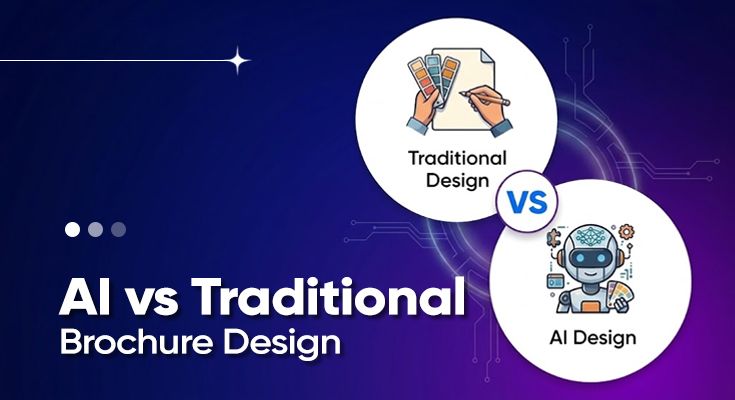
When it comes to creating a brochure for your business, you now have two very different paths in front of you: let artificial intelligence do the heavy lifting, or hire a skilled human designer to craft something custom from scratch.
In the 2026 marketing landscape, the humble brochure has undergone a profound, AI-driven evolution. Autoppt Businesses of every size, from solo entrepreneurs to enterprise marketing teams, are now asking the same question: Should I use an AI brochure tool, or stick with traditional professional design?
This guide breaks down both methods side by side, covering costs, quality, speed, and use cases – so you can make the right call for your brand.
Traditional Brochure Design – The Classic Approach
Traditional brochure design involves working with a professional graphic designer (freelancer, studio, or in-house team) who uses tools like Illustrator or Photoshop to build a brochure. The traditional design process for graphic designers typically begins with a brief or concept, which is then developed into a visual concept or sketch. This process can be time-consuming and labor-intensive, requiring designers to spend hours perfecting every detail.
AI Brochure Design – The Modern Solution
AI brochure design tools let anyone create a professional-looking brochure in minutes, regardless of design experience. You provide your brand inputs, logo, colors, text, and the AI generates a layout, suggests visuals, and formats everything automatically.
Using a DesignWiz AI brochure maker tool, users can automate a lot of the design and content creation process, saving a significant amount of time compared to creating a brochure from scratch.
Learn more: Explore AI brochure prompts to generate high-quality designs faster
Key Differences Between AI and Traditional Design
Here’s a direct comparison across the most important factors in the AI vs traditional brochure design debate:
| Factor | AI Brochure Design | Traditional Brochure Design |
|---|---|---|
| Speed | Minutes to hours | Days to weeks |
| Cost | Low (free to ~$40/yearly) | Medium–High ($150–$2,500+) |
| Customization | Template-based, limited | Fully custom |
| Print readiness | Often RGB only | CMYK, bleed, crop marks |
| Brand uniqueness | Generic risk | Fully differentiated |
| Skill required | None | High (tools + creative skill) |
| Scalability | Very high | Time-limited |
| Creative strategy | Algorithmic | Human-led |
| Revisions | Instant regeneration | Time and cost per round |
| Best for | Speed, digital sharing, low budget | Premium, print, complex branding |
Which One Should You Choose?
The right answer depends on three things: your budget, your timeline, and the purpose of the brochure.
Choose the AI brochure design if:
- You’re a startup or small business with a tight budget
- You need brochures quickly for digital distribution (email, website, social media)
- You need multiple versions or high-volume output
- The brochure is internal, promotional, or temporary in nature
- You don’t have access to an in-house designer
Choose traditional brochure design if:
- Your brochure will be professionally printed and physically distributed
- You’re creating a flagship brand piece that needs to stand out
- Your audience is high-end, and brand perception is critical
- You need a complex layout, custom illustration, or premium finishes
Consider a hybrid approach if:
- You want to use AI to generate a first draft or layout concept, then hand it to a designer for refinement
- You’re working under a tight deadline, but still need a polished final product
In 2026, teams use AI to generate variants, while designers refine hierarchy, rhythm, and print polish for a premium feel. This hybrid workflow is increasingly the norm among professional marketing teams, combining the speed of AI with the craft of human design.
Real-World Use Case Scenarios
Understanding the difference between AI vs traditional brochure design is easier when you see it play out in real situations. Here are four scenarios that show exactly which approach fits which business reality.
Food truck owner needs a brochure by tomorrow morning
Priya booked a last-minute festival spot and needs a tri-fold brochure by 8 a.m. — no designer, $30 budget. She uses an AI tool, picks a template, adds her menu, and exports a print-ready PDF in 40 minutes.
Speed and cost. A freelance designer couldn’t even respond this fast.
SaaS startup tests 5 brochure versions for a trade show
A B2B company needs 5 messaging variants for three events. Instead of 5 designer briefs, the marketing manager generates all variants in an afternoon — tweaking copy and layout each time.
Volume and iteration speed. High-volume variant testing is where AI pays off immediately.
Luxury real estate agency creates a property portfolio brochure
A high-end firm launches a residential tower. The brochure is printed on 350 gsm silk with gold foil — every detail signals exclusivity. A template-based AI output would instantly undercut years of brand building.
The brochure is a brand artefact. Its physical quality is part of the product experience.
Hospital launches a patient-facing cancer care brochure
A hospital needs an oncology brochure for newly diagnosed patients. It requires medical accuracy, careful tone, and accessibility compliance. A generic AI template carries real legal and clinical risk.
Trust and compliance demand a professional working with clinical and legal reviewers.
Agency uses AI for concepts, designer for final polish
A marketing agency needs a 12-page visitor guide on a tight budget. AI generates 3 layout concepts in a day to lock direction, then a senior designer handles hierarchy, CMYK profiles, and print-ready files.
AI cuts concepting from a week to a day. The designer focuses on craft, not blank-canvas exploration.
Frequently Asked Questions
For digital brochures distributed via email, PDF, or web, AI tools can absolutely produce professional-quality results. For high-end print work, however, you’ll want a traditional designer to ensure proper CMYK color profiles, resolution, and bleed settings.
Brochure design costs $75 to $200 per page, depending on the booklet size, number of pages, complexity, and the graphic designer’s experience and location. A simple tri-fold brochure might cost $150–$500 from a freelancer, while an agency-produced multi-page brochure can exceed $2,500.
Some AI tools do support print-ready exports, but you need to verify CMYK support and 300 DPI export before sending to a professional printer. Most AI brochure generators offer limited free versions, often with watermarked exports or restricted templates. To unlock premium templates, high-resolution downloads, and brand kits, a subscription or credit-based payment plan is usually required.
Not at all. The global graphic design market is a massive and growing industry, valued at over $60 billion as of 2025. Premium, print-focused, and strategically complex brochures continue to require skilled human designers. What’s changing is that AI is increasingly handling routine, low-stakes brochure work.
AI is significantly faster for initial output. A basic brochure can be generated in minutes with AI, while traditional design typically takes several days from brief to final file, especially when revision rounds are included.
Final Thoughts
The AI vs. traditional brochure debate doesn’t have a single winner; it’s about the right tool for the right job. AI is shifting from experiment to infrastructure, and design is moving toward more human, story-led aesthetics. The question isn’t “What’s new?” so much as “What do we want to do on purpose?
If you need speed, scalability, and cost efficiency, AI brochure tools deliver. If you need craft, brand differentiation, and print perfection, traditional design delivers. AI is quickly becoming the future of brochure creation, making professional-quality design accessible to all.