
Many service providers waste resources on generic Cyber Monday flyers that fail to connect with different customer groups. Targeted editable Cyber Monday flyer templates solve this by using demographic segmentation and personalized messaging to engage specific audiences with greater precision and relevance.
By analyzing customer data, adapting visuals, and tailoring offers, businesses can create promotional flyers that resonate with each audience segment while maintaining brand consistency. This guide explores effective customization strategies, data-driven personalization, and free flyer design templates that help agencies maximize engagement and conversions during the Cyber Monday rush.
How Can Content Marketing Agencies Create Cyber Monday Targeted Flyers For Different Client Demographics?
Content marketing agencies can boost results by creating demographic-specific Cyber Monday promotional flyers based on customer data analysis. Each group, millennials, Gen Z, Gen X, or baby boomers, needs distinct visuals, messaging, and offers that match their shopping preferences. Customizing color schemes, typography, and tone while keeping brand consistency helps campaigns resonate more deeply. Agencies can also streamline the process by creating flyers designed for each demographic group, turning generic campaigns into high-converting, personalized marketing materials.
Research-Driven Demographic Profiling for Cyber Monday Campaign Development
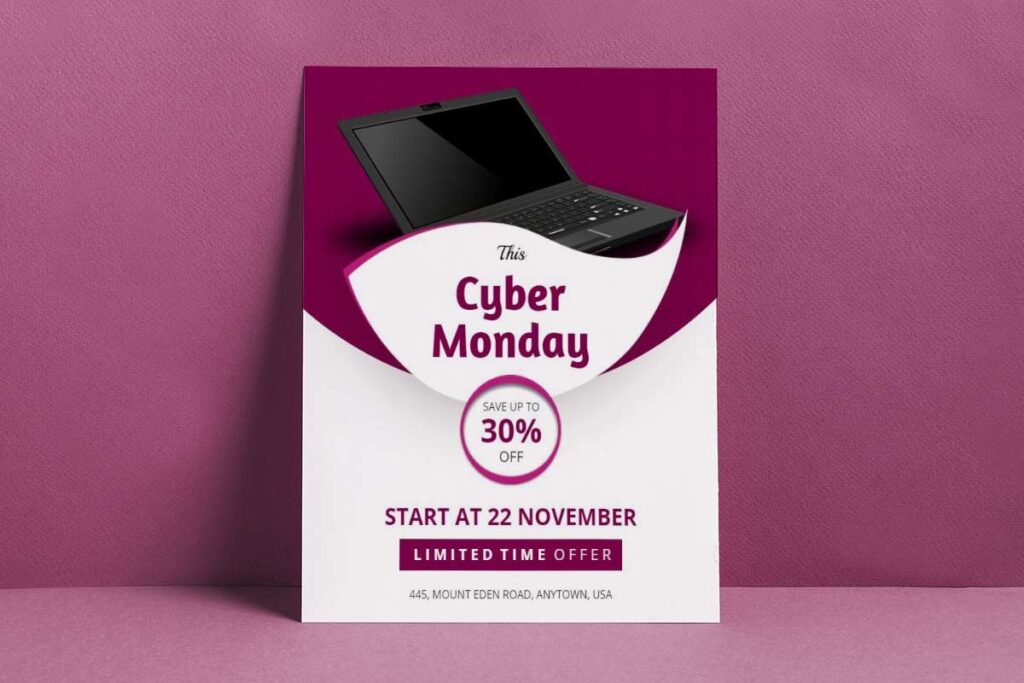
Agencies begin by collecting and analyzing customer data across age groups, income levels, shopping frequency, and preferred channels (University of Houston Libraries).1 Millennials respond to authenticity and social proof, requiring influencer-style imagery and sustainability messaging. Gen Z demands bold visuals with mobile-first design and instant gratification offers.
Baby boomers prefer traditional layouts with clear value propositions and detailed product information. Gen X shoppers appreciate family-focused messaging with practical benefits and time-saving solutions. Purchase history reveals preferred product categories, average order values, and seasonal buying patterns. Geographic data enables location-specific offers and cultural customization (Florida Gulf Coast University Online).2 Behavioral analytics identify optimal sending times and preferred communication frequencies for maximum engagement.
Discover demographic-specific Cyber Monday flyer templates on DesignWiz designed for millennials, Gen Z, Gen X, and baby boomers with age-appropriate visuals and messaging frameworks.
Visual Design Adaptation Techniques for Multi-Generational Flyer Appeals
Color psychology drives demographic targeting success (Rice University & OpenStax).3 Younger demographics respond to bright, saturated colors and gradient backgrounds, while mature audiences prefer high-contrast combinations and traditional color schemes. Typography selection varies significantly—sans-serif fonts appeal to tech-savvy younger customers, while serif fonts build trust with older demographics.
Layout complexity differs across age groups, with younger audiences accepting dense information while seniors prefer spacious, organized presentations. Image selection requires demographic alignment—lifestyle photos for millennials, family scenes for Gen X, and product-focused imagery for practical shoppers. Interactive elements like QR codes work well for tech-comfortable segments but may confuse traditional customers. Avoiding common flyer design mistakes is critical when creating demographic-specific variations that maintain brand consistency.
Data Integration Methods for Personalized Cyber Monday Business Flyers
Personalized Cyber Monday flyers maximize engagement and conversions by leveraging customer data, automation, and performance tracking to deliver individually tailored marketing messages.
- CRM Integration: Uses customer relationship management data to personalize flyer content based on purchase history and preferences.
- Email Engagement Metrics: Identifies active subscribers versus re-engagement candidates to apply appropriate urgency levels and incentive structures.
- Website Behavior Tracking: Analyzes browsing patterns and abandoned cart items for precise product targeting.
- Dynamic Content Systems: Automatically inserts customer names, preferred products, and location-specific offers into flyer designs.
- Automated Design Tools: Generate thousands of personalized flyer variations efficiently using integrated customer data.
- Mobile Responsiveness: Ensures a consistent and optimized experience across devices, particularly for smartphone shoppers.
- A/B Testing: Validates design choices and optimizes conversion rates across different demographic segments.
- Performance Tracking: Uses unique codes to measure demographic-specific response rates and inform future campaign refinements.
What Messaging Strategies Work Best For Cyber Monday Targeted Flyers Across Diverse Customer Segments?
Effective Cyber Monday targeted flyers use segment-specific messaging that aligns with each audience’s motivations and communication preferences. Value-focused shoppers respond to discounts, while convenience-driven customers prefer early access offers. Quality-conscious buyers seek detailed product info and brand credibility. Matching psychological triggers and language styles to each segment helps maximize engagement and conversion rates. Understanding the key elements of a flyer ensures demographic-specific variations include essential components that drive response across all segments.
Psychological Trigger Optimization for Different Customer Mindsets
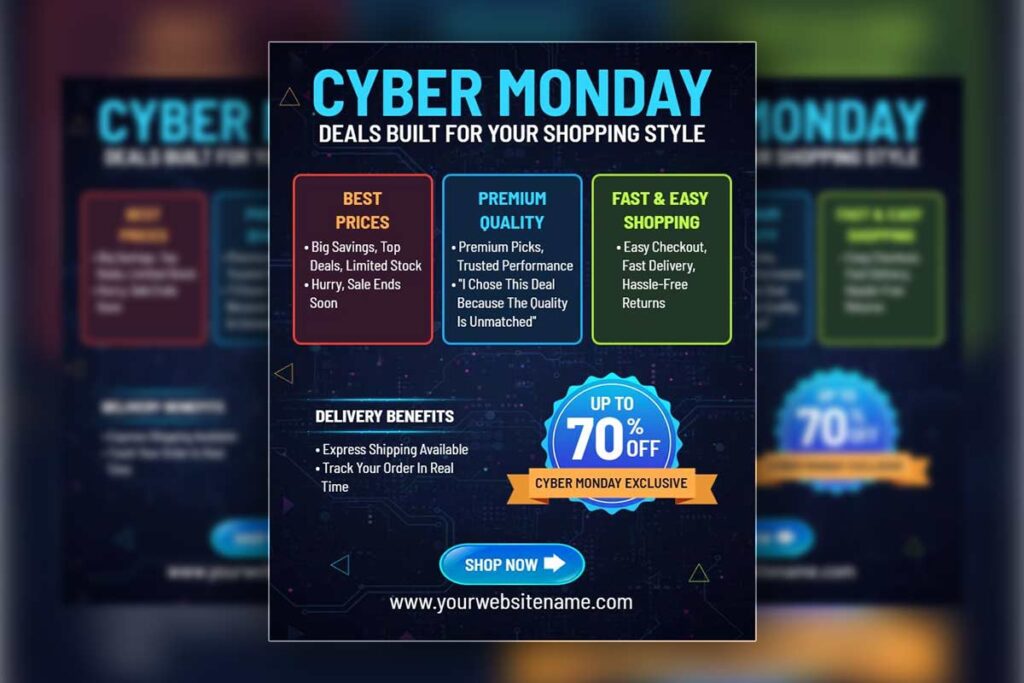
Different customer segments respond to distinct psychological motivators in Cyber Monday promotional flyers (University of Southern California).4 Price-sensitive shoppers need clear savings calculations with “Save $X” or “70% Off” messaging prominently displayed. Quality-conscious buyers require social proof elements like “Rated #1” or testimonials highlighting durability and performance. Convenience-driven customers respond to time-saving benefits such as “Free Shipping” or “Same-Day Delivery” prominently featured.
Impulse buyers need urgency triggers like countdown timers and “While Supplies Last” messaging. Methodical shoppers prefer comparison charts and detailed specifications. Tech-savvy segments engage with QR codes and interactive elements, while traditional customers favor straightforward product showcases. Successful Cyber Monday flyers for small business targeting incorporate multiple triggers while maintaining clear visual hierarchy that guides each segment’s attention to their preferred decision-making information. Learn comprehensive strategies to boost Cyber Monday promotions with flyers that leverage psychological triggers effectively across diverse customer segments.
Explore psychology-optimized Cyber Monday templates on DesignWiz featuring urgency elements, social proof sections, and trigger-based messaging layouts for various buyer types.
Cultural and Generational Language Customization in Flyer Copy
Effective Cyber Monday flyers engage diverse customer segments by tailoring language, tone, and cultural references to generational and regional preferences.
- Millennial Preferences: Use authentic, conversational tone with community-focused messaging and casual calls-to-action like “Don’t miss out” (University of Southern California Libraries).5
- Gen X Preferences: Emphasize direct, benefit-driven language highlighting family value propositions and practical applications.
- Baby Boomer Preferences: Utilize formal, respectful copy with complete sentences, avoiding slang or abbreviations.
- Urban Cultural Adaptation: Apply concise, trendy language that resonates with city-dwelling audiences.
- Suburban Cultural Adaptation: Incorporate community-oriented messaging emphasizing local engagement and shared values.
- Regional Tone Considerations: Southern markets prefer warmer, relationship-focused language; Northeast audiences respond to efficiency-focused messaging.
- International Adaptation: Include culturally appropriate color psychology, imagery, and translated copy that preserves brand voice while respecting local norms and shopping behaviors.
Urgency and Scarcity Messaging Calibration Across Buyer Personas
Effective Cyber Monday flyers use urgency and scarcity messaging tailored to buyer personas, maximizing response while maintaining credibility.
- High-Income Segments: Emphasize exclusivity with messaging like “VIP Early Access” or “Limited Premium Collection”; avoid aggressive countdowns.
- Budget-Conscious Shoppers: Apply clear deadline pressure with phrases like “Final Hours” and specific end times.
- Mid-Market Customers: Use moderate urgency such as “This Weekend Only” without overwhelming pressure.
- B2B Segments: Provide longer decision timelines with messaging like “Extended Through December” to accommodate approval processes.
- B2C Impulse Buyers: Trigger immediate action with time-sensitive calls and attention-grabbing phrases.
- Younger Demographics: Leverage social proof urgency, e.g., “Join 50K+ shoppers,” to create FOMO.
- Mature Audiences: Use factual scarcity statements like “25% of inventory remaining” to motivate purchase.
- Regional Differences: Urban markets tolerate higher-pressure messaging; rural markets respond better to gentle encouragement.
- Testing & Calibration: Continuously balance action-inducing urgency with credibility to optimize response across psychological profiles and shopping behaviors.
How Do You Customize Cyber Monday Targeted Flyers For B2B Versus B2C Client Campaigns?
Customizing Cyber Monday targeted flyers differs for B2B and B2C audiences due to contrasting motivations and decision processes. B2B flyers focus on ROI-driven messaging, professionalism, and detailed specifications for multiple stakeholders. In contrast, B2C flyers use emotional appeal, urgency, and bold visuals to prompt quick purchases. Each approach ensures messaging and design align with audience behavior for maximum impact.
Messaging Tone and Value Propositions for Business vs Consumer Audiences
B2B Cyber Monday marketing flyers require professional, consultative messaging that addresses business pain points and quantifiable returns. Content emphasizes bulk purchasing advantages, year-end budget utilization, and operational efficiency improvements. Headlines focus on “Increase Productivity by 40%” or “Reduce Operational Costs with Enterprise Solutions.” Technical specifications, compliance certifications, and integration capabilities take precedence over emotional appeals.
B2C messaging leverages emotional triggers and personal benefits. Headlines emphasize savings percentages, limited availability, and lifestyle improvements: “Save 60% on Holiday Gifts” or “Transform Your Home This Weekend.” Content addresses personal desires, convenience factors, and social status considerations. Testimonials focus on personal satisfaction rather than business metrics.
Discover B2B and B2C Cyber Monday template collections on DesignWiz featuring professional business-focused designs and emotion-driven consumer promotional layouts.
Decision-Making Timeline Considerations in B2B vs B2C Flyer Content
B2B purchasing cycles extend beyond Cyber Monday, requiring flyers that acknowledge committee decisions and approval processes. Content includes “Valid through Q1 for Budget Planning” and provides detailed proposal templates for internal presentations. Technical documentation, implementation timelines, and support structure information help buyers navigate organizational approval requirements.
B2C flyers maximize urgency with countdown timers, flash sale messaging, and immediate availability indicators. “24-Hour Flash Sale” or “While Supplies Last” creates purchase pressure. Content emphasizes instant gratification with same-day shipping, immediate downloads, or in-store pickup options that eliminate decision delays.
Visual Hierarchy and Information Architecture for Different Buyer Types
Effective visual hierarchy and information architecture tailor Cyber Monday flyers for B2B and B2C audiences, optimizing readability, engagement, and conversion.
- B2B Layout Design: Structured layouts with charts, comparison tables, and specification sheets; ample white space for professional appearance; conservative color schemes (blues, grays, subtle accents).
- B2B Typography & CTAs: Clear headers distinguishing features from benefits; professional call-to-action buttons like “Request Demo,” “Schedule Consultation,” or “Download Specifications”; multiple contact channels and business hours. Crafting effective calls to action strategies for flyers requires understanding how different demographics process urgency and decision-making triggers.
- B2C Layout Design: Bold colors, dynamic layouts, and prominent pricing displays; product imagery with lifestyle contexts; price comparisons, savings calculations, and benefit icons for quick scanning.
- B2C Typography & CTAs: Attention-grabbing fonts with varied sizes; action-oriented CTAs like “Shop Now,” “Buy Today,” or “Claim Your Discount”; social proof elements including customer reviews and popularity indicators.
- Mobile Optimization: Both B2B and B2C designs require mobile responsiveness; B2B emphasizes document viewing/sharing, while B2C prioritizes fast purchasing flows and social sharing capabilities.
Implementing professional business flyer layout principles helps organize complex information while maintaining demographic-specific appeal.
Which Design Elements Make Cyber Monday Targeted Flyers More Effective For Specific Audience Segments?
Effective Cyber Monday targeted flyers apply design psychology tailored to each audience segment. Younger shoppers prefer bold colors and dynamic layouts, while older audiences favor clean, structured designs. Tech-savvy buyers engage with interactive elements, whereas traditional consumers prefer simple visuals. Geographic and income-based personalization further refines appeal, balancing luxury aesthetics for premium buyers and value-focused visuals for budget-conscious ones.
Color Psychology and Typography Choices for Different Demographic Groups

Color selection drives immediate emotional response across demographic segments. Gen Z and millennials gravitate toward vibrant gradients, neon accents, and bold color combinations that reflect digital-native aesthetics. Gen X responds to professional color schemes like navy, burgundy, and forest green that convey stability and trust. Baby boomers prefer traditional combinations with high contrast ratios for readability.
Typography choices must align with generational communication patterns. Younger segments engage with modern sans-serif fonts, condensed headers, and varied font weights that mirror social media design trends. Mature audiences require larger, serif-based fonts with generous spacing for accessibility. Professional segments favor clean, corporate typography that reinforces credibility and expertise in Cyber Monday business flyers.
Explore color-psychology Cyber Monday templates on DesignWiz with demographic-specific palettes, generational typography pairings, and contrast-optimized designs.
Interactive Elements and Technology Integration by Audience Tech-Savviness
Technology adoption levels determine interactive element effectiveness across customer segments. High-tech audiences expect QR codes linking to augmented reality previews, interactive product configurators, and social media integration features. These segments appreciate gamified elements like scratch-off discounts and progressive reveal mechanics that create engagement beyond traditional static formats.
Traditional consumers require simpler interaction models focusing on clear navigation paths and prominent contact information. Phone numbers, physical addresses, and straightforward redemption processes work better than complex digital interactions. Middle-ground segments respond to hybrid approaches combining basic interactive elements like tear-off tabs with digital components like simple QR codes for convenience without overwhelming complexity.
Geographic and Cultural Visual Customization Strategies
Effective flyer designs adapt visual elements to geographic, cultural, and income-based audience differences to maximize engagement and relevance.
- Urban Visuals: Metropolitan imagery, sleek minimalist layouts, and cosmopolitan color palettes reflect city lifestyle preferences.
- Suburban Visuals: Family-oriented imagery, comfortable layouts, and warmer color schemes emphasize community values.
- Regional Cultural Factors: Southwestern markets respond to earth tones and desert-inspired imagery; coastal regions prefer ocean blues and contemporary styling.
- Cultural & Local Relevance: Incorporate local landmarks, cultural celebrations, and region-specific icons for immediate connection.
- Affluent Neighborhoods: Luxury aesthetics with premium photography, sophisticated typography, and elegant white space appeal to high-income segments.
- Budget-Conscious Areas: Value-driven designs emphasize savings percentages, product quantity, and clear pricing with bold graphics.
- Modular Design Libraries: Develop reusable components for rapid customization across demographic, geographic, and psychographic segments while maintaining brand consistency.
How Can Agencies A/b Test Cyber Monday Targeted Flyers Without Exceeding Client Budgets?
Agencies can run cost-effective A/B tests for Cyber Monday targeted flyers using digital-first methods to avoid high printing costs. Test small audience samples with 2–3 headline variations across demographic segments via email or social media. Track engagement metrics to identify top performers before full print runs. Design automation tools enable quick layout variations, ensuring only proven designs move to large-scale production.
Budget-Conscious Testing Methodologies for Cyber Monday Sale Flyers Design
Effective budget management requires prioritizing tests by potential impact. Focus on elements that drive the highest conversion differences: headline messaging, discount presentations, and call-to-action placement. Create testing matrices that examine only one variable per segment to isolate performance drivers. Use 80/20 sample distribution, allocating 80% of budget to proven concepts and 20% to experimental approaches.
Digital mockup tools enable rapid iteration without production costs. Test headline variations through social media polls before finalizing designs. Implement staged testing approaches where successful digital variants progress to small-scale print runs. Track cost-per-engagement across test variations to identify budget-efficient messaging strategies. Agencies should establish minimum performance thresholds before investing in full print production, ensuring client budget preservation while maximizing testing value.
Browse A/B testing-ready Cyber Monday templates on DesignWiz with variable headline sections, multiple CTA options, and rapid-iteration design frameworks.
- Cyber Monday Sale Promotion Flyer Template
- Cyber Monday Sale Promotional Flyer Template
- Cyber Monday Super Sale Announcement Flyer Template
Digital Pre-Testing Strategies Before Print Investment
Digital channels provide cost-effective validation environments for Cyber Monday marketing flyers before print commitments. When planning campaigns, consider the digital vs print flyers pros and cons to optimize testing approaches and budget allocation Email marketing serves as an ideal testing ground, allowing demographic segmentation and performance measurement at minimal cost. Social media platforms enable rapid A/B testing of visual elements and messaging approaches through promoted posts targeting specific audience segments.
Landing page testing validates design elements and conversion paths before print production. Create multiple landing page versions featuring different flyer designs and track user behavior patterns. Heat mapping tools reveal which design elements capture attention and drive engagement. QR code testing on digital versions measures scan rates and user interaction patterns before incorporating into print materials.
Survey tools gather direct feedback on design preferences from target demographics. Focus groups conducted via video conferencing provide qualitative insights at reduced costs compared to in-person sessions. This digital-first approach reduces print waste while generating actionable data for final design optimization.
Resource Allocation Framework for Multi-Segment Campaign Validation
Effective resource allocation ensures comprehensive campaign testing across diverse client segments while optimizing budget efficiency and maximizing measurable results.
- Segmented Budget Allocation: Assign 40% of testing budget to highest-value segments, 35% to moderate-value prospects, and 25% to experimental growth segments.
- Tiered Testing Approaches: Premium clients receive comprehensive multi-variable testing; mid-tier clients focus on primary demographics; entry-level clients use template-based testing with minimal customization.
- Cascading Approval Processes: Establish spending gates at 25%, 50%, and 75% of budget, requiring performance review before proceeding.
- Performance Tracking: Monitor cost-per-lead and conversion metrics throughout testing phases to validate ongoing investment.
- Standardized Testing Protocols: Develop reusable frameworks to reduce setup costs and maintain consistent testing quality across campaigns.
- Batch Testing for Economies of Scale: Group similar testing requirements across clients to achieve efficiency in design and implementation.
What Conversion Metrics Should Agencies Track For Segmented Cyber Monday Targeted Flyers?
Agencies should track segment-specific conversion metrics to understand how different audiences respond to Cyber Monday marketing flyers. Key indicators include response rates, offer redemptions, and time-to-conversion by demographic. Engagement can be measured through QR scans, flyer-specific landing page visits, and social interactions. Tracking cost-per-acquisition and cross-channel attribution helps identify top-performing segments and long-term customer value.
Segment-Specific Response Rate Analysis for Targeted Campaigns
Track response rates separately for each demographic segment using unique tracking codes and dedicated landing pages. Millennials typically show higher digital engagement with QR codes and social sharing, while Gen X demonstrates stronger direct response through phone calls and website visits. Monitor email open rates, click-through rates, and conversion percentages by age group, income level, and geographic location.
Baby boomers often require longer decision periods but show higher average order values. Gen Z responds quickly but needs multiple touchpoints. Establish baseline response rates for each segment during initial campaigns, then compare performance across different messaging approaches and design variations. Track micro-conversions like email signups, catalog requests, and social follows alongside macro-conversions. Document which segments respond best to urgency messaging versus value propositions. Use cohort analysis to identify segment-specific behavioral patterns and optimize future Cyber Monday targeted flyers accordingly.
Cross-Channel Attribution Tracking from Flyer to Final Purchase
Implement multi-touch attribution models tracking customer journeys from initial flyer exposure to final purchase across all channels. Use UTM parameters, unique promo codes, and dedicated phone numbers for each flyer version to track cross-channel movement. Monitor how customers interact with Cyber Monday promotional flyers then complete purchases through different channels – online, mobile apps, phone orders, or in-store visits. Track assisted conversions where flyers influence purchase decisions without being the final touchpoint.
Measure view-through conversions from customers who saw flyers but purchased later through other channels. Document the typical customer path for each segment – some may research online after seeing flyers while others purchase immediately. Use customer surveys and feedback forms to capture attribution data that analytics miss. Implement first-party data collection through QR codes linking to preference centers that track individual customer journeys across multiple Cyber Monday campaigns. Optimizing Cyber Monday flyer distribution networks helps agencies maximize reach and tracking accuracy across demographic segments.
Check out attribution-ready Cyber Monday templates on DesignWiz with UTM parameter sections, multi-touch tracking elements, and cross-channel journey optimization.
- Cyber Monday Mega Sale Discount Flyer Template
- Cyber Monday Online Shopping Discount Flyer Template
- Cyber Monday Sale Discount Flyer Template
ROI Measurement Frameworks for Multi-Demographic Cyber Monday Outreach
Segment-specific ROI measurement ensures precise evaluation of campaign effectiveness and guides strategic budget allocation for maximum return.
- Segmented ROI Calculation: Compare total campaign costs against revenue generated per demographic group.
- Cost Considerations: Include production costs for multiple flyer versions, distribution expenses, and staff time.
- Customer-Specific CAC: High-value segments may justify higher acquisition costs; price-sensitive segments require lower costs.
- Immediate and Long-Term ROI Tracking: Monitor both Cyber Monday sales and long-term customer lifetime value.
- Segment Metrics Monitoring: Track average order value, purchase frequency, and retention rates following flyer campaigns.
- Conversion vs. Lifetime Value Analysis: Identify segments with high immediate conversion versus strong lifetime value potential.
- Cost Efficiency Documentation: Capture ROI improvements (typically 20–30%) versus generic flyer campaigns.
- Incremental Revenue Measurement: Compare personalized messaging versus control groups with standard flyers.
- Brand Awareness & Satisfaction: Measure non-revenue benefits by segment.
- Break-Even Analysis: Determine break-even points per demographic to guide budget allocation.
- Predictive Analytics: Forecast high-return segments for future campaigns.
- Opportunity Cost Evaluation: Consider missed revenue from not targeting specific demographics in campaign planning.
How Do You Create Scalable Templates For Cyber Monday Targeted Flyers Across Multiple Client Segments?
Creating scalable Cyber Monday targeted flyers involves developing modular templates with adaptable components for various audience segments. Identify reusable elements like headers, product sections, and CTAs that adjust to different demographics. Build flexible template libraries with variable text, colors, and imagery while maintaining brand consistency. This system allows agencies to deliver high-quality, customized Cyber Monday promotional flyers quickly across diverse client needs.
Building Modular Component Libraries for Multi-Segment Flyer Production
Modular component libraries streamline the creation of targeted Cyber Monday marketing flyers, ensuring design consistency while allowing rapid adaptation for multiple customer segments.
- Component-Based Design Systems: Standardize headers, product grids, and promotional sections for cross-segment usability.
- Reusable Elements: Include discount badges, product showcases, and social proof sections adaptable to various brands.
- Template Hierarchies: Primary headers for luxury segments, mid-tier options for mainstream audiences, and value-focused layouts for budget-conscious customers.
- Asset Libraries: Store demographic-specific imagery, color palettes, and typography combinations for rapid deployment.
- Functional Organization: Organize components by purpose rather than appearance to simplify assembly of targeted flyers.
- Multiple Variations per Component: Address different psychological triggers—urgency for impulse buyers, benefits for methodical shoppers, exclusivity for premium audiences.
- Rapid Customization: Enable fast adaptation of flyers while maintaining consistent design quality and brand standards across segments.
- Quality and Consistency Assurance: Systematic approach ensures brand integrity is preserved across diverse client portfolios.
Establishing Brand-Flexible Design Systems Across Client Demographics
Create adaptable brand frameworks that preserve core client identity while accommodating segment-specific messaging and visual preferences. Develop brand guideline templates with flexible zones for demographic customization, maintaining consistent logo placement, color schemes, and typography while varying messaging tone and imagery selection.
Implement tiered customization levels allowing surface-level changes for quick deployment and deeper modifications for specialized segments. Build approval workflows enabling rapid client feedback on demographic variations without requiring complete redesign cycles. Establish visual hierarchy systems that work across age groups – simplified layouts for mature audiences, dynamic designs for younger demographics, and balanced approaches for mixed segments.
Create brand compliance checklists ensuring all Cyber Monday business flyers maintain client standards while maximizing segment appeal. This approach balances creative flexibility with brand consistency, enabling agencies to serve diverse client needs without compromising design quality or approval timelines during high-pressure campaign periods.
Implementing Variable Content Zones for Rapid Template Customization
Variable content zones allow agencies to quickly adapt Cyber Monday flyer templates for multiple customer segments without full redesigns, maintaining visual consistency and high-quality standards.
- Predefined Variable Zones: Design templates with areas for content swapping without restructuring layouts.
- Smart Text Areas: Automatically adjust text size and spacing based on content length for consistent visual balance.
- Placeholders for Key Content: Include offers, product features, and testimonials tailored to segment-specific value propositions.
- Automated Sizing Rules: Prevent content overflow while maintaining readability across demographic preferences.
- Psychologically Organized Content Libraries: Urgency messaging for time-sensitive buyers, feature-focused content for research-driven shoppers, social proof for influence-responsive segments.
- Template Versioning Systems: Enable rapid A/B testing across segments without creating entirely new designs.
- Merge Field Capabilities: Insert personalized elements like customer names, location-specific offers, and purchase history references.
- Quality Control Checkpoints: Ensure customized versions maintain professional appearance and brand consistency.
- Scalable Production Processes: Transform custom design into efficient assembly, supporting diverse client portfolios during peak demand.
What Copywriting Techniques Increase Engagement Rates For Demographic-specific Cyber Monday Targeted Flyers?
Effective copywriting for Cyber Monday targeted flyers tailors language, urgency, and value propositions to each audience segment. Millennials respond to authentic storytelling, while Gen X prefers straightforward benefit-driven messaging. Use psychological triggers like social proof for younger audiences and authority cues for older ones. Craft headlines that align with segment-specific motivations—status, value, or convenience—to ensure each Cyber Monday marketing flyer connects with its target group.
Adapting Language Patterns and Tone for Generational Preferences
Generational copywriting requires distinct linguistic approaches for maximum engagement. Baby Boomers respond to formal language, detailed explanations, and traditional value messaging emphasizing quality and reliability. Use complete sentences and avoid slang or abbreviated terms in Cyber Monday promotional flyers targeting this demographic.
Gen X prefers direct, no-nonsense copy focusing on practical benefits and time-saving solutions. Incorporate references to family responsibilities and financial security. Use phrases like “proven results” and “trusted quality” in your messaging. Millennials engage with conversational tone, authentic storytelling, and experience-focused messaging. Include social responsibility elements and personalization options. Use inclusive language and address lifestyle integration rather than just product features.
Gen Z responds to concise, mobile-optimized copy with visual elements and interactive components. Incorporate trending terminology and emphasize uniqueness and self-expression. Use action-oriented language with clear, immediate benefits.
Find tone-adaptive Cyber Monday templates on DesignWiz with generational language frameworks, formal-to-casual spectrum options, and age-appropriate messaging.
Leveraging Psychological Triggers Based on Demographic Buying Motivations
Different demographics respond to distinct psychological triggers in Cyber Monday business flyers. High-income segments react to exclusivity messaging, limited availability, and premium positioning. Use phrases like “exclusive access,” “limited collection,” and “premium members only” to create desire through scarcity. Price-conscious demographics respond to percentage savings, comparison charts, and value-focused messaging. Highlight dollar amounts saved and include clear before-and-after pricing. Use “biggest savings” and “maximum value” terminology.
Status-driven buyers engage with prestige messaging, brand name emphasis, and social proof elements. Include testimonials from recognizable figures or successful businesses. Use terms like “industry-leading” and “preferred by professionals.” Convenience-focused segments prioritize time-saving benefits and ease-of-use messaging. Emphasize quick delivery, simple processes, and hassle-free experiences. Use “instant access,” “one-click ordering,” and “ready-to-use” language throughout Cyber Monday flyers for small business targeting.
Crafting Segment-Specific Value Propositions and Urgency Messaging
Customizing value propositions and urgency messaging for different customer segments ensures higher engagement and conversion rates for Cyber Monday targeted flyers.
- Segment Motivation Understanding: Identify core motivations and decision-making criteria for each audience segment.
- Business Buyer Value Propositions: Highlight ROI, productivity gains, and competitive advantages with metrics like “increase efficiency by X%” or “reduce costs by Y dollars.”
- Consumer Segment Messaging: Use lifestyle benefits, problem-solving, and enjoyment-focused copy that creates emotional connection.
- Experiential Language: Enable prospects to visualize product usage and personal benefits.
- Impulse Buyer Urgency Messaging: Employ countdown timers, flash sales, and strong action cues like “act now” and “limited time only.”
- Methodical Shopper Urgency Messaging: Provide gentle urgency with sufficient decision time, detailed product information, and guarantees.
- Geographic Personalization: Incorporate local references, regional imagery, and culturally adapted messaging for increased relevance.
- A/B Testing Variations: Measure engagement, click-through, and conversion rates for different demographic segments.
- Scaling Successful Copy: Apply top-performing messaging techniques across similar audience segments.
- Brand Consistency: Balance personalization with core brand messaging to maintain consistent identity across campaigns.
How Can Agencies Integrate Client Brand Guidelines Into Segmented Cyber Monday Targeted Flyers?
Agencies can integrate client brand guidelines into Cyber Monday targeted flyers using modular design systems that balance consistency with segment-specific customization. Establish core brand elements like logos, colors, and typography as fixed components. Create flexible templates that adapt messaging for different customer segments while maintaining brand identity. Use compliance checklists and automated tools to ensure all Cyber Monday promotional flyers adhere to guidelines without losing personalization.
Brand Compliance Frameworks for Multi-Segment Campaign Deployment
Successful brand compliance requires systematic frameworks that define flexible boundaries within client guidelines. Create brand hierarchy documents that classify elements as “fixed” (logos, primary colors, core fonts) versus “adaptable” (secondary colors, imagery styles, layout variations). Develop approval workflows where segment-specific variations maintain brand DNA while allowing demographic customization.
Establish pre-approved component libraries containing brand-compliant headers, color schemes, and typography combinations that work across age groups, income levels, and cultural preferences. This systematic approach enables rapid deployment of Cyber Monday marketing flyers while ensuring brand consistency. Document decision trees for common customization scenarios, such as when to use formal versus casual language or bright versus muted color palettes for different segments.
Visual Identity Adaptation Strategies Across Customer Demographics
Visual identity adaptation requires understanding how brand elements resonate with different demographic segments while maintaining recognition. Younger demographics may respond to dynamic layouts and bold color applications within brand parameters, while mature audiences prefer traditional, structured presentations using the same brand palette.
Develop segment-specific style guides that show approved ways to apply brand colors, fonts, and imagery across different customer groups. For instance, a luxury real estate brand might use full-color photography for high-end segments while employing elegant line art for budget-conscious prospects, maintaining brand sophistication across both approaches.
Create cultural sensitivity guidelines that adapt brand presentation for diverse geographic and ethnic segments. This includes appropriate imagery selection, color psychology considerations, and typography choices that respect cultural preferences while preserving brand integrity across all Cyber Monday business flyers.
Quality Control Systems for Brand-Consistent Cyber Monday Marketing Flyers
Ensuring consistent brand representation across multiple flyer variations protects brand integrity while maximizing segment-specific effectiveness.
- Automated Brand Checks: Use digital asset management systems to provide approved elements and prevent unauthorized modifications.
- Design Validation Tools: Implement automated checks to flag potential brand violations before production.
- Multi-Tier Approval Processes: Junior designers manage segment customization within approved parameters; senior brand managers review high-risk changes.
- Brand Scoring Rubrics: Evaluate flyer variations for color accuracy, typography consistency, logo placement, and adherence to brand standards.
- Client Feedback Loops: Capture responses to segment variations and build databases of approved modifications for future campaigns.
- Documentation of Challenges and Solutions: Maintain searchable resources for recurring brand adaptation issues and their resolutions.
- Regular Quality Audits: Compare produced flyers against brand guidelines to identify drift patterns and reinforce compliance.
- Segment-Specific Relevance: Ensure demographic-targeted flyers maintain brand consistency while enhancing audience engagement.
Which Customer Data Points Are Most Valuable For Personalizing Cyber Monday Targeted Flyers?
Key customer data for personalizing Cyber Monday targeted flyers includes purchase history, browsing behavior, demographics, and engagement preferences. Purchase frequency and order value inform discount levels, while product preferences guide featured items. Geographic and device data enable localized messaging and optimal delivery timing. Using these insights ensures flyers resonate with each segment and maximize conversions.
Behavioral Analytics That Drive Flyer Personalization Success
Behavioral data transforms generic Cyber Monday promotional flyers into precision-targeted campaigns. Website browsing patterns reveal product interests, while cart abandonment data identifies hesitant buyers requiring confidence-building messaging. Click-through rates from previous campaigns indicate preferred visual styles and offer types. Time-on-site metrics help determine content complexity levels for different segments.
Social media engagement data reveals communication preferences and lifestyle indicators crucial for Cyber Monday marketing flyers. Users who engage with video content respond better to dynamic visual elements, while text-focused audiences prefer detailed product specifications. Mobile versus desktop usage patterns inform layout decisions and call-to-action placement.
Email open rates and click patterns provide timing insights for flyer distribution. Customers who consistently open promotional emails during specific hours should receive Cyber Monday business flyers during those optimal windows. Previous purchase timing data reveals whether customers prefer early-bird specials or last-minute deals, enabling precise urgency messaging calibration.
Demographic Segmentation Data for Precision Marketing Campaigns
Leveraging detailed demographic data enables Cyber Monday flyers to target specific customer segments with tailored visuals, messaging, and offers.
- Age Groups: Millennials prefer minimalist designs, while baby boomers respond to traditional layouts with clear product imagery.
- Income Levels: Luxury segments receive exclusive previews; budget-conscious customers are offered percentage-based savings.
- Geographic Location: Urban customers favor convenience-focused messaging; suburban families respond to value-oriented promotions.
- Regional Preferences: Influence color choices, imagery selection, and language patterns for culturally relevant campaigns.
- Gender: Affects product categorization and visual presentation strategies.
- Family Status: Guides messaging tone and product bundling opportunities.
- Education Level: Determines copy complexity and inclusion of technical details.
- Combined Personas: Integrates multiple demographic factors to create hyper-targeted promotions that align with customer motivations and decision-making behaviors.
Transaction History Insights for Cyber Monday Business Flyers Optimization
Analyzing customer transaction histories enables precise personalization of Cyber Monday flyers, maximizing engagement and conversion rates.
- Average Order Value: High-value customers receive dollar-amount discounts; price-sensitive segments get percentage-based offers.
- Purchase Frequency: Loyal customers see exclusive access messaging; new or infrequent buyers receive acquisition-focused promotions.
- Product Category Preferences: Guides featured items and cross-selling opportunities; electronics buyers see tech-focused layouts, fashion buyers see lifestyle designs.
- Seasonal Buying Patterns: Holiday gift purchasers prefer bundled offerings; personal buyers respond to individual item focus.
- Payment Method Preferences: Credit card users respond to premium positioning; discount seekers prefer comparison charts and savings calculations.
- Return History: Positive return experiences enable streamlined purchasing; affects inclusion of trust-building elements.
- Time Between Purchases: Regular buyers get early access campaigns; irregular buyers require stronger urgency triggers.
- Combined Transaction Insights: Enable creation of comprehensive customer profiles for data-driven, highly personalized flyer campaigns.
People Also Ask: Customize Messaging For Targeted Segments Implementation Questions
- Who should receive different Cyber Monday targeted flyers?
Loyal customers, new prospects, lapsed buyers, high-value shoppers, and price-sensitive segments should each receive customized Cyber Monday targeted flyers with relevant messaging and offers tailored to their specific needs and shopping behaviors. - How much do segmented Cyber Monday targeted flyers cost?
Segmented Cyber Monday targeted flyers typically cost 30-50% more than generic versions due to design variations and production complexity, but generate higher ROI through improved conversion rates and customer engagement. - When should agencies start creating Cyber Monday targeted flyers?
Agencies should begin developing Cyber Monday targeted flyers 6-8 weeks before the event to allow time for client approval, segmentation analysis, design variations, and testing across different customer demographics. - What makes Cyber Monday targeted flyers convert better?
Personalized messaging, relevant offers, demographic-specific imagery, clear CTAs, and mobile optimization significantly improve conversion rates for Cyber Monday targeted flyers compared to generic, one-size-fits-all approaches. - Which colors work best for Cyber Monday targeted flyers?
Red and orange create urgency, blue builds trust for premium segments, while black and gold appeal to luxury buyers. Color selection should align with target demographic preferences and brand guidelines. - How do you track Cyber Monday targeted flyers performance?
Use unique QR codes, promo codes, landing pages, and UTM parameters for each segment. Track metrics like scan rates, clicks, conversions, and ROI to measure flyer effectiveness across demographics.
Frequently Asked Questions
- How do content marketing agencies segment audiences for Cyber Monday targeted flyers?
Segment by demographics, purchase history, engagement behavior, and client industry. Tailor messaging, offers, and visuals to each group for higher conversions. - What is the ROI difference between generic and segmented Cyber Monday targeted flyers?
Segmented flyers deliver 25–40% higher conversion rates. Despite higher production costs, improved engagement and retention justify the investment. - How many versions of Cyber Monday targeted flyers should agencies create per client?
Create 3–5 versions targeting key segments: loyal customers, price-sensitive shoppers, and premium buyers. Too many dilute resources; too few miss opportunities. - What tools help agencies efficiently produce multiple Cyber Monday targeted flyers?
Use DesignWiz, Adobe Creative Suite, and dynamic content platforms for quick customization and consistent branding across multiple client campaigns. - How do agencies measure demographic engagement with Cyber Monday targeted flyers?
Track QR codes, unique landing pages, promo codes, and UTM parameters. Monitor scans, clicks, conversions, and cost per acquisition for each segment. - What messaging frameworks work best for B2B Cyber Monday targeted flyers?
Emphasize business value: cost savings, productivity gains, and year-end budget use. Tailor language for decision-makers versus end-users. - How do agencies handle brand consistency across segmented Cyber Monday targeted flyers?
Maintain logos, colors, and typography while varying messaging, imagery, and offers. Use client brand guidelines to preserve identity across segments. - What demographic data is most valuable for Cyber Monday targeted flyers?
Age, income, purchase history, shopping behavior, location, family status, and preferred channels guide segmentation and distribution for maximum impact. - How do agencies optimize Cyber Monday targeted flyers for mobile viewing?
Use larger fonts, simplified layouts, touch-friendly buttons, vertical orientation, and test across devices to ensure CTAs are easily tappable. - What is the ideal timeline for deploying segmented Cyber Monday targeted flyers?
Send main flyers 7–10 days before the event, with reminders 2–3 days prior. Segment timing based on shopping patterns for maximum engagement.
Conclusion: Customize Messaging For Targeted Segments Success Framework
Targeted Cyber Monday flyers turn generic promotions into precision marketing tools by aligning messaging, visuals, and offers with specific customer segments. Agencies that implement demographic-focused strategies achieve higher engagement and conversion rates, ensuring campaigns resonate with each audience’s unique preferences and shopping behaviors.
Success relies on systematic segmentation, modular template systems, and continuous performance tracking. By testing and optimizing content for different demographics, agencies create scalable, data-driven flyer campaigns that maximize ROI while maintaining consistent brand quality across all variations.
Reference
- Business Resources – University of Houston Libraries.
- Identifying Your Company’s Target Market – Florida Gulf Coast University Online.
- Market Segmentation and Consumer Markets – Rice University & OpenStax.
- Psychology of Successfully Marketing to Millennials – University of Southern California.
- Age Groups – Demographics – University of Southern California Libraries.